

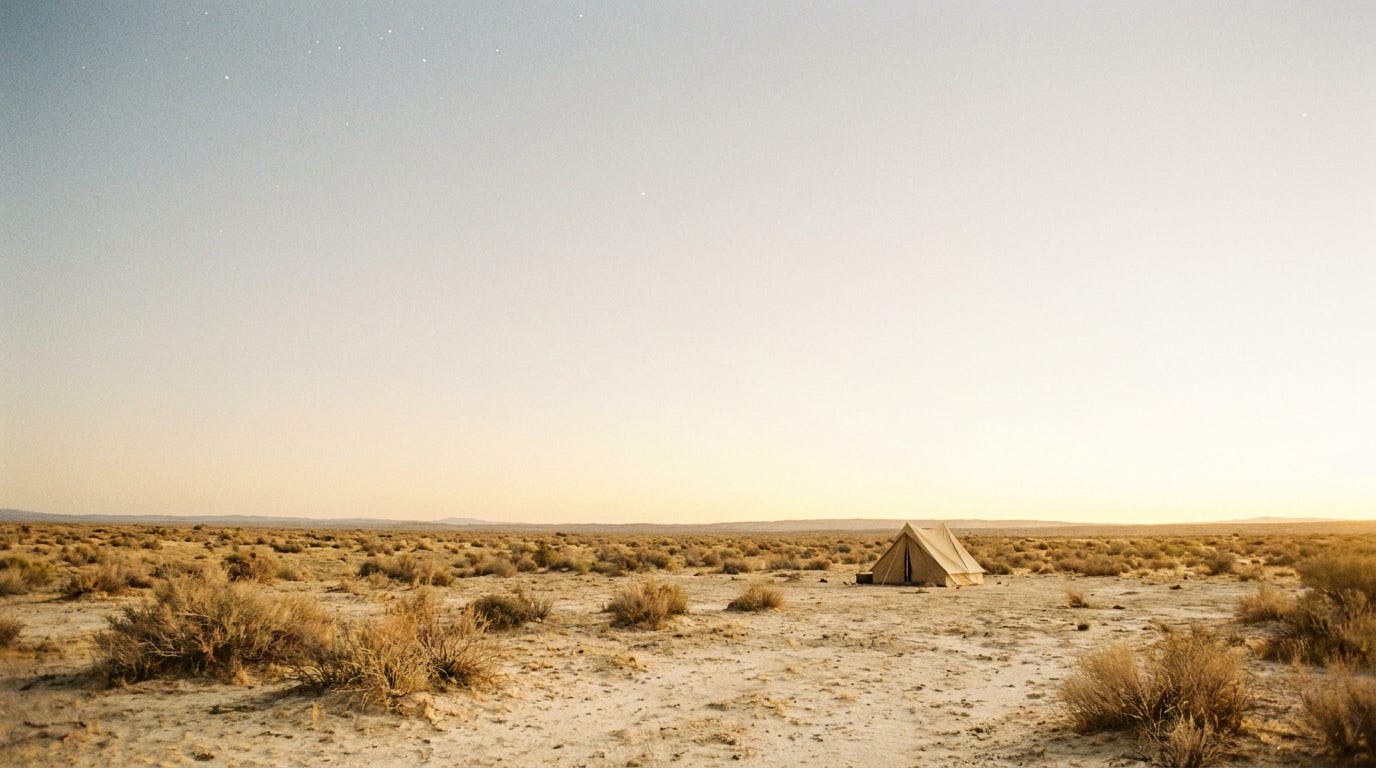
Abram has everything except the one thing the promise needs.
Cattle, silver, a household big enough to field an army against four kings. And no child. He has just come home from turning down a king's fortune, and now, in the quiet after the fighting, God speaks to him in a vision. "Do not be afraid, Abram. I am your shield, your very great reward" (Genesis 15:1). The God who owns heaven and earth calls Himself the reward, and Abram, for once, answers with exactly what is on his mind.
"O Lord GOD, what can You give me, since I remain childless, and the heir of my house is Eliezer of Damascus?" (Genesis 15:2). It is an old ache, said plainly to God's face. By the custom of that world a childless man's estate passed to a trusted servant, so Abram spells it out. "You have given me no offspring, so a servant in my household will be my heir" (Genesis 15:3). This is what hearing God looks like when the promise and your life have not met yet. Abram carries the ache straight back to the One who spoke it.
God answers with something specific. "This one will not be your heir, but one who comes from your own body will be your heir" (Genesis 15:4). Then He takes him outside. "Now look to the heavens and count the stars, if you are able" (Genesis 15:5), and then, "So shall your offspring be" (Genesis 15:5). A childless old man stands under a sky he cannot number, and God hangs the whole promise where he can see it. Every clear night from here on, Abram has something to look up at and remember what he was told.
Then comes one of the most important sentences in the Bible. "Abram believed the LORD, and it was credited to him as righteousness" (Genesis 15:6). He is still old, his wife is still barren, the tent is still empty. And he sets the whole weight of his future on what God has just said, with the empty tent still behind him. God counts that trust as the thing that makes him right. This is what it is to know the God who speaks, to take Him at His word while everything you can see is still arguing the other way.
Centuries later Paul reaches back to this exact verse to explain how anyone is put right with God. "Abraham believed God, and it was credited to him as righteousness" (Romans 4:3), and it was written for us too, Paul says, "for us who believe in Him who raised Jesus our Lord from the dead" (Romans 4:24). The stars Abram counted run all the way out to a family no one can number, and down to a single child of his line, Christ, through whom every last one of them is gathered in (Galatians 3:16).
So do what Abram did. Take the gap between what God has said and what you can see, and say it to Him plainly, out loud. Then find what He gives you to hold the promise by, a verse, an encouragement from a friend, the night sky itself, and put your weight there. Write down what He has told you while you can still hear it clearly, and read it back on the nights the tent feels empty.
What has God said to you that your circumstances are still arguing with, and where could you write it down tonight so you can look back on it?
The Doxa Deeper Dive
Credited as Righteousness: How Abram Was Made Right (Genesis 15)
The word of the LORD comes to Abram in a vision, and the first thing it says is "Do not be afraid" (Genesis 15:1). Fear is in the room before faith is. What follows is the night the Bible chooses, out of a whole long life, to define what it means to trust God.
Why does God call Himself Abram's shield and reward?
"I am your shield, your very great reward" (Genesis 15:1). Both words are chosen with care. 'Shield' is magen (H4043), the round shield a soldier carried into the line, and Abram has just come home from a real fight against four kings. 'Reward' is sakar (H7939), the wages or plunder a soldier was owed. An hour earlier Abram had refused the king of Sodom's spoil so that no one could say a man had made him rich (Genesis 14:23). Now God answers the soldier who turned down a fortune by naming Himself the wages. The protection Abram carried and the payment he walked away from, God says, are Me.
What was Abram really saying about his servant Eliezer?
Abram's reply is honest, and it is more exact than it first sounds. He names the heir he already has, Eliezer of Damascus, and says the arrangement plainly, "a servant in my household will be my heir" (Genesis 15:3). Clay tablets dug up at Nuzi, from roughly Abram's corner of the ancient world, record this very practice. A childless couple would legally adopt a trusted servant as their heir, on the understanding that a natural son, if one ever came, would take the servant's place. Abram has an heir on paper. He is holding God's promise of Genesis 12 in one hand and a household contract in the other, and the two do not agree.
God's answer sets the paperwork aside. "This one will not be your heir, but one who comes from your own body will be your heir" (Genesis 15:4). Then the vision opens onto the sky. God tells him to "count the stars, if you are able" (Genesis 15:5), and promises, "So shall your offspring be" (Genesis 15:5). To a man whose entire ache is one missing child, God gives a number he cannot reach the beginning of.
What does it mean that Abram believed the LORD?
"Abram believed the LORD, and it was credited to him as righteousness" (Genesis 15:6). The word for 'believed' is aman (H539), and it is worth slowing down on, because most of us say it several times a week without knowing it. Aman is the root behind 'amen'. Its oldest sense is firmness, being solid enough to bear weight. It is the word for a pillar that holds a roof up, and the same root gives the name for a guardian or nurse who carries a child, held so securely the child can go completely limp in the arms. It is the picture behind Moses' complaint in Numbers 11:12, "Carry them in your bosom, as a nurse carries an infant". So when Genesis says Abram 'amaned' the LORD, the scene is a man leaning his whole weight on the God who had spoken, the way a child goes heavy in arms it trusts. He said amen with his life to a promise his own body could not back up.
Why was his faith credited to him as righteousness?
'Credited' is chashab (H2803), an accountant's word. It means to reckon, to calculate, to enter something in a ledger and count it at a set value. The same verb weighs out silver and settles a price. Here God keeps the books on Abram, and in the column marked righteousness, tsedaqah (H6666), being in the right with God, He enters Abram's trust. Abram has done nothing yet. Isaac is years away, and every act of obedience the New Testament will later praise is still ahead of him. What God counts as righteousness, before a single work, is that Abram took Him at His word.
This is the verse the New Testament keeps returning to. Paul quotes it whole in Romans 4:3, "Abraham believed God, and it was credited to him as righteousness" (Romans 4:3), and again in Galatians 3:6, to show that God has always put people right with Himself the same way, by trusting what He says. The crediting was written down, Paul adds, "for us who believe in Him who raised Jesus our Lord from the dead" (Romans 4:24). James, reading the same line, says Abram "was called a friend of God" (James 2:23), which is what this kind of trust makes a person, someone known by God and welcome near Him. And the offspring like stars narrows, Paul says, to a single seed, Christ (Galatians 3:16), then opens wide again into the countless family gathered into Him out of every nation.
Which is why this quiet, fearful night is where Scripture defines what it means to know God. To know the God who speaks is to hear Him say something your circumstances flatly deny, carry your honest questions back to His face, and then set the full weight of your life on His word and call it enough. Abram counted the stars he could not number and believed the God who could. Look up, and lean.
Keep exploring. If this raised a question, or brought back something God has said to you, take it further. Ask Doxa. It answers from Scripture, real stories, and your own journey, free in your browser. No signup to start.
Questions and comments are welcome below.
Download Doxa, the app for recording, weighing and remembering prophetic encouragement.