

Originally published on the Doxa blog.
When Rebekah went to ask the LORD why her twins struggled inside her, He told her, "Two nations are in your womb, and two peoples from within you will be separated" (Genesis 25:23). Decades later Genesis 36 opens with the second of those nations written out by name: "This is the account of Esau (that is, Edom)" (Genesis 36:1). A list of wives and sons is God's promise to a mother, kept to the letter, and we come to know Him by watching Him keep what He said.
Two nations from one womb
Genesis 36 lists the descendants of Esau because God had promised Rebekah two nations, and this list records the second one. Esau's wives bore him Eliphaz, Reuel, Jeush, Jalam and Korah, "the sons of Esau, who were born to him in the land of Canaan" (Genesis 36:5). Their sons became chiefs, and the chapter calls him "Esau, the father of the Edomites" (Genesis 36:9).
Rebekah heard God's answer before either boy drew breath. In the pain of one pregnancy she could not see two peoples, and she did not need to see them, because the LORD had said it, and years later the names came one by one.
Too many possessions for one land
Esau moved away from Jacob because the land could not feed both of their herds. "For their possessions were too great for them to dwell together; the land where they stayed could not support them because of their livestock" (Genesis 36:7). Abram and Lot had parted for the same reason, when "the land was unable to support both of them while they stayed together" (Genesis 13:6).
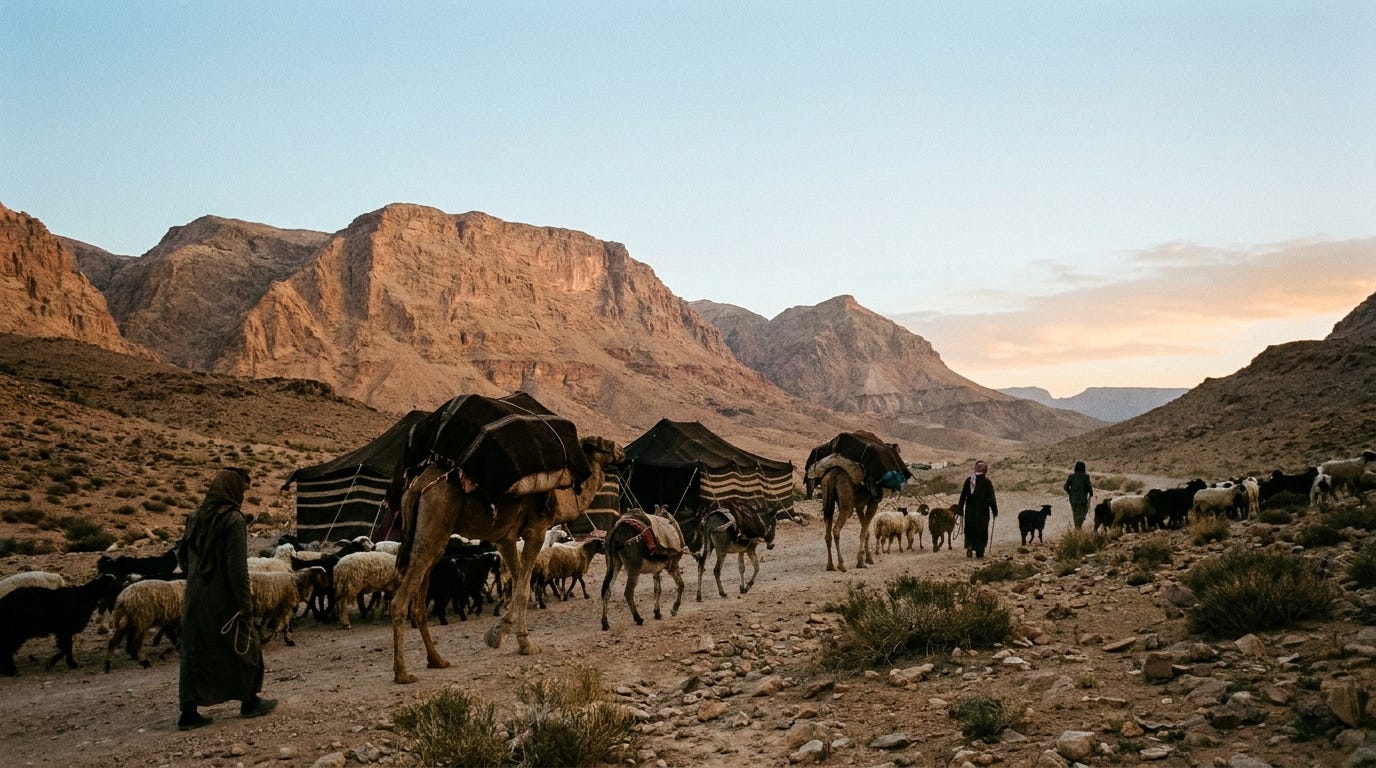
So "Esau (that is, Edom) settled in the area of Mount Seir" (Genesis 36:8). The two peoples separated, as the LORD had told Rebekah, and the brothers who had once been enemies parted over the size of their flocks, with no quarrel recorded.
Mount Seir, given by God
God gave Mount Seir to Esau, and centuries later He said so plainly to Israel. On the road to the promised land He told Moses, "Do not provoke them, for I will not give you any of their land, not even a footprint, because I have given Mount Seir to Esau as his possession" (Deuteronomy 2:5). At Shechem Joshua spoke the LORD's words again: "I gave Esau Mount Seir to possess" (Joshua 24:4).
The brother who sold his birthright still lived on land God had given him. Centuries later people from that same country came to Jesus. Mark records a crowd from "Jerusalem, Idumea, the region beyond the Jordan" (Mark 3:8), and Idumea is the Greek form of the name Edom. "The large crowd came to Him when they heard what great things He was doing" (Mark 3:8). People from Esau's land came to Jacob's greatest Son.
Hold what He has said
We are the people who remember what God has said. Rebekah heard Him before her sons were born, and Genesis 36 is the record, many years later, that He meant every word. When God speaks to you, write down what He said and the date in the Doxa app, and read it back when the names and the years begin to arrive.
God kept His promise to a mother through both of her sons, and through Jacob's line He sent Christ, to whom the crowds from Idumea came.
What has God told you that you are still waiting to see written out in full?
Keep exploring. If this raised a question, or brought back something God has said to you, take it further. Ask Doxa. It answers from Scripture, real stories, and your own journey, free in your browser. No signup to start.
Download Doxa, the app for recording, weighing and remembering prophetic encouragement.
Also please feel free to read the Doxa Deeper Dive below where we delve into the original language and historical context.
The Doxa Deeper Dive
Esau's Red Name Became a Promise to the Nations (Genesis 36:1–19)
Originally published on the Doxa blog.
To a Hebrew ear, Genesis 36:8 carries a play on words: "Esau (that is, Edom) settled in the area of Mount Seir" (Genesis 36:8). Edom is built on the word for red, Seir is spelled like the word for hairy, and Esau was born "red, covered with hair like a fur coat" (Genesis 25:25). Centuries later, through Amos, the LORD made the red name part of a promise to every people on earth, and James stood up in Jerusalem and read it as good news for the Gentiles.
Red and hairy, a man and a mountain
Edom means red, and Seir is spelled like the Hebrew word for hairy, so both names match the way Esau was born. "The first one came out red, covered with hair like a fur coat; so they named him Esau" (Genesis 25:25). Edom (H123) is built on adom (H122), red, and Esau earned it with a bowl of stew. He begged Jacob, "Let me eat some of that red stew, for I am famished" (Genesis 25:30), and the same verse adds, "That is why he was also called Edom" (Genesis 25:30).
Mount Seir had its name long before Esau was born, from the days of "the Horites in the area of Mount Seir" (Genesis 14:6). But Seir (H8165) is written with the same letters as sa'ir (H8163), hairy, the word Jacob used when he told his mother, "Look, my brother Esau is a hairy man" (Genesis 27:11). So when "Esau (that is, Edom) settled in the area of Mount Seir" (Genesis 36:8), a Hebrew listener heard the red man settle on the hairy mountain. The meal that cost Esau his birthright became the name his whole people carried.
Amos used that red name again, in a promise about the nations.
Edom and adam in one spelling
In Acts 15 James quoted the remnant of men where Amos wrote the remnant of Edom, because Edom and adam (H120), mankind, are built on the same three Hebrew letters, and James quoted the Greek translation of Amos, which read the word as mankind. The LORD promised through Amos to rebuild David's fallen tent "that they may possess the remnant of Edom and all the nations that bear My name" (Amos 9:12). At the council in Jerusalem, as the apostles weighed whether Gentiles who believed in Jesus must first keep the Law of Moses, James answered with that promise: "so that the remnant of men may seek the Lord, and all the Gentiles who are called by My name" (Acts 15:17).
The verbs differ by a single Hebrew letter too: possess is yarash (H3423) and seek is darash (H1875). So one promise was heard two ways, and in both, God's promise to rebuild David's house reached past Israel, first to the people named for Esau's red stew and then to all mankind, beside "all the nations that bear My name" (Amos 9:12). James heard that promise being kept in his own day: "Simon has told us how God first visited the Gentiles to take from them a people to be His own" (Acts 15:14). The brother who moved away to Seir was written into the promise that welcomed the nations to Christ.
The first people to hear Genesis 36 read aloud knew Esau's family well.
Amalek, and the first command to write
The first readers of Genesis heard Esau's sons as their own cousins, and they heard one grandson as the people who had attacked them in the wilderness. "Additionally, Timna, a concubine of Esau's son Eliphaz, gave birth to Amalek" (Genesis 36:12). Israel had met Amalek (H6002) at Rephidim: "the Amalekites came and attacked the Israelites" (Exodus 17:8). When that day was over, "the LORD said to Moses, 'Write this on a scroll as a reminder and recite it to Joshua'" (Exodus 17:14). It is the first command in the Bible to write anything down, from kathab (H3789), and what Moses wrote was a promise about what God Himself would do: "I will utterly blot out the memory of Amalek from under heaven" (Exodus 17:14). God had the promise written on a scroll and recited to Joshua, the man who would lead Israel after Moses. Then Moses "built an altar and named it The LORD Is My Banner" (Exodus 17:15).
So when the name Amalek came up in Genesis 36:12, the first hearers already knew it from the scroll God told Moses to write. The first record God ever commanded was His own promise, kept in writing for the next generation.
The same people heard the Law tell them how to treat the rest of Esau's house: "Do not despise an Edomite, for he is your brother" (Deuteronomy 23:7). Moses had already sent word to Edom's king as "your brother Israel" (Numbers 20:14). A family in Israel hearing Genesis 36 read aloud heard the names of their brothers, and among them the one people God had told Moses to write about on a scroll.
Esau's family left Jacob's tents for Seir, and God still wrote the remnant of Edom into His promise to the nations. We are the people who remember what God has said, and we come to know Him by writing it down, as Moses did on the scroll, and reading it back until we see Him do it. When God speaks to you, record it with the date in the Doxa app and keep it before you. The Lord who rebuilt the fallen tent of David has made room in it for "the remnant of men" who seek Him (Acts 15:17), and He keeps every word He speaks.
Keep exploring. If this raised a question, or brought back something God has said to you, take it further. Ask Doxa. It answers from Scripture, real stories, and your own journey, free in your browser. No signup to start.
Questions and comments are welcome below.
Download Doxa, the app for recording, weighing and remembering prophetic encouragement.