

Originally published on the Doxa blog.
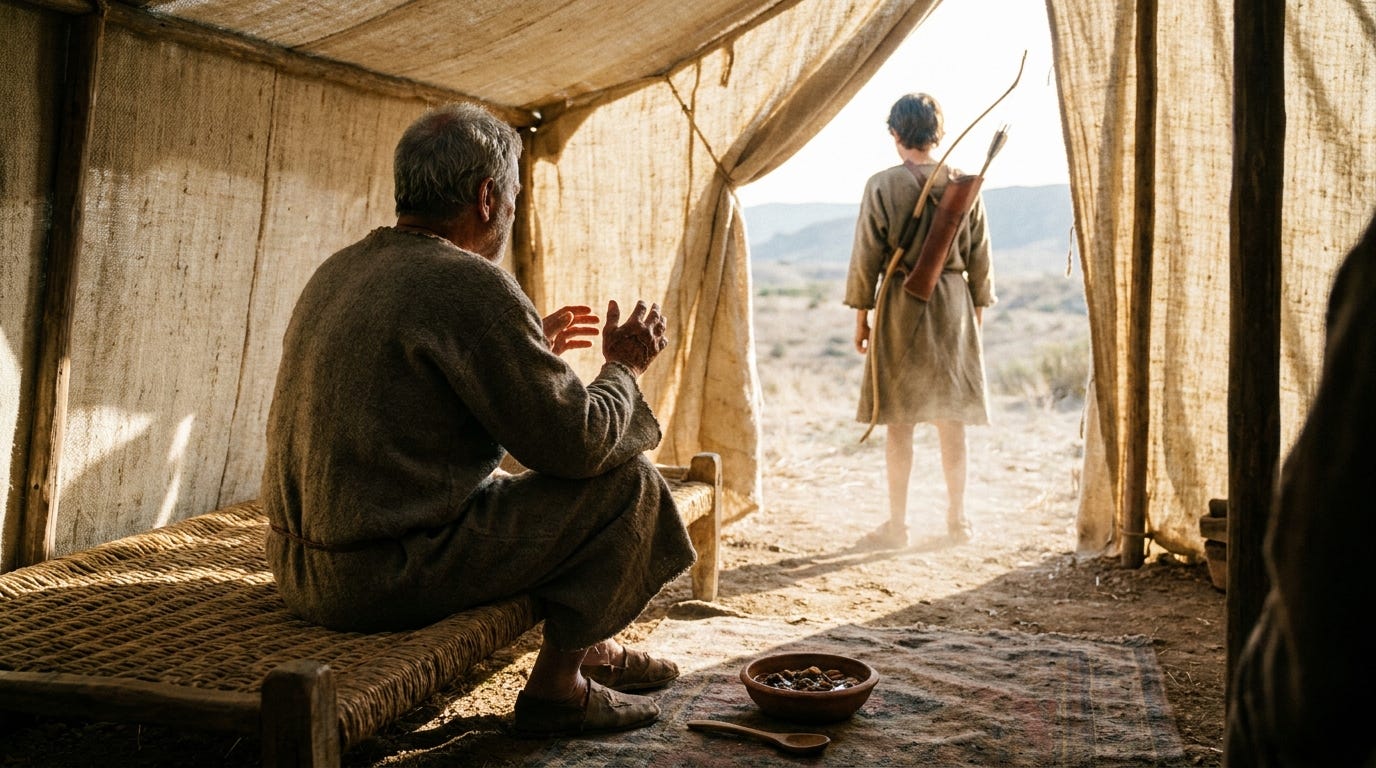
Jacob is barely out of the tent when Esau comes in from the field. He carries a bowl of cooked game to the bed and says the words Jacob used moments earlier: "My father, sit up and eat of your son's game, so that you may bless me" (Genesis 27:31).
From the bed comes the same question Jacob heard. "Who are you?" (Genesis 27:32).
Isaac trembled violently
Isaac trembled because in one moment he saw that God's word had been carried out in his tent while he was busy carrying out his own plan. "Isaac began to tremble violently" (Genesis 27:33). Before the twins were born, God had told Rebekah, "the older will serve the younger" (Genesis 25:23). Isaac had made his plan for Esau. Now Esau stands at the bed with a warm bowl, and Isaac knows whose word has been standing in the room the whole time.
He will be blessed
Isaac refused to take the blessing back because he recognised that God had kept His own word through it, and he bowed to it. He tells Esau plainly, "I ate it all and blessed him" and then, "indeed, he will be blessed" (Genesis 27:33). "Look, I have made him your master and given him all his relatives as servants" (Genesis 27:37).
Moments earlier Isaac weighed his son with his hands. Now he weighs the moment against what God said before the boys were born, and he holds to it. Scripture records that moment as faith: "By faith Isaac blessed Jacob and Esau concerning the future" (Hebrews 11:20). This is what knowing God looks like in an old man's tent, letting what He has said stand over what we had planned.
A loud and bitter cry
Esau cried for the blessing because he wanted what it would give him, and in all these verses he never once asks for the God who gives it. Esau "let out a loud and bitter cry" (Genesis 27:34), and then he asks, "Haven't you saved a blessing for me?" (Genesis 27:36) and, "Do you have only one blessing, my father?" (Genesis 27:38). He names his father, his brother and his birthright. He never names the LORD. The letter to the Hebrews remembers it: "He could find no ground for repentance, though he sought the blessing with tears" (Hebrews 12:17).
Isaac still had a promise for Esau. He sends him toward dry country and the sword, and then gives him this: "But when you rebel, you will tear his yoke from your neck" (Genesis 27:40). In the days of King Jehoram, Edom did exactly that (2 Kings 8:20). God keeps what He says, even for the son who wept.
Every spiritual blessing in Christ
Genesis 27 points to Jesus because Esau's question, "Do you have only one blessing, my father?" (Genesis 27:38), is answered by the Father in His Son. Isaac had one blessing to give, and it was spent. The Father "has blessed us in Christ with every spiritual blessing in the heavenly realms" (Ephesians 1:3). To know God and be known by Him is the blessing Esau wept outside of.
Let His word stand
Isaac trembled, and then he held. When something God has said crosses a plan you have carried for years, read it back and let it stand. Write what He has said to you in the Doxa app, dated and in His exact words, so that on the day your plan and His word meet in the same room you can read which one was spoken first. "Does He speak and not act? Does He promise and not fulfill?" (Numbers 23:19).
We are the people who remember what He has said, and He keeps every word of it.
What has God said to you that you have been keeping outside the tent?
Keep exploring. If this raised a question, or brought back something God has said to you, take it further. Ask Doxa. It answers from Scripture, real stories, and your own journey, free in your browser. No signup to start.
Download Doxa, the app for recording, weighing and remembering prophetic encouragement.
Also please feel free to read the Doxa Deeper Dive below where we delve into the original language and historical context.
The Doxa Deeper Dive
Why Esau's Blessing Uses Jacob's Exact Words (Genesis 27:30–40)
Originally published on the Doxa blog.
The verb behind Isaac's trembling in verse 33 is one that every Israelite who first heard Genesis had felt in their own body, at the foot of a mountain.
The trembling Israel knew
Isaac trembled with the fear of a man who has just met God's word coming true in his own tent. The Hebrew piles the words on top of each other: the verb charad (H2729) with its own noun charadah (H2731), then great, then exceedingly. Read word for word, he trembled a great trembling, beyond measure. The BSB gives it as "Isaac began to tremble violently" (Genesis 27:33).
Israel knew that verb. On the third morning at Sinai, with thunder, cloud and the ram's horn, "all the people in the camp trembled" (Exodus 19:16). The people who first heard Genesis read aloud were the people who had trembled when God spoke from the mountain. When they heard their father Isaac shake with the same verb, they knew what had happened in that tent. He had come face to face with the God who speaks, and with a word God had spoken before the twins were born: "the older will serve the younger" (Genesis 25:23).
The trembling ends in surrender. Isaac says, "and indeed, he will be blessed" (Genesis 27:33), and Esau's reply turns on two words that sound almost alike.
Birthright and blessing
The birthright was the firstborn's legal share of his father's estate, and the blessing was the father's last spoken word to his heir, and in Hebrew the two are nearly the same word. Esau says, "He took my birthright, and now he has taken my blessing" (Genesis 27:36). Birthright is bekorah (H1062), b-k-r; blessing is berakah (H1293), b-r-k. The same three letters, two of them swapped. An English reader sees two different things. A Hebrew listener heard one loss said twice, the second an echo of the first.
The two were different in law. The firstborn's right was "a double portion of all that he has" (Deuteronomy 21:17). The blessing was the father's final spoken word, and in that world a dying father's words to his son carried the weight of a will. Once Isaac had spoken, he did not unsay it.
Then Esau reaches for his brother's name: "Is he not rightly named Jacob? For he has cheated me twice" (Genesis 27:36). Cheated is aqab (H6117), to grab by the heel, the root of the name Jacob. Hosea remembers it: "In the womb he grasped his brother's heel, and in his vigor he wrestled with God" (Hosea 12:3). Centuries later Jeremiah wrote, "every brother deals craftily" (Jeremiah 9:4), and the Hebrew there reads, every brother acts like Jacob. Esau names his brother's grasping twice and never names the God whose word had been at work since before the boys were born. Isaac's answer shows that word still at work, in the very phrases Jacob had just heard.
Away from the dew of heaven
The words away from the dew of heaven mean Esau would live at a distance from the plenty Jacob was given, and the Hebrew says it with Jacob's own words, turned around by one small prefix. Jacob heard, "May God give to you the dew of heaven and the richness of the earth" (Genesis 27:28). Esau hears, "your dwelling place shall be away from the richness of the land, away from the dew of heaven above" (Genesis 27:39).
In Hebrew both verses use the same two phrases, mishmanne ha'aretz and mittal hashamayim: richness, mashman (H4924), and dew, tal (H2919). Each carries the prefix mi-, short for min (H4480), which can mean some of or away from. For Jacob it means a share of the dew. For Esau it means distance from it. The King James Version translated verse 39 the other way, as a promise that Esau would live on rich land, which shows how close the two sentences sit. One syllable, the same in both blessings, and only the speaker's purpose tells you which way it points.
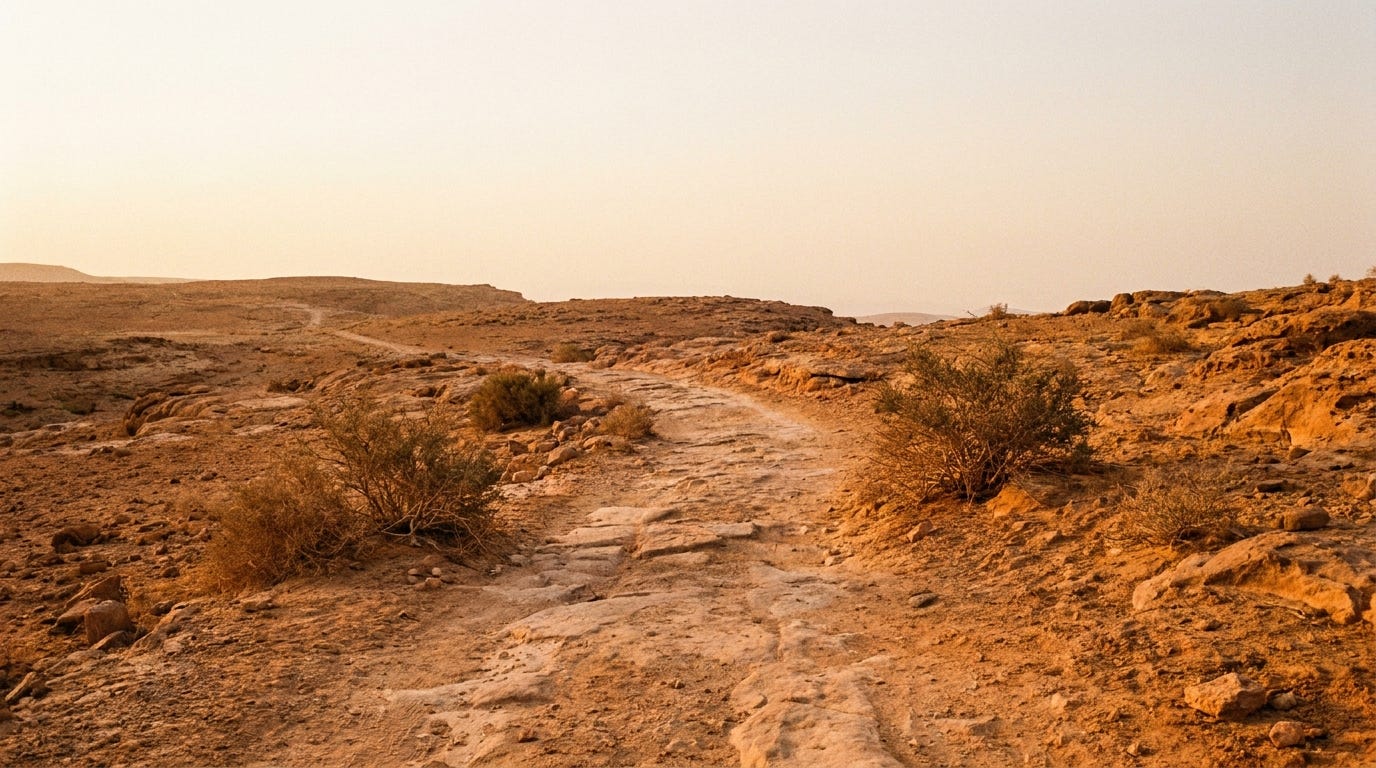
The land fits the word. Esau "settled in the area of Mount Seir" (Genesis 36:8), the high, dry country south-east of the Dead Sea, where the main north-south trade road, the King's Highway, crossed Edom's land. "You shall live by the sword" (Genesis 27:40), and when Israel asked to pass along that road, Edom answered, "we will come out and confront you with the sword" (Numbers 20:18). The yoke broke too: "In the days of Jehoram, Edom rebelled against the hand of Judah and appointed their own king" (2 Kings 8:20).
Edom, your brother
Israel first heard Esau's blessing as the story of the neighbour on their southern border, a brother God had told them not to despise. Moses' message to Edom began, "This is what your brother Israel says" (Numbers 20:14). On the way into the land God told them, "I have given Mount Seir to Esau as his possession" (Deuteronomy 2:5), and in the law, "Do not despise an Edomite, for he is your brother" (Deuteronomy 23:7).
So when the tribes heard Isaac's words to Esau, they heard God keeping His word to the son who lost the blessing as carefully as to the son who received it. Esau had land because God said so, and Israel was not to take a footprint of it. To know God is to know a God who keeps His word to the brother we would rather forget.
The remnant of Edom
Esau's story points to Jesus because the prophets promised that Edom's remnant would be gathered under God's name, and the apostles saw that promise opening as Gentiles came to Christ. Amos foretold that Israel would "possess the remnant of Edom and all the nations that bear My name" (Amos 9:12). The Hebrew words Edom (H123) and adam (H120), mankind, share the same consonants. The Greek Bible read the word as adam, and when James quoted Amos at the council in Jerusalem, he quoted it that way: "so that the remnant of men may seek the Lord, and all the Gentiles who are called by My name" (Acts 15:17). The Greek is anthropos (G444).
Amos counted Edom's remnant among the nations that bear God's name, and James, reading the Greek, heard that promise being kept as Gentiles sought the Lord in Christ. The son who left his father's tent with a hard blessing has children who come to the Father through the Son, and they find what Esau never asked for: to know God and be known by Him.
Isaac trembled when the word God spoke before the twins were born came true in front of him. We are the people who write those words down. Record what God has said to you in the Doxa app, with the date and His exact words, so that when it comes to pass you can read it back and see who spoke first. He is the God who speaks, and He knows us by name.
Keep exploring. If this raised a question, or brought back something God has said to you, take it further. Ask Doxa. It answers from Scripture, real stories, and your own journey, free in your browser. No signup to start.
Questions and comments are welcome below.
Download Doxa, the app for recording, weighing and remembering prophetic encouragement.