

The potter’s word
Genesis 1 has one signature verb for God’s making. Bara (H1254), to create. The Hebrew Bible only ever gives that verb one subject, God Himself, and it means making from nothing, at a distance, by speech.
Turn the page and the verb changes. “Then the LORD God formed man from the dust of the ground” (Genesis 2:7). Formed is yatsar (H3335), the potter’s word. Jeremiah gets sent down to a workshop to watch it happen, a wheel turning under a man’s foot and clay wet enough to slump and stiff enough to hold a thumbprint, and God says over his shoulder, “Just like clay in the potter’s hand, so are you in My hand” (Jeremiah 18:6). Isaiah reaches for the same verb in prayer: “You are the potter; we are all the work of Your hand” (Isaiah 64:8). The switch from bara to yatsar is deliberate. God spoke the cosmos into place. Then He put His hands in the clay, thumbs pressing, unhurried.
The raw material gets named without any flattery. Aphar (H6083) is dust, loose dry ground, the stuff a sandal kicks up on a path. It comes back one chapter later in the sentence “for dust you are, and to dust you shall return” (Genesis 3:19). Whatever dignity sits in Genesis 2:7 comes from the hands that worked that dust, and from what God put inside it.
The breath that made a soul
“...and breathed the breath of life into his nostrils, and the man became a living being” (Genesis 2:7). Three Hebrew words carry that line.
Breathed is naphach (H5301), an exhale, a face bent low over the clay. The breath of life is neshamah (H5397), a word Scripture keeps almost entirely for God and for human beings; Proverbs calls it the lamp God lights inside a person (”The spirit of a man is the lamp of the LORD,” Proverbs 20:27, the same neshamah). Living being is nephesh chayyah (H5315), a living soul.
That last phrase is shared. Genesis has already called the animals nephesh chayyah, the sea creatures in Genesis 1:21 and the beasts in Genesis 2:19. The creatures are living souls too. God spoke the animals up out of the ground; into the man He breathed His own neshamah. Same dust, same aliveness, and one creature walking around with a borrowed breath in him. Every claim the Bible goes on to make about human worth stands on that borrowed breath.
The tree still standing
Two trees stand in the middle of the garden, “the tree of life and the tree of the knowledge of good and evil” (Genesis 2:9). Chapter 3 will bar the road to the tree of life, and that guard on the path is a mercy as much as a sentence; God will not let ruined people live forever in their ruin.
The tree survives, guarded, and Scripture never forgets it. On the last page it stands again with the fence gone: “On either side of the river stood a tree of life, bearing twelve kinds of fruit and yielding a fresh crop for each month. And the leaves of the tree are for the healing of the nations” (Revelation 22:2). What Eden lost, the garden-city hands back, wide open, with fruit twelve months a year.
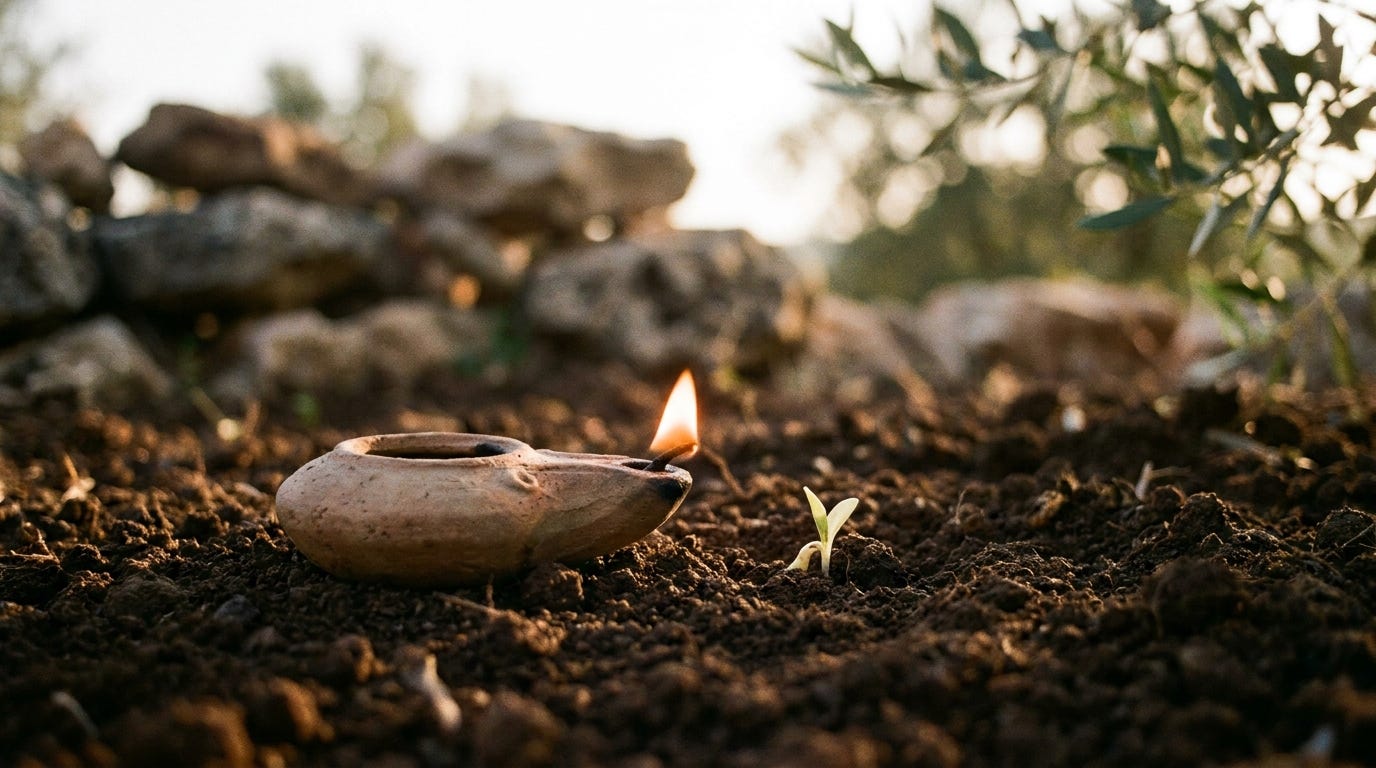
Today’s Doxa Daily Lift carries the single picture from this chapter, God down in the dirt, close enough to breathe. Come here when you want the Hebrew underneath it.
The deep sleep and the opened side
The strangest scene in the chapter reaches the furthest. “So the LORD God caused the man to fall into a deep sleep, and while he slept, He took one of the man’s ribs and closed up the area with flesh” (Genesis 2:21). Deep sleep is tardemah (H8639), a God-sent sleep. The same word falls on Abram in the dark while God moves between the pieces and cuts the covenant alone (Genesis 15:12). It marks the moments where God does the decisive work and the human can only receive it.
The woman comes from an opened side, “bone of my bones and flesh of my flesh” (Genesis 2:23). Then the narrator steps out of the story to say what it was for: “For this reason a man will leave his father and mother and be united to his wife, and they will become one flesh” (Genesis 2:24).
Paul quotes that verse word for word and tells you where it was always pointing. “This mystery is profound, but I am speaking about Christ and the church” (Ephesians 5:31–32). A death-like sleep falls on the last Adam. A soldier opens His side, “one of the soldiers pierced His side with a spear, and immediately blood and water flowed out” (John 19:34). Out of that opened side comes His bride, the church.
Originally published at https://doxa.app/blog/daily-lift-deep-dive-2-genesis-2