

Originally published on the Doxa blog.
Sarah died at Kiriath-arba, the town later called Hebron, at 127 years old. "Abraham went out to mourn and to weep for her" (Genesis 23:2).
Then he got up from beside her body and went to ask the Hittites for a grave.
What happens in Genesis 23?
He opened with the plain truth about himself: "I am a foreigner and an outsider among you" (Genesis 23:4). More than sixty years earlier God had appeared to him in this land and said, "I will give this land to your offspring" (Genesis 12:7). Later the promise widened to "all the land of Canaan, as an eternal possession" (Genesis 17:8). After all those years on that promise, Abraham owned none of it, and had to ask the neighbours for somewhere to bury his wife.
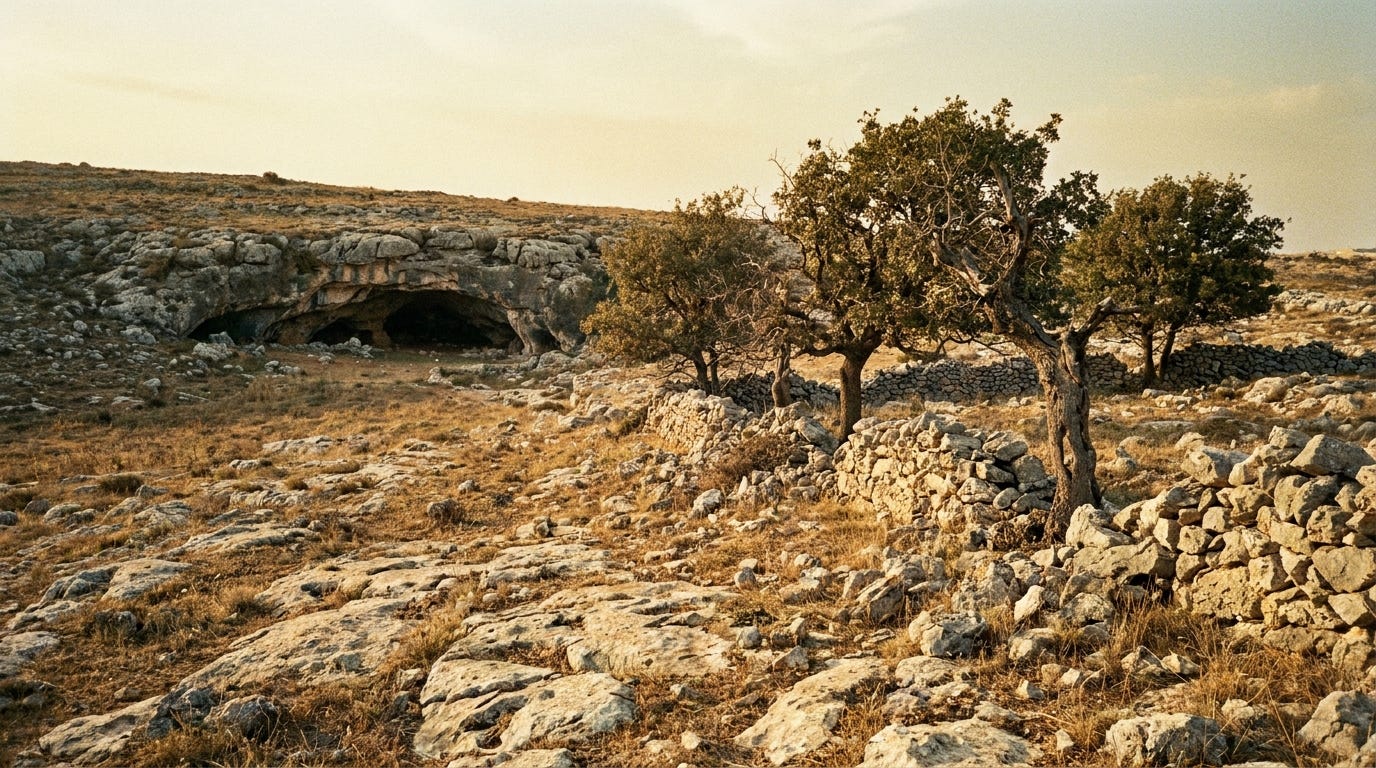
The Hittites offered him the finest of their tombs. Ephron, who owned the cave at Machpelah, offered him the whole field as a gift, in front of the town. Abraham bowed to them twice and kept asking to pay. Ephron named a price, four hundred shekels of silver, and Abraham weighed it out "in the hearing of the Hittites" (Genesis 23:16). The field, the cave and every tree inside its boundaries passed to him "in the presence of all the Hittites who had come to the gate of his city" (Genesis 23:18).
Why did Abraham insist on paying?
God says nothing in this chapter. No vision, no voice, no angel at the gate. Abraham acts on words God had spoken decades before, and he acts in public. A gift leaves the giver's family with a claim on the ground. A sale weighed out before witnesses at the city gate is a record that stands. Abraham wanted the first piece of the promised land on the record, legally his, in the country God had said would belong to his children.
This is what holding a promise looks like in a week of grief. Of all the land of Canaan, Abraham would hold one field and one cave in his lifetime, and he buried Sarah there as a man who expected the rest to follow.
How does Genesis 23 point to Jesus?
Stephen, on trial in Jerusalem, said God gave Abraham "no inheritance here, not even a foot of ground" (Acts 7:5). Hebrews says Abraham and his family "died in faith, without having received the things they were promised" (Hebrews 11:13). The cave at Machpelah filled with people who died holding that promise: Sarah, then Abraham, Isaac, Rebekah, Leah and Jacob.
Jesus answered a question about the resurrection with God's words from the burning bush, "I am the God of Abraham, the God of Isaac, and the God of Jacob" (Matthew 22:32). The men in that cave still had a living God. Then Jesus Himself was laid in a tomb cut into rock outside Jerusalem, and on the third morning an angel told the women, "Come, see the place where He lay" (Matthew 28:6). Christ is "the firstfruits of those who have fallen asleep" (1 Corinthians 15:20). Everyone buried at Machpelah was buried waiting for Him.
What do you do with a promise you have not seen yet?
Abraham knew God well enough to pay full price for a grave in the land God had promised him. That is how God made Himself known to Abraham: He spoke, and Abraham trusted Him for the rest of his life on the strength of it.
If God has promised you something and you are still waiting, put it on the record. Write the words and the date in the Doxa app, the way Abraham's purchase was witnessed at the gate. Then write down the small part you already hold, your one field. On a day when the grief is heavy and you hear nothing from heaven, you will have both in front of you.
What has God promised you that you are still holding without seeing it?
Keep exploring. If this raised a question, or brought back something God has said to you, take it further. Ask Doxa. It answers from Scripture, real stories, and your own journey, free in your browser. No signup to start.
Download Doxa, the app for recording, weighing and remembering prophetic encouragement.
Also please feel free to read the Doxa Deeper Dive below where we delve into the original language and historical context.
The Doxa Deeper Dive
Cave of Machpelah: Why Abraham Paid 400 Shekels for a Tomb
Originally published on the Doxa blog.
Abraham's first sentence to the Hittites joins two nouns: "I am a foreigner and an outsider among you" (Genesis 23:4). The Hebrew is ger wetoshav. A ger (H1616) is someone who has come to live in another people's land. A toshav (H8453), translated outsider here, is a resident who holds no ground of his own. An English reader takes it as a polite opening to a negotiation. The pair comes back in the law, where God says it of Israel, and in David's prayers, where David says it to God.
Where else does the Bible use foreigner and resident?
The first is in the law, about the very land Abraham was trying to buy into: "The land must not be sold permanently, because it is Mine, and you are but foreigners and residents with Me" (Leviticus 25:23). Same two words. Abraham was a foreigner among the Hittites. Israel, settled in Canaan with fields and boundary stones, was to count itself a foreigner with God, on ground that still belonged to Him.
David used the pair twice. In a psalm he prayed, "For I am a foreigner dwelling with You, a stranger like all my fathers" (Psalms 39:12). And at the end of his reign, with gold, silver and cut stone piled up for the temple, he stood before the whole assembly and prayed, "For we are foreigners and strangers in Your presence, as were all our forefathers" (1 Chronicles 29:15). A king who held the land and its capital described himself in the words Abraham used at the gate of Hebron, and "all our forefathers" began with Abraham.
The Greek translation of Genesis that the early church read renders the pair paroikos kai parepidemos, paroikos (G3941) and parepidemos (G3927). Peter wrote to believers scattered across Asia Minor and used both words: "Beloved, I urge you, as foreigners and exiles" (1 Peter 2:11). Hebrews says Abraham's family "acknowledged that they were strangers and exiles on the earth" (Hebrews 11:13). An English reader meets foreigner, stranger and exile in four different books and never sees the thread. Abraham's words at a funeral negotiation became how God described Israel on His land, how Israel answered Him, and then how the church talked about itself.
Why did Abraham insist on the full price?
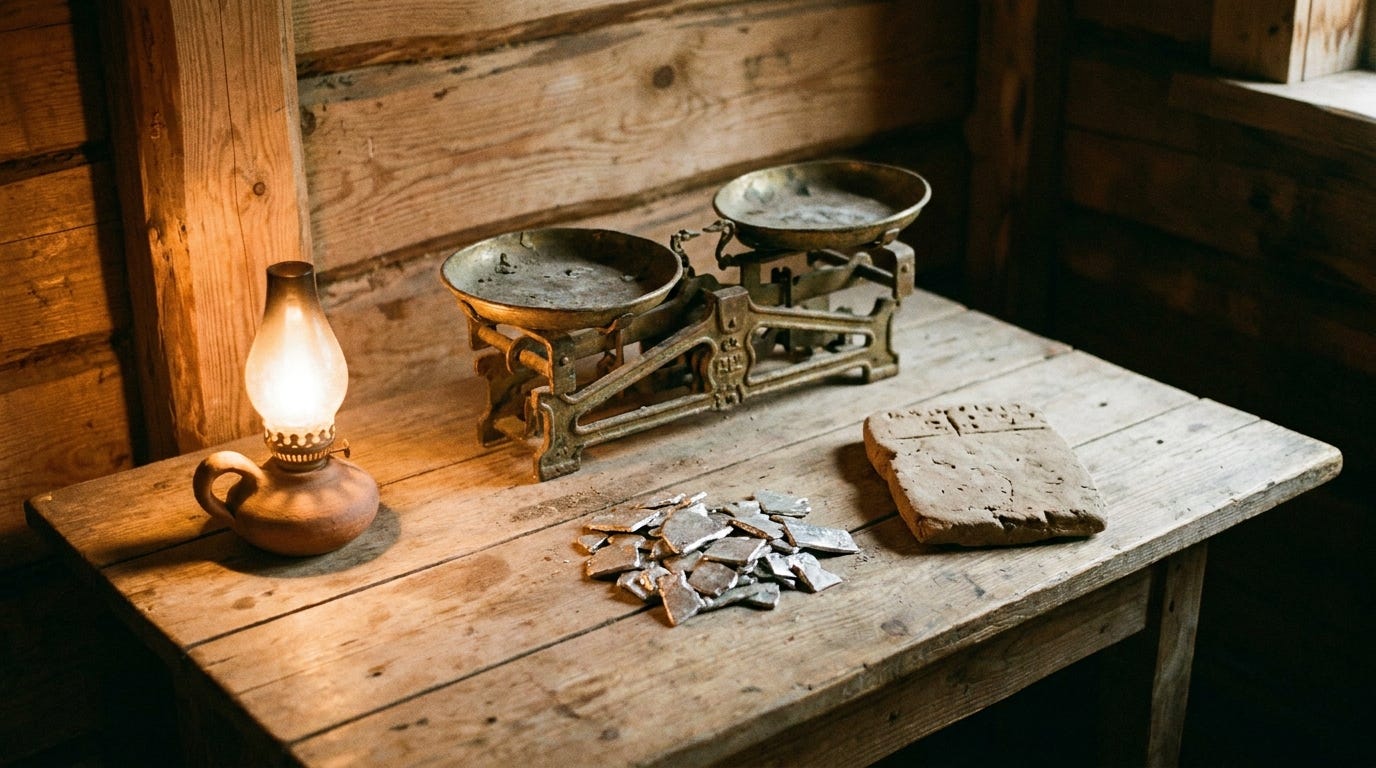
Before Ephron offered anything, Abraham had already asked for the cave "for full price" (Genesis 23:9). The Hebrew is bekhesef male, literally in full silver, from male (H4392), full. Four hundred shekels is about four and a half kilograms of silver, a sum the whole gate could watch go onto the scales.
The same phrase turns up once more in a land purchase. David was buying the threshing floor where the temple would stand, and when its owner offered it free, David answered, "I insist on paying the full price" (1 Chronicles 21:24). Both men turned down a gift of ground they meant for God's purposes and paid in silver.
There were no coins yet. Abraham "weighed out" the silver, from shaqal (H8254), "according to the standard of the merchants" (Genesis 23:16), on a balance, in front of witnesses. Verses 17 and 18 read like the land deeds of the ancient Near East, naming the field, the cave and "all the trees within the boundaries of the field" (Genesis 23:17), then the seller, the buyer and the witnesses.
Jeremiah's purchase is Abraham's carried into a siege. With the Babylonian army outside Jerusalem, God told him to buy his cousin's field at Anathoth, and he "weighed out seventeen shekels of silver" (Jeremiah 32:9). He "signed and sealed the deed, called in witnesses, and weighed out the silver on the scales" (Jeremiah 32:10). God gave the reason through him: "Houses, fields, and vineyards will again be bought in this land" (Jeremiah 32:15). Abraham and Jeremiah both bought ground they could not yet enjoy, on the strength of what God had said about the future.
How did Israel first hear Genesis 23?
The people who first heard Genesis read aloud were a nation on its way into Canaan, or newly settled there. For them this chapter answered a practical question: what did the family already own in the land?
One field and one cave, and they knew who lay in it. Jacob had listed them on his deathbed: "There Abraham and his wife Sarah are buried, there Isaac and his wife Rebekah are buried, and there I buried Leah" (Genesis 49:31). His sons carried his body up out of Egypt to the cave "which Abraham had purchased from Ephron the Hittite as a burial site" (Genesis 50:13). Genesis names that purchase four more times after this chapter. For a people about to fight for the land, it mattered that their fathers had paid for the first piece in silver, in public.
Hebron also had a history they remembered with shame. The twelve spies "came to Hebron, where Ahiman, Sheshai, and Talmai, the descendants of Anak, dwelled" (Numbers 13:22). Ten came back afraid, and that generation died in the wilderness. The town that frightened them held the grave of the man who had trusted God's promise about that very land. Caleb, who believed God, later asked for Hebron and received it "because he wholly followed the LORD, the God of Israel" (Joshua 14:14). Israel heard Genesis 23 knowing that their fathers' grave sat in the town where one generation forgot what God had said and one man held on to it.
What does a foreigner know about God?
Hebrews draws the line from Abraham's words to God's answer: "they were longing for a better country, a heavenly one. Therefore God is not ashamed to be called their God" (Hebrews 11:16). At the burning bush God named Himself "the God of Abraham, the God of Isaac, and the God of Jacob" (Exodus 3:6), three men who were lying in the cave at Machpelah. The man who called himself a foreigner and a resident is the man whose name God took into His own.
That is what it is to know God and be known by Him in this chapter. Abraham took God at His word for longer than his own life, and God tied His name to Abraham's for good. Peter handed the same two words to the church, so anyone still waiting on a promise stands where Abraham stood at the gate, silver on the scales. Put what God has said to you on the record in the Doxa app, with the date, beside the small part of it you already hold, so the people after you can read it.
Keep exploring. If this raised a question, or brought back something God has said to you, take it further. Ask Doxa. It answers from Scripture, real stories, and your own journey, free in your browser. No signup to start.
Questions and comments are welcome below.
Download Doxa, the app for recording, weighing and remembering prophetic encouragement.