

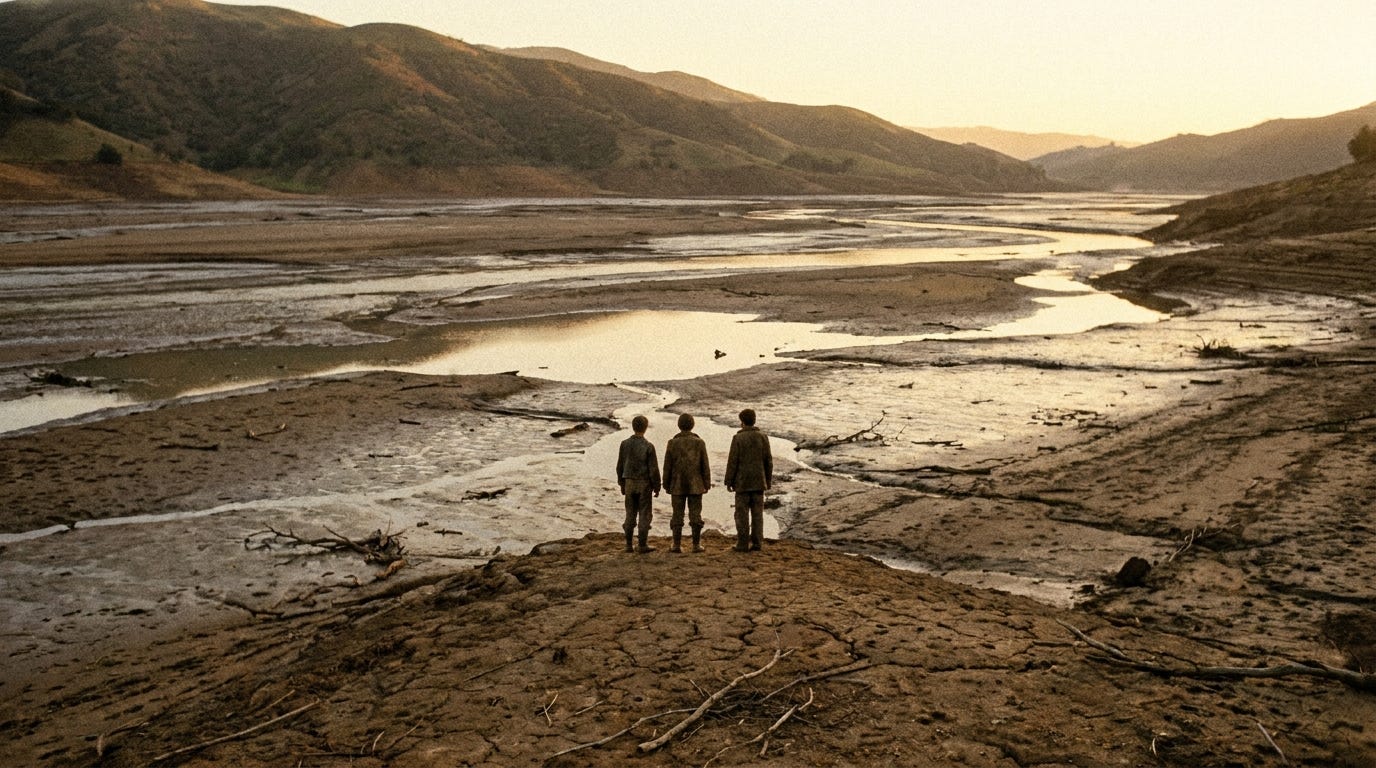
The floodwaters are gone, and the world is silent.
Eight people stand on a scrubbed hillside with the smell of a fresh altar still in the air (Genesis 8:20). Everything they knew is under the mud. Into that silence God speaks again, and His first words to Noah set the terms of the whole new world.
What does God say first to Noah after the flood?
He blesses him. "Be fruitful and multiply and fill the earth" (Genesis 9:1). If that line sounds familiar, it should. It is word for word what God spoke over the first man and woman in the garden (Genesis 1:28). The world drowned. The plan survived it. God picks the story back up with the exact sentence He began it with, and Noah stands there as a kind of second Adam on washed ground.
Watch what Noah is doing in this scene. He is listening. He came off the ark only when God told him to (Genesis 8:16), and now he stands and takes the rules of the new earth from God's own mouth. This is what it means to know the God who speaks. You let Him tell you the shape of the life you are stepping into, before you build a thing.
Why does God forbid eating blood?
God fills the table generously. Every creature is now given for food, where before there had only been plants (Genesis 9:3). But He draws a line around it. "You must not eat meat with its lifeblood still in it" (Genesis 9:4). The life is in the blood, and life belongs to God. Even while He feeds Noah's family, God keeps one truth in front of them: they live on a gift, and the giver still owns the life.
Why is human life sacred in Genesis 9?
Then comes the heart of it. "Whoever sheds the blood of man, by man his blood will be shed; for in His own image God has made mankind" (Genesis 9:6).
Read the reason God gives. Every person you meet is stamped with the image of God, so to lift your hand against a man is to strike at the likeness of the One who made him. In a world only just washed clean of violence (Genesis 6:11), God's first law puts a fence around human life, and tells Noah exactly why it stands.
How does Genesis 9 point to Jesus?
There is a line here that runs straight to the cross. God says a man's blood is precious because it carries a life made in His image. Generations later God gives His own Son, and the blood of Jesus is poured out by the hands of men (Acts 2:23). Yet Hebrews says that blood "speaks a better word than the blood of Abel" (Hebrews 12:24). The first shed blood in Genesis cried out for justice against a murderer (Genesis 4:10). The blood of Christ cries mercy over the very people who shed it.
So carry this down the mountain with Noah. The next person who annoys you, wounds you, or wearies you still bears the image of God. Hold onto the thing God told Noah, and let it change how you see a face across the room.
What would shift in your day if you treated the people around you as image-bearers of the God who made you both? And when God tells you how to live in the world He has handed you, do you write it down and keep it, or quietly draw up your own terms?
The Doxa Deeper Dive
Made in God's Image: Why Shedding Blood Strikes at God (Genesis 9:1-7)
God begins the new world the way He began the first one, by speaking.
Why does God repeat the creation blessing to Noah?
The first words over the new earth are borrowed from the old one. "Be fruitful and multiply and fill the earth" (Genesis 9:1) repeats the blessing God spoke over humanity on the sixth day (Genesis 1:28). Be fruitful, parah (H6509), and multiply, rabah (H7235), are the same two verbs, the ones God had already spoken over the animals leaving the ark (Genesis 8:17), now carried across the flood and set over Noah himself. By the end of the passage God says it a second time: "be fruitful and multiply; spread out across the earth and multiply upon it" (Genesis 9:7). The blessing frames the whole section, spoken at the front and again at the back. Noah stands on washed ground as a second Adam, handed the same commission and the same empty world to fill.
What does it mean that the life is in the blood?
God widens the diet. "Everything that lives and moves will be food for you" (Genesis 9:3), a permission Adam never had. But one clause guards the gift. "You must not eat meat with its lifeblood still in it" (Genesis 9:4). The word rendered "lifeblood" holds two Hebrew words together, nephesh (H5315), the life or soul, and dam (H1818), the blood. The Hebrew reads, roughly, its flesh with its nephesh, its dam. Israel would hear the reason spelled out at Sinai: "the life of the flesh is in the blood" (Leviticus 17:11). To Genesis, blood is where the life lives, and the life is God's. Even as God fills the plate, He keeps His claim on the one thing that is His alone to give and to take.
Why does bearing God's image make murder an assault on God?
Here the passage reaches its centre. "Whoever sheds the blood of man, by man his blood will be shed; for in His own image God has made mankind" (Genesis 9:6). The verb for shed is shaphak (H8210), to pour out. The word for image is tselem (H6754), the same word used when God made humanity "in the image of God" on the sixth day (Genesis 1:27). Every human being alive is a walking tselem of the Maker. Follow the logic. To pour out a man's blood is to deface the image of God on the earth, an assault on the likeness of God Himself, stamped on the one whose blood is spilt. That is why the penalty is so heavy, and why the accounting belongs to God Himself: "I will require the life of any man or beast by whose hand your lifeblood is shed" (Genesis 9:5).
Where do the image and the blood find their end?
The two threads of this passage, the image and the shed blood, both run forward into the gospel.
Take the image first. Humanity carries the tselem of God, cracked and smeared by sin from Genesis 3 onward. The New Testament names the one place it is perfect. Christ "is the image of the invisible God" (Colossians 1:15); the word for image there is eikon (G1504), the flawless likeness the rest of us carry only in fragments. What Adam and Noah bore in a broken way, the Son bears fully, and the aim of salvation is that we are "conformed to the image of His Son" (Romans 8:29). The defaced tselem of Genesis 9 is being restored in Him.
Now the blood. Genesis 9 says human blood is so weighty that God Himself will require an accounting for it. Hebrews carries that weight to the cross: "without the shedding of blood there is no forgiveness" (Hebrews 9:22). The blood God guards in Genesis is the very price He will one day pay, in His own Son, to buy back the image-bearers who spilled it. And so the blood of Jesus "speaks a better word than the blood of Abel" (Hebrews 12:24). Abel's blood, the first human blood shed in Scripture, cried from the ground for justice (Genesis 4:10). The blood of Christ, poured out by the hands of men (Acts 2:23), cries mercy over the guilty.
Read Genesis 9 and you can see the shape of the whole Bible in it. God blesses, God gives, God guards the life He made in His own image, and when that image is marred beyond human repair, God gives His own blood to mend it. To know this God is to see every human face, including the ones you would rather avoid, as the image of the God who speaks. And it is to know that your own defaced image is being remade by the blood He shed.