

Originally published on the Doxa blog.
The feast was for Isaac. He had been weaned, which in that world happened around the age of two or three, and Abraham marked the day with a great feast (Genesis 21:8). Among the guests Sarah watched Hagar's son, a teenager by now, and did not like what she saw.
She went to Abraham with a demand: "Expel the slave woman and her son, for the slave woman's son will never share in the inheritance with my son Isaac!" (Genesis 21:10).
What happens in Genesis 21:8–21?
Abraham was distressed, because the boy was his son too. God spoke to him. "Do not be distressed about the boy and your maidservant" (Genesis 21:12), He said, and He made a promise about the son who was leaving: "I will also make a nation of the slave woman's son, because he is your offspring" (Genesis 21:13).
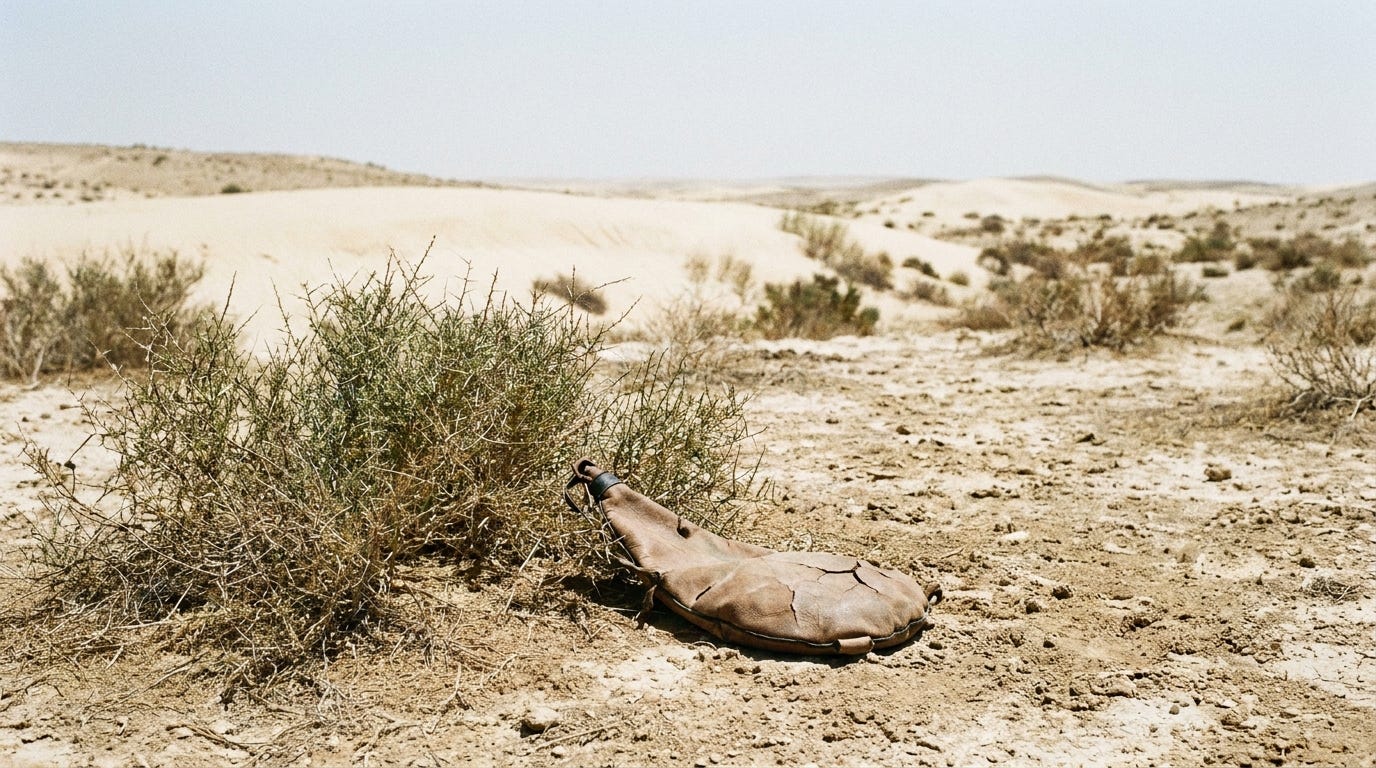
Abraham was up early the next morning (Genesis 21:14). He loaded Hagar with bread and a single skin of water, and mother and son walked out into the Wilderness of Beersheba. He let his son go on the strength of one sentence from God, heard the night before.
When the skin was empty, Hagar left the boy under a bush and walked off about a bowshot. "I cannot bear to watch the boy die!" she said (Genesis 21:16), and she sat down and wept out loud.
Why did God hear the boy?
"Then God heard the voice of the boy" (Genesis 21:17). The boy's name is Ishmael, and Ishmael means God hears.
Hagar had been in this desert before. Some seventeen years earlier, pregnant and running from Sarah, she stopped at a spring on the road to Shur, and the angel of the LORD told her what to call her son: "you shall name him Ishmael, for the LORD has heard your cry of affliction" (Genesis 16:11). She answered by giving God a name of her own. "You are the God who sees me," she said (Genesis 16:13).
So every time she called her son in from the tents, she said out loud what God does. And on the day the water ran out, with that name still on the boy, she sat a bowshot away and waited for him to die. Most of us know that place. We have something God said, and a day comes when the skin is empty and we stop expecting Him to do it.
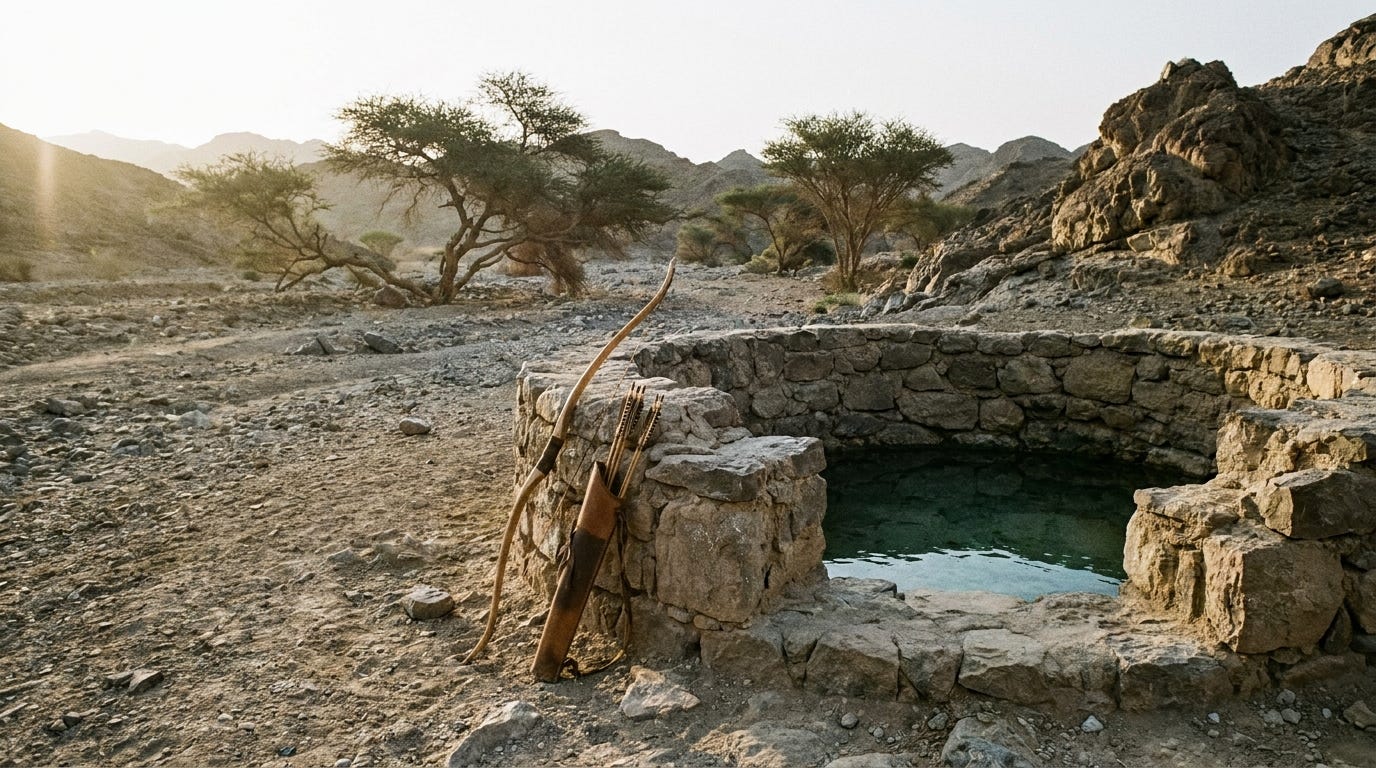
The angel called to her: "What is wrong, Hagar? Do not be afraid, for God has heard the voice of the boy where he lies" (Genesis 21:17). Then he repeated the promise she had carried all along: "I will make him into a great nation" (Genesis 21:18). "Then God opened her eyes, and she saw a well of water" (Genesis 21:19). It was close enough to fill the skin and get back to the boy.
How does Genesis 21 connect to Jesus?
Centuries later Jesus sat tired by Jacob's well in Samaria, and a woman came at midday to draw water (John 4:6–7). She was an outsider too, and He offered her water: "whoever drinks the water I give him will never thirst" (John 4:14). She ran back to town saying, "Come, see a man who told me everything I ever did" (John 4:29). Hagar had met the God who sees. This woman met Him face to face, and found that He already knew her completely.
Hagar learned in the desert that the God who sees also hears, and that He keeps what He has said after she has stopped expecting it. That is how anyone comes to know Him. He speaks, we keep what He said, and we watch Him do it, and along the way we find we were known by Him first.
If God has told you something you are still waiting on, write it down with today's date; this is what the Doxa app is for. On the day the water runs low, read it back before you sit down a bowshot away.
What has God already said to you that you need to read again today?
Keep exploring. If this raised a question, or brought back something God has said to you, take it further. Ask Doxa. It answers from Scripture, real stories, and your own journey, free in your browser. No signup to start.
Download Doxa, the app for recording, weighing and remembering prophetic encouragement.
Also please feel free to read the Doxa Deeper Dive below where we delve into the original language and historical context.
The Doxa Deeper Dive
Ishmael's Unspoken Name and the Well Hagar Could Not See (Genesis 21)
Originally published on the Doxa blog.
In Hebrew, Ishmael's name never appears in Genesis 21. Verse 11 in the Berean Standard Bible says the matter "concerned his son Ishmael" (Genesis 21:11), but the Hebrew says only his son, and from the feast until his mother finds him a wife from Egypt he is the son of the slave woman or simply the boy. The narrator holds the name back for the whole chapter. Then, at the moment the boy is about to die, God acts it out.
What was Ishmael doing in Genesis 21:9?
Sarah "saw that the son whom Hagar the Egyptian had borne to Abraham was mocking her son" (Genesis 21:9). The verb is metsacheq, from tsachaq (H6711), the same root as Yitschaq (H3327), Isaac. Three verses after Sarah said "God has made me laugh" (Genesis 21:6), she sees the older boy doing the younger boy's name.
In this intensive form the verb has a wide range of meanings. It is Isaac "caressing his wife Rebekah" (Genesis 26:8), Potiphar's wife accusing Joseph of coming "to make sport of us" (Genesis 39:14), and Israel at the golden calf getting up "to indulge in revelry" (Exodus 32:6). So mocking is one fair reading, and playing is another. Paul read it as hostility: "the son born by the flesh persecuted the son born by the Spirit" (Galatians 4:29).
An English reader sees a teenager teasing a toddler. A Hebrew listener heard a question about who gets to be Isaac. Sarah's answer, in the next verse, is legal.
Sarah's demand and the old law
Her verb is garash (H1644), drive out. Genesis has used it twice before. God "drove out the man" from Eden (Genesis 3:24), and Cain cried, "this day You have driven me from the face of the earth" (Genesis 4:14). Both times someone is sent away from the place where God had put them, and both times God provides for the one sent out: He clothed Adam and Eve with garments of skin before they left (Genesis 3:21), and He put a mark on Cain to protect him (Genesis 4:15). By the time Sarah says garash, a Hebrew listener has learned that the people this verb sends away stay in God's sight.
Sarah's demand also had a legal shape that people across the ancient Near East would have recognised. A law code from the city of Isin, issued by King Lipit-Ishtar about four thousand years ago, rules that when a man frees his slave woman and the children she bore him, those children do not divide the estate with the children of his wife. The Code of Hammurabi has a matching rule for sons a father had not acknowledged as his heirs. Freedom with no share was the formal way to settle a slave mother's sons. That is the whole of Sarah's sentence, "never share in the inheritance" (Genesis 21:10), and it is why Abraham is distressed. The law could release Ishmael and leave him with nothing.
God gave him a promise: "I will also make a nation of the slave woman's son" (Genesis 21:13). Abraham sent his son away carrying a promise the law had no power to give.
Why is the boy never named in Genesis 21?
The only human voice the narrator lets us hear in the desert is Hagar's: "she lifted up her voice and wept" (Genesis 21:16). The voice God answers is the boy's: "God heard the voice of the boy" (Genesis 21:17). The son says nothing on the page, and God hears him anyway.
Heard is shama (H8085), and God is Elohim (H430). Put the verb and the short form of God's name together, yishma and El (H410), and you have Yishma'el (H3458), God hears. The boy's name is said in what God does.
It is the third time. In Genesis 16 the name came with its reason, that the LORD had heard Hagar (Genesis 16:11). When Abraham prayed for the boy, God answered, "As for Ishmael, I have heard you" (Genesis 17:20). Now He hears the boy himself. Each time, God's hearing is joined to a promise God had already spoken. The bowshot comes back at the end of the passage, too. The boy his mother left a bowshot away to die grew up to be "a great archer" (Genesis 21:20), a man of the bow, alive because God heard him.
What does it mean that God opened her eyes?
"Then God opened her eyes, and she saw a well of water" (Genesis 21:19). The verb is paqach (H6491), and it is almost always used of opening eyes. It first appears in the garden, where the serpent promised, "your eyes will be opened" (Genesis 3:5), and then "the eyes of both of them were opened, and they knew that they were naked" (Genesis 3:7). There it opened eyes to shame. Here it opens a mother's eyes to water that was already in the ground.
The clearest echo is Elisha's servant, surrounded by an army, when the prophet prays, "O LORD, please open his eyes that he may see" (2 Kings 6:17). The hills were already full of horses and chariots of fire. In both stories God's provision is already in place, and what changes is that a frightened person can see it. The well, be'er (H875), ties back to Hagar's first meeting with God, at the well that took its name from her words, Beer-lahai-roi (Genesis 16:14), the well of the Living One who sees me.
How did Israel first hear Genesis 21:8–21?
Israel heard this story as a people who had been slaves in Egypt and who knew the Wilderness of Paran first-hand. Their journey from Sinai ended there, "until the cloud settled in the Wilderness of Paran" (Numbers 10:12), and the spies went out from there. They knew what an empty water skin meant. Three days out of the sea they had found no water and cried, "What are we to drink?" (Exodus 15:24).
They also knew garash. God had told Moses that Pharaoh "will drive you out completely" (Exodus 11:1), and they left in such a hurry that they "had been driven out of Egypt" with no provisions prepared (Exodus 12:39). Their rescue began when "God heard their groaning, and He remembered His covenant with Abraham" (Exodus 2:24).
So Israel heard its own story told about an Egyptian slave woman: driven out, carrying bread and water, thirsty in the wilderness, heard by God because of what He had promised Abraham. The God who rescued them had done the same for a woman from the people who enslaved them, on the strength of a promise He had made to her.
Three times Genesis sets God's hearing beside this boy, and each time it is tied to something God had already said. In the desert the promise was the one Hagar already had, and the well was already in the ground; God opened her eyes to both. The boy was known by God where he lay, and Hagar came to know God better by seeing that what He had said was still standing. Keep what He tells you where you will see it on a dry day; the Doxa app holds it with its date, ready to read back.
Keep exploring. If this raised a question, or brought back something God has said to you, take it further. Ask Doxa. It answers from Scripture, real stories, and your own journey, free in your browser. No signup to start.
Questions and comments are welcome below.
Download Doxa, the app for recording, weighing and remembering prophetic encouragement.
El Roi. The God who sees me.