

Originally published on the Doxa blog.
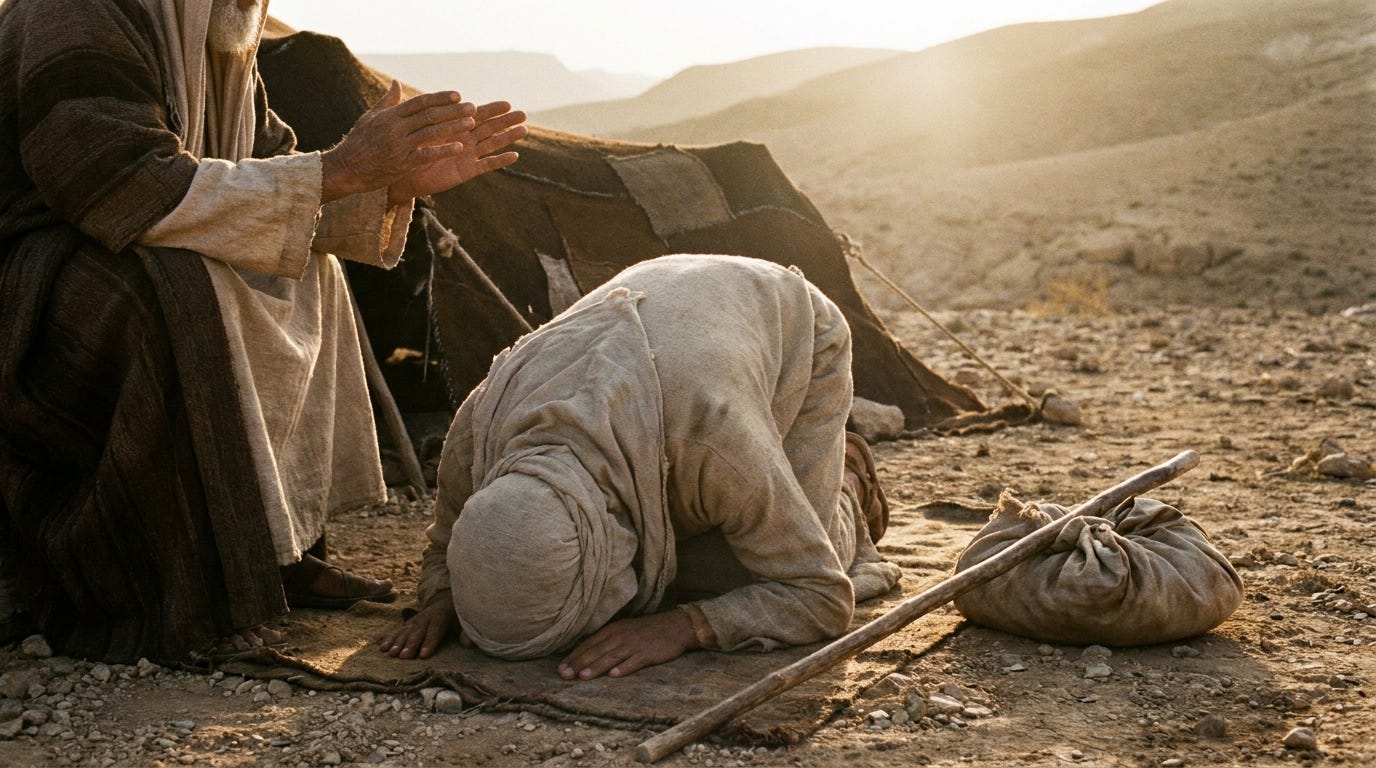
The last time Isaac blessed Jacob, he had to ask who was standing in front of him. This morning he calls Jacob by name and blesses him with nobody in disguise.
May God Almighty bless you
Isaac gave Jacob the blessing of Abraham: God Almighty's promise of many descendants and of the land. "May God Almighty bless you and make you fruitful and multiply you, so that you may become a company of peoples" (Genesis 28:3). "And may He give the blessing of Abraham to you and your descendants, so that you may possess the land where you dwell as a foreigner" (Genesis 28:4).
Every phrase of that blessing came from God first. When Abram was ninety-nine, the LORD appeared to him and said, "I am God Almighty. Walk before Me and be blameless" (Genesis 17:1), and then, "I will make you exceedingly fruitful" (Genesis 17:6). Abraham was dead, and what God had said to him was still the most valuable thing Isaac had to give. Now Isaac is old and blind, and he gives his son the promise God spoke to his father, almost word for word.
A chapter ago Isaac meant the blessing for the son he preferred. Here he makes it agree with what God said over the twins before they were born: "the older will serve the younger" (Genesis 25:23). In his old age Isaac has come to know God well enough to want His word, above anything of his own, in his son's hands.
Esau watched his father's face
Esau married Ishmael's daughter because he saw that his father disliked his Canaanite wives and hoped a bride from Abraham's family would please him. "And seeing that his father Isaac disapproved of the Canaanite women" (Genesis 28:8), "Esau went to Ishmael and married Mahalath, the sister of Nebaioth and daughter of Abraham's son Ishmael, in addition to the wives he already had" (Genesis 28:9).
Esau learns three things in these verses: Isaac has blessed Jacob, Isaac has forbidden him a Canaanite wife, and Jacob has obeyed and gone. He reads his father's mood with great care and answers it with a third wife. The blessing Isaac gave Jacob named God Almighty and the promise to Abraham, and Esau answers it by trying to please his father. Jacob is already on the road to Haran, and at a certain place on the way the God of his fathers will speak to him in the dark.
The blessing of Abraham reaches us
Genesis 28:1–9 points to Jesus because the blessing of Abraham that Isaac handed to Jacob is the blessing Christ gives to everyone who belongs to Him. Paul writes that Christ "redeemed us in order that the blessing promised to Abraham would come to the Gentiles in Christ Jesus, so that by faith we might receive the promise of the Spirit" (Galatians 3:14).
Isaac prayed that Jacob would become a company of peoples. Paul tells believers from every one of those peoples, "And if you belong to Christ, then you are Abraham's seed and heirs according to the promise" (Galatians 3:29). Jacob left his father's tent with a promise he would not see fulfilled in his lifetime, and God kept every word of it in His Son.
Hand on what He said
Isaac spent the strength of his old age passing on words God had spoken to his father. Years later God spoke the same blessing to Jacob in His own voice at Bethel: "I am God Almighty. Be fruitful and multiply" (Genesis 35:11). What God has said to you is meant to be handed on too. Write it down in the Doxa app with the date and His exact words, read it back until you know it, and give it whole to the people coming after you.
We are the people who remember what God has said, and we put His promises into our children's hands.
Which promise from God would you want the next generation to hear in His own words?
Keep exploring. If this raised a question, or brought back something God has said to you, take it further. Ask Doxa. It answers from Scripture, real stories, and your own journey, free in your browser. No signup to start.
Download Doxa, the app for recording, weighing and remembering prophetic encouragement.
Also please feel free to read the Doxa Deeper Dive below where we delve into the original language and historical context.
The Doxa Deeper Dive
Why Isaac Called Jacob's Family an Assembly (Genesis 28:1–9)
Originally published on the Doxa blog.
Isaac's blessing in verse 3 holds a name of God and a Hebrew noun for a gathered crowd. Both travel with Jacob for the rest of his life, and the people who first heard Genesis knew that noun from the day they gathered at Horeb.
God Almighty, three times over
God Almighty is El Shaddai, the name God gave Himself when He promised Abram a son at ninety-nine: "I am God Almighty. Walk before Me and be blameless" (Genesis 17:1). El (H410) is God, and Shaddai (H7706) is a title whose root scholars still argue over. Genesis teaches its meaning by where it puts it. Four of the five times the book uses El Shaddai, the words fruitful and multiply stand beside it: the name belongs to the God who makes one family into many.
An English reader meets the name in Isaac's prayer and moves on. Follow it through Jacob's life and it changes speaker twice. Isaac prays it over his son here. Decades later God says it Himself, at Bethel: "I am God Almighty. Be fruitful and multiply" (Genesis 35:11). And on his deathbed in Egypt, Jacob tells Joseph, "God Almighty appeared to me at Luz in the land of Canaan, and there He blessed me" (Genesis 48:3). A father's prayer became God's own word to Jacob, and Jacob held that word for the rest of his life and gave it back to his son.
A company of peoples
Company of peoples is qehal ammim, an assembly of peoples. Qahal (H6951) is a crowd called together for a purpose, and am (H5971) is a people. The same noun runs through all three El Shaddai blessings in Jacob's life. Isaac prays that Jacob may become "a company of peoples" (Genesis 28:3). God promises "a company of nations" (Genesis 35:11). Jacob, dying, remembers God saying "a multitude of peoples" (Genesis 48:4).
English readers meet three different phrases. A Hebrew listener heard qahal every time, and heard that Jacob's family was to become more than a large clan. Any herdsman could pray for many sons. Isaac prayed for an assembly, a people gathered to hear God.
The day of the assembly
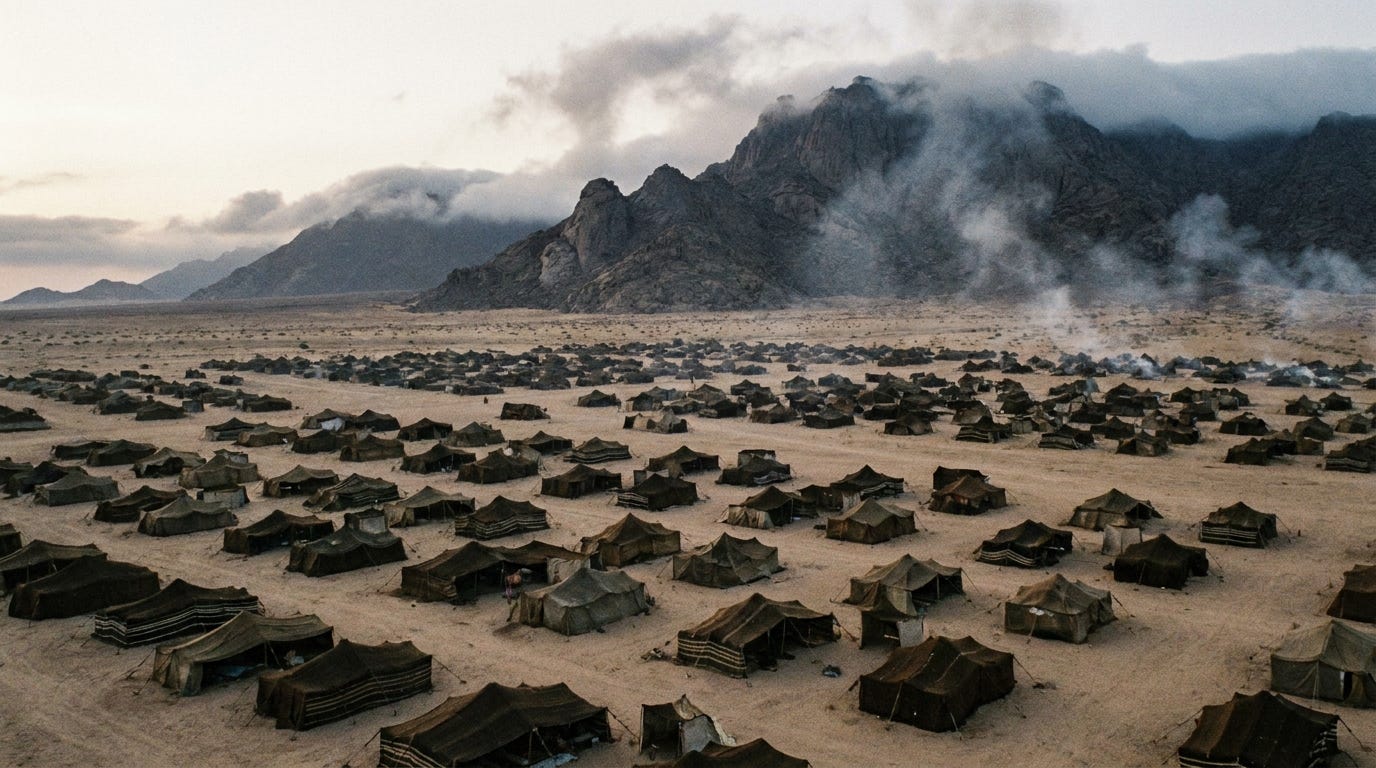
The day of the assembly was the day at Horeb when the whole people gathered at the mountain and heard God speak, and there Israel first became what Isaac prayed for. Moses called it "the day of the assembly" (Deuteronomy 9:10), the same noun. The LORD had told him, "Gather the people before Me to hear My words, so that they may learn to fear Me all the days they live on the earth, and that they may teach them to their children" (Deuteronomy 4:10). Gather there is qahal (H6950), the noun's own verb.
Forty days later God gave Moses the two tablets, "inscribed by the finger of God with the exact words that the LORD spoke to you out of the fire on the mountain on the day of the assembly" (Deuteronomy 9:10). The people who first heard Genesis read aloud were that assembly or its children. When they heard Isaac pray that Jacob would become a qahal of peoples, they heard their own beginning: a family that went down to Egypt and came out as a people gathered to hear God's voice and teach it to their sons and daughters. Isaac, handing on to Jacob what God had said to Abraham, is the same assembly at the size of one family.
A wife from your mother's family
Isaac forbade a Canaanite wife because a marriage joined two households and their gods, and the family that carried God's promise could not take on Canaan's gods. Abraham gave the same charge for Isaac, sending his servant to "my country and my kindred to take a wife for my son Isaac" (Genesis 24:4). In the ancient Near East a bride brought her family's loyalties into the household, and often its household gods with them. Genesis shows how real that was even among Abraham's relatives: "Rachel stole her father's household idols" (Genesis 31:19).
Israel heard Isaac's command as its own law. On the edge of Canaan, Moses told them, "Do not intermarry with them" (Deuteronomy 7:3), and gave the reason, "because they will turn your sons away from following Me to serve other gods" (Deuteronomy 7:4).
Esau heard the same command and measured it by his father's taste. Where the BSB says Isaac disapproved, the Hebrew of verse 8 says the daughters of Canaan were evil in the eyes, ayin (H5869), of Isaac his father. So Esau kept his wives and added one more to suit those eyes. Moses later warned Israel against living where "everyone does what seems right in his own eyes" (Deuteronomy 12:8). Esau let his father's eyes decide for him. The assembly at Horeb was gathered so that the voice of God would decide for them.
The congregation of the firstborn
Genesis 28:1–9 points to Jesus because the assembly Isaac prayed for is gathered in Him. When the Greek translators of the Hebrew Bible came to the day of the assembly at Horeb, they chose ekklesia (G1577), the word the New Testament uses for the church. Stephen uses it for Israel at the mountain: Moses "was in the assembly in the wilderness with the angel who spoke to him on Mount Sinai, and with our fathers. And he received living words to pass on to us" (Acts 7:38).
Hebrews takes the reader from Sinai to Zion and names who is gathered there: "the congregation of the firstborn, enrolled in heaven" (Hebrews 12:23). Seven verses earlier, the same chapter warns against being "godless like Esau, who for a single meal sold his birthright" (Hebrews 12:16). The man who traded away the firstborn's portion stands a few lines from an assembly where everyone in Christ is enrolled as firstborn.
To know God is to belong to the people He gathers to hear Him, and to pass on what He said. Moses received living words to pass on, Isaac passed on Abraham's blessing, and Jacob passed it to Joseph from his deathbed. Record what God has said to you in the Doxa app, with the date and His exact words, so that you can hand it on whole. El Shaddai is still gathering His assembly, and He still speaks to it.
Keep exploring. If this raised a question, or brought back something God has said to you, take it further. Ask Doxa. It answers from Scripture, real stories, and your own journey, free in your browser. No signup to start.
Questions and comments are welcome below.
Download Doxa, the app for recording, weighing and remembering prophetic encouragement.