

Originally published on the Doxa blog.
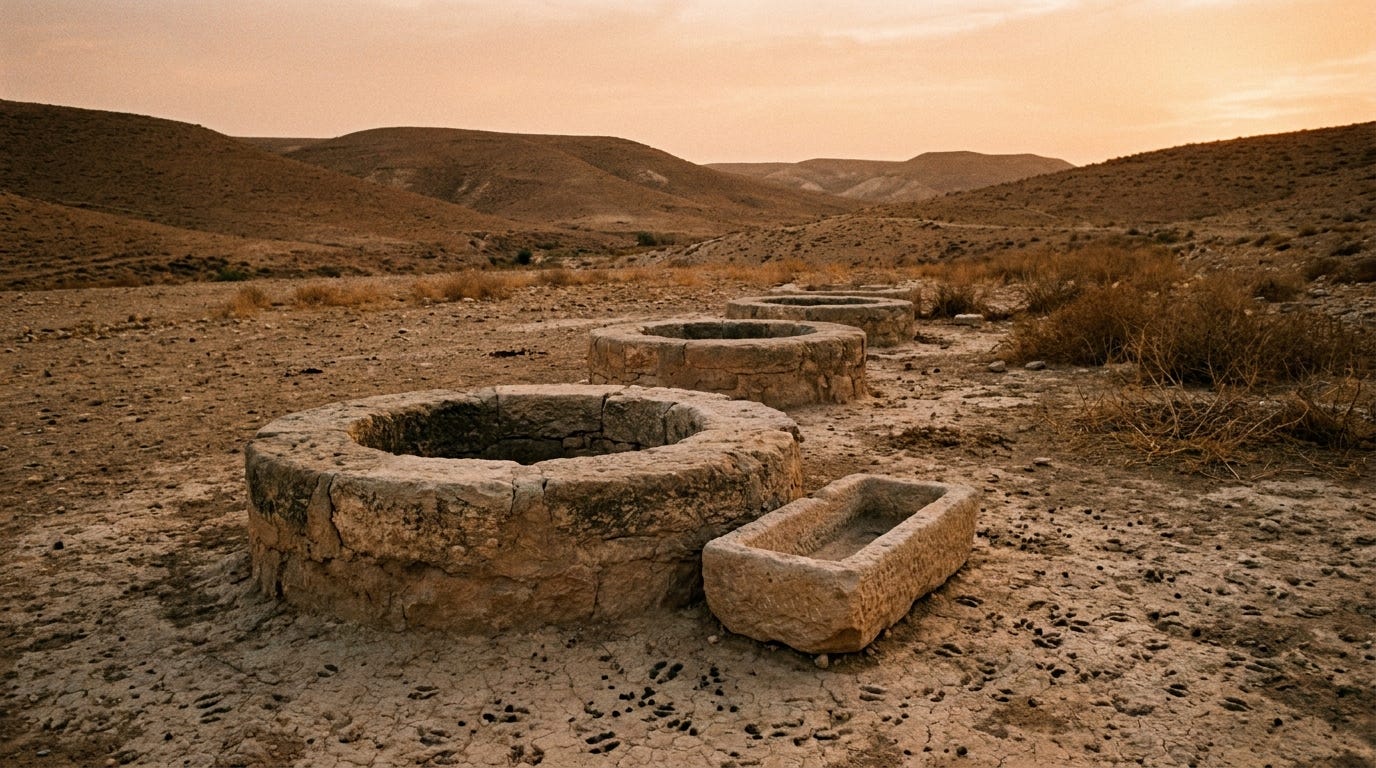
Three stone well mouths in a wide dry valley in the Negev at evening, a stone water trough beside the nearest, goat tracks in the dust, low hills beyond, no people, no text
Isaac planted grain in a land just out of famine. "Now Isaac sowed seed in the land, and that very year he reaped a hundredfold. And the LORD blessed him" (Genesis 26:12).
Why did the Philistines stop up Isaac's wells?
The Philistines stopped up the wells because they envied Isaac, and in the dry south a herdsman without water has to leave. "So the Philistines took dirt and stopped up all the wells that his father's servants had dug in the days of his father Abraham" (Genesis 26:15).
Abimelech sent him away, and Isaac camped in the Valley of Gerar among wells full of earth.
Why did Isaac give the wells his father's names?
Isaac gave the wells his father's names because each name kept a record of what God had done for Abraham, and Isaac chose to remember it. "Isaac reopened the wells that had been dug in the days of his father Abraham, which the Philistines had stopped up after Abraham died. And he gave these wells the same names his father had given them" (Genesis 26:18).
Abraham had argued for one of those wells and given Abimelech seven ewe lambs "as my witness that I dug this well" (Genesis 21:30). Isaac's servants cleared out the dirt, and the old names came back with the water.
What do the names Esek, Sitnah and Rehoboth mean?
Esek means quarrel, Sitnah means accusation and Rehoboth means room, each named for what happened there. The herdsmen of Gerar claimed the first new well, "So he named the well Esek, because they contended with him" (Genesis 26:20). They fought over the second as well, and he named it Sitnah.
Nobody quarrelled over the third. "He named it Rehoboth and said, 'At last the LORD has made room for us, and we will be fruitful in the land'" (Genesis 26:22). Two names keep the hard days honestly, and the third is a sentence of praise said aloud every time someone drew water.
What did God say to Isaac at Beersheba?
God told Isaac not to be afraid, because He was with him and would keep every promise He had made to Abraham. On his first night at Beersheba, "the LORD appeared to him and said, 'I am the God of your father Abraham. Do not be afraid, for I am with you'" (Genesis 26:24).
Decades earlier God had told Abram, "Do not be afraid, Abram. I am your shield, your very great reward" (Genesis 15:1). Isaac had kept his father's names, and now the God of those names spoke the same words to him. To know God is to know the One who has spoken before and speaks again. "So Isaac built an altar there and called on the name of the LORD" (Genesis 26:25).
How do Isaac's wells point to Jesus?
Isaac's wells point to Jesus because Jesus sat at a well handed down from Isaac's son Jacob and offered water nobody can stop up. "Since Jacob's well was there, Jesus, weary from His journey, sat down by the well" (John 4:6). He told the woman who came to draw, "But whoever drinks the water I give him will never thirst" (John 4:14).
A Philistine with a basket could fill Isaac's well in a night. The water Christ gives rises inside the one who drinks it and lasts to eternal life.
Name what God has done
When God makes room for you, give that day a name and write it down in the Doxa app, with the date and the words He spoke. When envy and quarrels come, read the names back: they are the record of the God who speaks and keeps His word, the God of Abraham and Isaac, who is with you now. We are the people who remember, and He is faithful for the whole journey.
What has God done for you that deserves a name you will say again?
Keep exploring. If this raised a question, or brought back something God has said to you, take it further. Ask Doxa. It answers from Scripture, real stories, and your own journey, free in your browser. No signup to start.
Download Doxa, the app for recording, weighing and remembering prophetic encouragement.
Also please feel free to read the Doxa Deeper Dive below where we delve into the original language and historical context.
The Doxa Deeper Dive
The Living Water Hidden in Isaac's Well
Originally published on the Doxa blog.
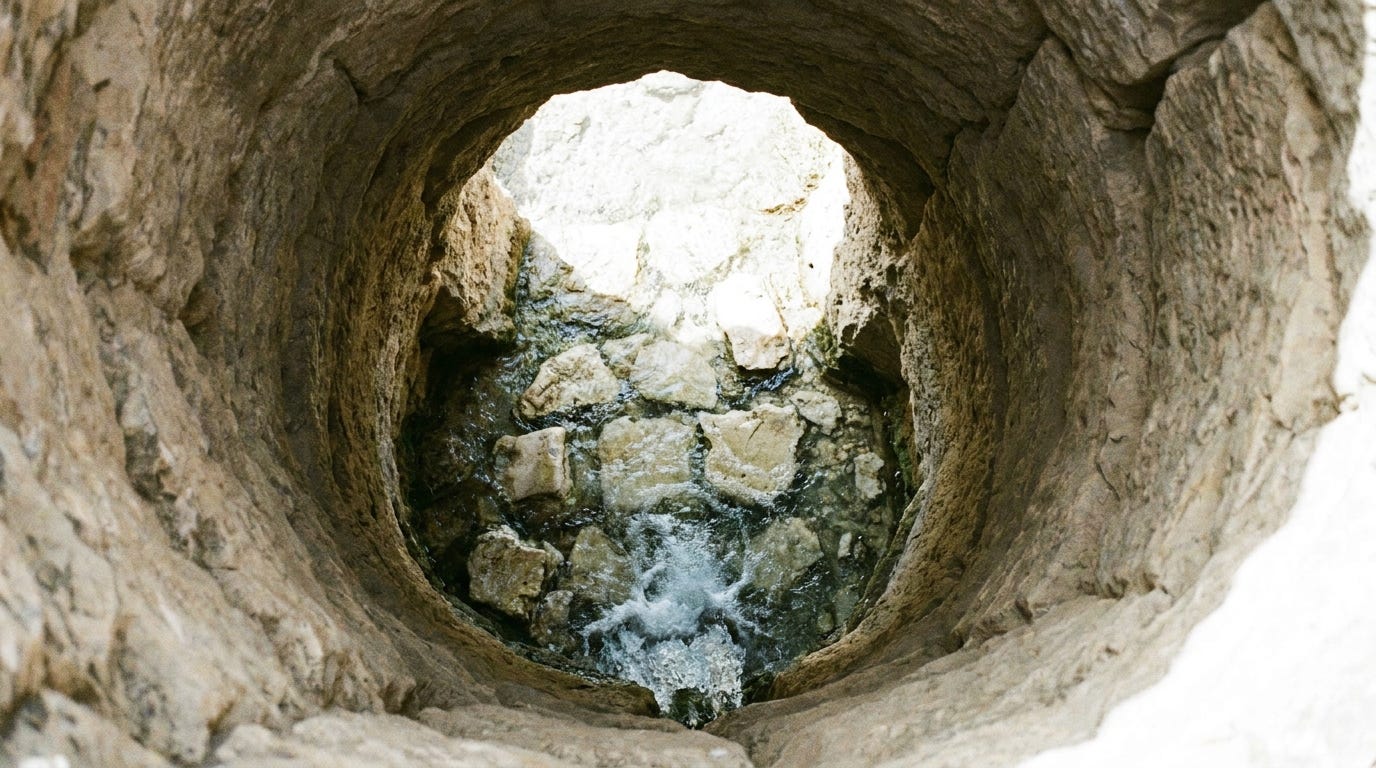
A clear spring welling up through pale stones at the bottom of a deep rock-cut well shaft, sunlight falling in from the round opening above, water moving, no people, no text
Three words in Genesis 26:19 carry a phrase that runs from Isaac's valley to Jeremiah and on to a well in Samaria.
What does fresh water mean in Genesis 26:19?
Fresh water in Genesis 26:19 is mayim chayyim in Hebrew, which means living water. Isaac's servants "dug in the valley and found a well of fresh water there" (Genesis 26:19): a be'er (H875) of mayim (H4325) chay (H2416), the ordinary Hebrew word for alive. A herdsman meant groundwater that flows on its own from a source, set against rain caught in a plastered cistern, a bor (H953), which goes stale and can crack.
Follow the phrase out of the valley. Jeremiah heard God name Himself with it: "They have forsaken Me, the fountain of living water" (Jeremiah 2:13), and in the same breath God described His people cutting tanks of their own in the rock that leak. That verse applies the well-digger's distinction to the heart: God is the source that flows, and His people preferred tanks they had cut and filled themselves.
Then Jesus sat by Jacob's well and used the same phrase in Greek, hudor (G5204) zao (G2198): "He would have given you living water" (John 4:10). The woman heard the herdsman's phrase and answered in herdsman's terms: "You have nothing to draw with and the well is deep" (John 4:11). An English reader meets fresh water in Genesis and living water in John as two different phrases. A Hebrew reader heard one phrase from Isaac's valley to Jeremiah's lament, and Jesus stood at the end of that line and offered Himself as the source.
Isaac's servants found that living water and then had to fight for it, and Isaac named the next two wells for the fighting.
Why does the name Sitnah sound like Satan?
Sitnah sounds like Satan because both come from the same Hebrew root, which means to accuse or to oppose. The first disputed well, Esek, takes its name from asaq (H6229), to quarrel, a verb found only here. The second goes further. Sitnah (H7856) is built on the verb satan (H7853), and the noun satan (H7854) is the accuser himself. Sitnah appears once more in the Hebrew Bible, as a legal charge: "an accusation was lodged against the people of Judah and Jerusalem" (Ezra 4:6).
The root shows its meaning best in Zechariah's vision of the high priest, "with Satan standing at his right hand to accuse him" (Zechariah 3:1). The Hebrew there has the satan standing to satan him. Isaac named the second well Accusation, left it to the men making the charge, and dug again. Paul answers every accuser with a question and its reply: "Who will bring any charge against God's elect? It is God who justifies" (Romans 8:33).
The next well Isaac dug, nobody claimed, and its name answers the first two.
What does Rehoboth mean in Hebrew?
Rehoboth means wide places, and its root is the word the Psalms use for what God does for a person hemmed in by trouble. The name Rechoboth (H7344) comes from rachab (H7337), to be wide, and Isaac explained it with the verb itself: "At last the LORD has made room for us" (Genesis 26:22).
English translations of the Psalms render that root in other words, and the picture goes missing. "You have relieved my distress" (Psalms 4:1) is, in Hebrew, in the tight place You made room for me. "He answered and set me free" (Psalms 118:5) is He answered me in the wide place, with merchab (H4800) from the same root, and the same noun stands behind "He brought me out into the open" (Psalms 18:19). When David prayed from distress, he prayed Isaac's well name.
Israel sang those Psalms in a land full of wells, and they had first heard Isaac's story as the heirs of that land.
How did Israel first hear the story of Isaac's wells?
Israel first heard it as a people about to inherit wells they had never dug, warned that full wells would tempt them to forget God. Moses told them the LORD would give them a land "with wells that you did not dig" (Deuteronomy 6:11), and then gave the command that came with it: "be careful not to forget the LORD who brought you out of the land of Egypt" (Deuteronomy 6:12).
They also knew what a stopped well meant. In the Negev the rain falls in a short winter and the dry months fill most of the year, so whoever held the water held the grazing around it. The Philistines' verb is satam (H5640), to stop up, and Israel's own history used it as a war order against Moab: "stop up every spring, and ruin every good field with stones" (2 Kings 3:19). Dirt in a well shut a family off its land. The same land where enemies had choked their father's wells was the land God would hand them full.
Hearing Genesis read, they met their father Isaac doing their task by hand: digging out the wells and saying the old names over them. Beersheba was a name they used every day, since the land ran "from Dan to Beersheba" (Judges 20:1), so every Israelite who named the southern border named the place where Isaac built an altar.
Call on the name at the well
Genesis ties Isaac's worship to his father's with a single phrase. At Beersheba Abraham "called upon the name of the LORD, the Eternal God" (Genesis 21:33), and at the same place Isaac "called on the name of the LORD" (Genesis 26:25): qara (H7121) with shem (H8034). Isaac called on the same name, at the same well-field, that his father had called on, and the God who had spoken to Abraham had just spoken to his son.
We are the people who remember what God has said and done, and we call on His name over it again. When God makes room for you, keep the day and His words in the Doxa app. When the accusers come, read back what you recorded, and God's acts are still there in His own words. The God of Abraham and Isaac is the fountain of living water, and Jesus still says, "If anyone is thirsty, let him come to Me and drink" (John 7:37).
Keep exploring. If this raised a question, or brought back something God has said to you, take it further. Ask Doxa. It answers from Scripture, real stories, and your own journey, free in your browser. No signup to start.
Questions and comments are welcome below.
Download Doxa, the app for recording, weighing and remembering prophetic encouragement.