

Originally published on the Doxa blog.
On a mountain in Gilead, two men who did not trust each other asked God to watch them, and the God they named was the God who had spoken to both of them.
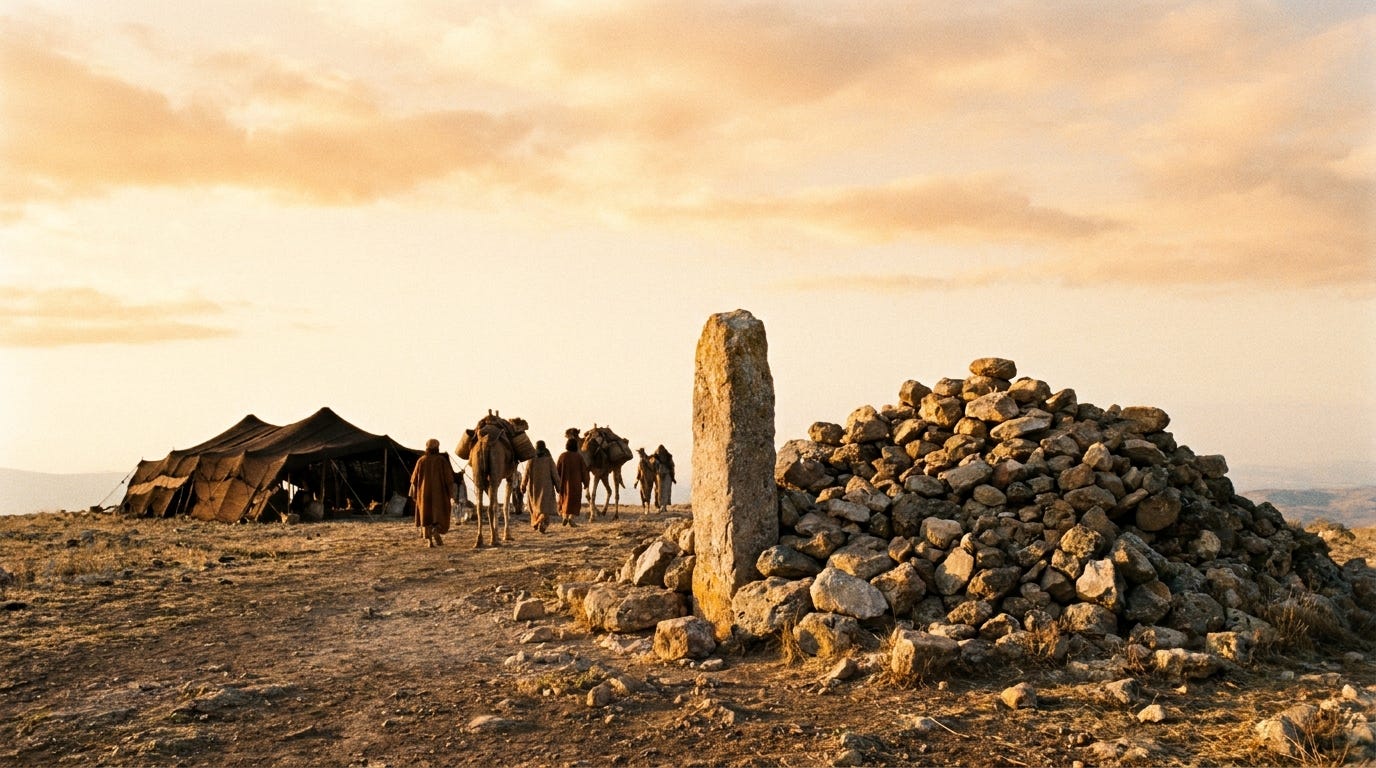
A heap of stones in Gilead
Jacob and Laban made a covenant of peace in Gilead, marked it with a stone pillar and a heap of stones, and named God as the witness to it. Laban began by claiming it all, "Everything you see is mine!" (Genesis 31:43), and then he gave way: "Come now, let us make a covenant, you and I, and let it serve as a witness between you and me" (Genesis 31:44).
"So Jacob picked out a stone and set it up as a pillar" (Genesis 31:45). He had done that once before, at Bethel, on the morning after God spoke to him in a dream (Genesis 28:18). His relatives gathered stones into a mound and ate beside it. Laban gave the heap an Aramaic name, Jegar-sahadutha. Jacob gave it a Hebrew one, Galeed. Both mean the heap of witness.
The LORD keep watch
Mizpah means a watchtower. Laban named the place for his prayer that the LORD would keep watch between him and Jacob while they were apart. "May the LORD keep watch between you and me when we are absent from each other" (Genesis 31:49). People engrave that line on matching pendants today, for friends who live far apart. Laban said it to a son-in-law he had chased for seven days, and the next thing out of his mouth was a warning: "If you mistreat my daughters or take other wives, although no one is with us, remember that God is a witness between you and me" (Genesis 31:50).
Laban knew something true: God sees what happens when no one else is there. That God had spoken into Laban's own sleep the night before. But when Laban named the witness for the oath, he set two names side by side: "May the God of Abraham and the God of Nahor, the God of their father, judge between us" (Genesis 31:53).
By the Fear of his father Isaac
Jacob swore by the Fear of his father Isaac because that was the God he knew, the God who had spoken to his family and to him. "So Jacob swore by the Fear of his father Isaac" (Genesis 31:53), and he named that God alone. Twenty years earlier at Bethel, God had told him, "I am with you, and I will watch over you wherever you go" (Genesis 28:15). Jacob had carried that promise through twenty years of heat and frost and watched God keep it.
Then Jacob offered a sacrifice on the mountain and shared a meal with his relatives (Genesis 31:54). In the morning Laban kissed his grandchildren and went home, and the stones stayed where they were.
A stone that heard every word
The heap at Galeed points to Jesus, the faithful witness in whom every word God has spoken is kept. Centuries later, at Shechem, Joshua set up a large stone and told Israel, "It will be a witness against us, for it has heard all the words the LORD has spoken to us" (Joshua 24:27). Jesus called Himself "the Amen, the faithful and true Witness" (Revelation 3:14), and Paul wrote, "For all the promises of God are “Yes” in Christ" (2 Corinthians 1:20). Every promise God made to Jacob at Bethel, and every one He has made to us, stands kept in Him.
Set up a stone of your own
We are the people who remember what God has said. Jacob set up stones where God had spoken to him and where God had kept His promise. Write down what God has said to you, and the day you saw Him keep it, in the Doxa app, and read it back when you are far from home. Knowing God grows this way, promise by kept promise, and the One who watched over Jacob wherever he went knows you and watches over you.
Where has God kept a promise to you that you have never marked?
Keep exploring. If this raised a question, or brought back something God has said to you, take it further. Ask Doxa. It answers from Scripture, real stories, and your own journey, free in your browser. No signup to start.
Download Doxa, the app for recording, weighing and remembering prophetic encouragement.
Also please feel free to read the Doxa Deeper Dive below where we delve into the original language and historical context.
The Doxa Deeper Dive
Laban's Word for Witness Came Back in Job's Prayer (Genesis 31:43–55)
Originally published on the Doxa blog.
Laban's name for the heap in Gilead is the first Aramaic in the Bible, and his word for witness turned up again in Job's prayer.
Two names for one heap
Jegar-sahadutha and Galeed both mean heap of witness: Jegar-sahadutha (H3026) is Laban's Aramaic, and Galeed (H1567) is Jacob's Hebrew. "Laban called it Jegar-sahadutha, and Jacob called it Galeed" (Genesis 31:47). Two men who had shared a household for twenty years named one pile of rocks in two languages, and each kept his own.
Laban's word for witness, sahadutha, comes from the root of sahed (H7717), and the Hebrew Bible uses that word once more, in the mouth of a man who had lost everything. Job said, "Even now my witness is in heaven, and my advocate is on high" (Job 16:19). An English reader sees two unrelated words. A Hebrew reader heard the word Laban had used to keep watch over a son-in-law come back as Job's hope that someone in heaven saw him truly and would speak for him.
Jacob's name joins gal (H1530), a heap, to ed (H5707), a witness. Gal-ed sounds like Gil'ad, Gilead, and the name of the whole hill country east of the Jordan recalled this covenant. Ed is the word of Israel's courts. "A matter must be established by the testimony of two or three witnesses" (Deuteronomy 19:15), and Laban gave the treaty two: "This mound is a witness, and this pillar is a witness" (Genesis 31:52). Later God gave the same word to His people: "'You are My witnesses,' declares the LORD" (Isaiah 43:10). The heap in Gilead stood for one promise between two men. God's people carry what He has said and done to the whole world.
A watchtower named for God
Mizpah comes from tsaphah (H6822), to keep watch from a high place, and the prophets used that verb for watching to hear what God would say. Laban said, "May the LORD keep watch between you and me" (Genesis 31:49), and the place became Mitspah (H4709), the watchpost. He meant God as a guard on the border between two wary men.
Habakkuk took the same verb up a tower: "I will stand at my guard post and station myself on the ramparts. I will watch to see what He will say to me" (Habakkuk 2:1). I will watch is tsaphah. God told Ezekiel, "I have made you a watchman for the house of Israel. Whenever you hear a word from My mouth, give them a warning from Me" (Ezekiel 3:17), and watchman is the same root again. The word that named Laban's border post became the word for a person on the wall, listening for God's voice.
The God of Nahor
Laban named the God of Nahor because treaties in his world called on the gods of both parties as witnesses, and he wanted his family's god beside Jacob's. "May the God of Abraham and the God of Nahor, the God of their father, judge between us" (Genesis 31:53). Treaties between kings in the ancient Near East closed with long lists of the gods of each side, called to watch the oath, and sometimes mountains and rivers were called as well. A boundary heap with a shared meal beside it was how such a covenant was cut.
In Hebrew the verb judge, from shaphat (H8199), is plural in this verse, yishpetu, may they judge, as if two gods would sit on the bench together. Jacob answered with one name: "So Jacob swore by the Fear of his father Isaac" (Genesis 31:53).
A stone that heard
Israel in the land heard the story of Galeed as a story about their own family's gods, because at Shechem Joshua had told them that their fathers, Nahor among them, served other gods. Joshua said, "Long ago your fathers, including Terah the father of Abraham and Nahor, lived beyond the Euphrates and worshiped other gods" (Joshua 24:2), and then, "cast aside the gods your fathers served beyond the Euphrates and in Egypt, and serve the LORD" (Joshua 24:14). An Israelite who heard Laban pray to "the God of Nahor" heard the very gods Joshua told them to throw away.
Joshua then did what Jacob did in Gilead. "Joshua recorded these things in the Book of the Law of God. Then he took a large stone and set it up there" (Joshua 24:26), and he told the people, "You see this stone. It will be a witness against us, for it has heard all the words the LORD has spoken to us" (Joshua 24:27). Israel knew a witness stone as a record of what God had said.
A witness in heaven
The witness in heaven that Job longed for, named with the same word Laban gave a heap of stones, has a name. John wrote to the church, "we have an advocate before the Father" (1 John 2:1), and named Him: Jesus Christ, the Righteous One. The writer of Hebrews said of Him, "He always lives to intercede for them" (Hebrews 7:25). Laban's heap could only stand on a hillside and be looked at. The Witness in heaven knows each one He speaks for.
Knowing Him is the reason we keep watch and keep the record. Habakkuk stood on the ramparts to hear, and the LORD answered him, "Write down this vision and clearly inscribe it on tablets, so that a herald may run with it" (Habakkuk 2:2). When God speaks to you through Scripture, or through an encouragement someone shares, write it down in the Doxa app with the date and read it back while you wait. Your Witness is in heaven, He knows your name, and He speaks for you before the Father.
Keep exploring. If this raised a question, or brought back something God has said to you, take it further. Ask Doxa. It answers from Scripture, real stories, and your own journey, free in your browser. No signup to start.
Questions and comments are welcome below.
Download Doxa, the app for recording, weighing and remembering prophetic encouragement.