

Originally published on the Doxa blog.
God had told Jacob twenty years earlier, "I will bring you back to this land" (Genesis 28:15), and on the morning after Peniel Jacob limped out to meet the brother who had sworn to kill him. God kept that promise on an open road in front of four hundred men. Jacob had held it for twenty years, and those of us whose hearts burn for God, and who want them still burning decades from now, are the people who hold on to what He said the way Jacob did.
Esau ran to meet him
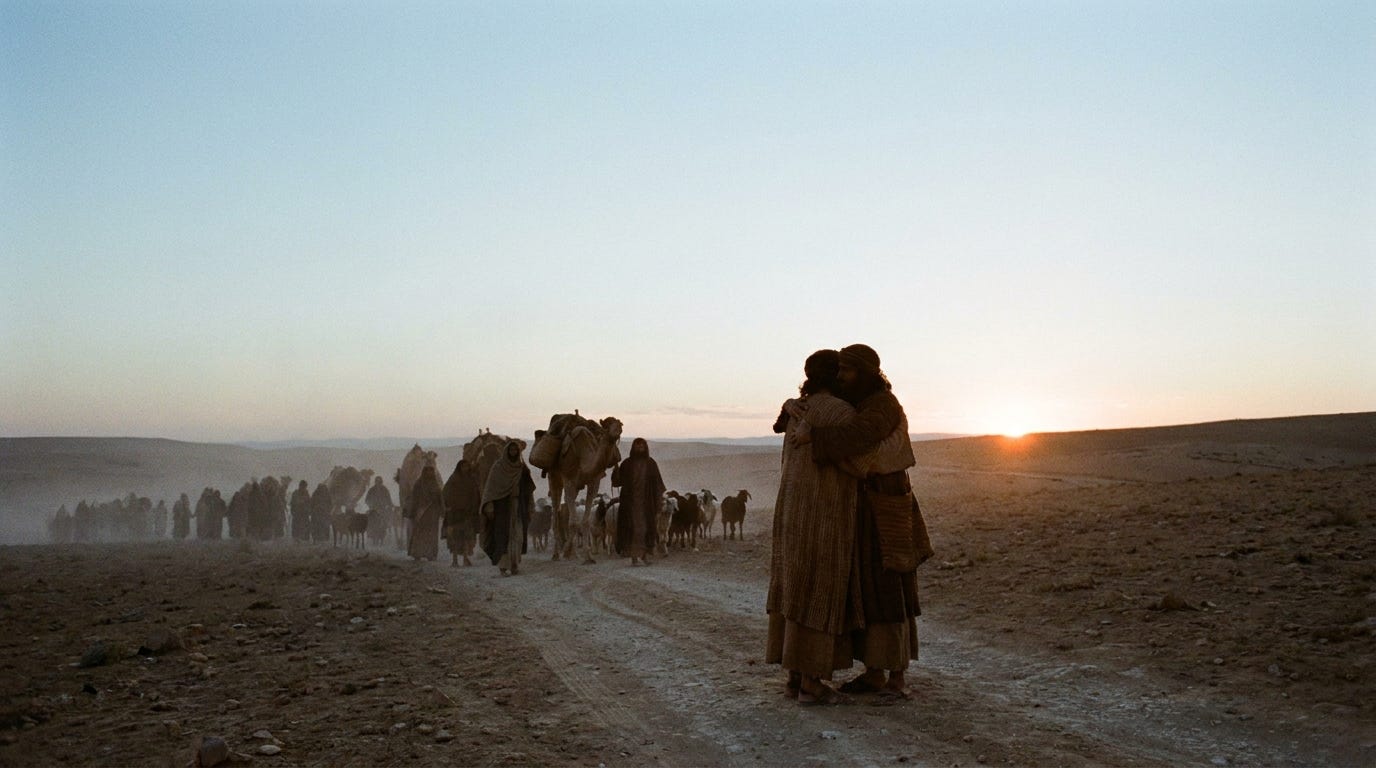
When Jacob met Esau, his brother welcomed him and the two of them wept together. Jacob had looked up and seen Esau "coming toward him with four hundred men" (Genesis 33:1). He put the maidservants and their children in front, Leah and her children next, and Rachel and Joseph at the rear, and then he walked out ahead of all of them. "Esau, however, ran to him and embraced him, threw his arms around his neck, and kissed him. And they both wept" (Genesis 33:4).
Twenty years before, Esau had said in his heart, "then I will kill my brother Jacob" (Genesis 27:41). At the Jabbok Jacob had prayed, "Please deliver me from the hand of my brother Esau" (Genesis 32:11). God answered that prayer with his brother's arms around his neck.
Seven times to the ground
Jacob bowed seven times because he came to Esau the way a servant comes to his lord, asking for peace. "But Jacob himself went on ahead and bowed to the ground seven times as he approached his brother" (Genesis 33:3). Through the whole meeting he called Esau his lord and called himself his servant.
The blessing Jacob had taken from his blind father said, "may the sons of your mother bow down to you" (Genesis 27:29). The blessing said his mother's sons would bow to him, and on this road Jacob bowed to his mother's son. He had grabbed that blessing by deceit, and that morning he walked out alone in front of his wives and children, trusting the God who had promised to bring him back.
Like seeing the face of God
Jacob meant that the God who met him at Peniel had met him again in his brother's welcome. The night before he had said, "I have seen God face to face, and yet my life was spared" (Genesis 32:30). In the morning he told Esau, "I have seen your face, and it is like seeing the face of God, since you have received me favorably" (Genesis 33:10).
Jacob also told his brother where everything had come from. When Esau asked about the women and children, Jacob answered, "These are the children God has graciously given your servant" (Genesis 33:5). Pressing his gift on Esau, he said, "God has been gracious to me and I have all I need" (Genesis 33:11). Twice in one conversation he named what God had done, telling his brother what God had given him.
The father who ran
Esau's welcome points to Jesus, because Jesus told of a father who ran to a son who had wronged him. In the parable, "while he was still in the distance, his father saw him and was filled with compassion. He ran to his son, embraced him, and kissed him" (Luke 15:20). Jesus told it with the same running, embrace and kiss that Genesis 33:4 records. Jacob came ready to pay for his past and was embraced, and in Christ the Father runs to meet everyone who comes home to Him.
God has been gracious to me
We are the people who remember what God has done. Jacob carried God's promise for twenty years, held on to it all night at the Jabbok, and on the road he said it out loud to his brother. When God answers what you have prayed, write down what He did and the date in the Doxa app, beside the promise you were holding, so you can read the two together for decades and keep your heart burning for Him. This is why we keep what He says, to know God and be known by Him, the God who goes ahead of us on every road home.
What has God graciously given you that you could name out loud to someone today?
Keep exploring. If this raised a question, or brought back something God has said to you, take it further. Ask Doxa. It answers from Scripture, real stories, and your own journey, free in your browser. No signup to start.
Download Doxa, the app for recording, weighing and remembering prophetic encouragement.
Also please feel free to read the Doxa Deeper Dive below where we delve into the original language and historical context.
The Doxa Deeper Dive
Jacob Gave Back the Blessing He Stole (Genesis 33:1–11)
Originally published on the Doxa blog.
Twenty years after Jacob stole his brother's blessing, he stood on the road from Peniel and handed it back, in the same Hebrew words Esau once used for the theft. He could give it away because of what he said in the same breath, "God has been gracious to me and I have all I need" (Genesis 33:11). Those of us whose hearts burn for God, and who want to keep burning for decades, can watch here what His grace does to a hand that used to grasp.
Please take my blessing
In Genesis 33:11 Jacob asked Esau to take his berakah (H1293), his blessing, the same word for the blessing he had taken from Esau in Genesis 27. English Bibles rightly translate it as gift here, because Jacob meant the flocks and herds he had sent ahead. A Hebrew listener heard more. On the day of the theft Esau cried, "He took my birthright, and now he has taken my blessing" (Genesis 27:36), laqach birkati, he has taken my blessing. On the road Jacob said, "Please accept my gift that was brought to you" (Genesis 33:11), qach-na et birkati, please take my blessing. The verb is laqach (H3947) both times, and the noun is the same.
One verse earlier Jacob had called the present a minchah (H4503): "receive this gift from my hand" (Genesis 33:10). When Esau refused, Jacob changed the word. He asked his brother to take his blessing, and "Jacob pressed him until he accepted" (Genesis 33:11). The man who had once grabbed a blessing now pressed one into his brother's hands.
The night before, the man at the Jabbok had blessed him. Jacob had the blessing of God, so he could give away the one he had stolen.
Tribute for a lord
The minchah Jacob sent was tribute, the present a lesser ruler brought to a greater one to ask for peace, and he bowed seven times for the same reason. When Israel served the king of Moab, they "sent him with tribute to Eglon king of Moab" (Judges 3:15), and that tribute is minchah too. The same word later named the grain offering brought to God: "When anyone brings a grain offering to the LORD" (Leviticus 2:1). Abel's and Cain's offerings in Genesis 4 carry the same name.
The bowing had a shape the first hearers knew. Letters from city rulers in Canaan to Pharaoh, written in the 1300s BC and found at Amarna in Egypt, open again and again with a vassal saying he falls at the feet of the king, his lord, seven times and seven times. "But Jacob himself went on ahead and bowed to the ground seven times as he approached his brother" (Genesis 33:3). The word for bowed is shachah (H7812), the word Scripture later uses for worship. Jacob came to his brother with the offering word and the worship word, the gift and the bow a person brings before God, and in verse 10 he said Esau's face was "like seeing the face of God" (Genesis 33:10). He came to Esau as a servant comes to a king. Esau answered as a brother: "I already have plenty, my brother" (Genesis 33:9).
Favor from a brother, grace from God
In Genesis 33 favor is what Jacob asked of Esau, and grace is what he said God had already given him; the Hebrew uses one root for both. The noun is chen (H2580), favor, the kind welcome of someone with the power to refuse you. Jacob's messengers had told Esau he came "so that I may find favor in your sight" (Genesis 32:5), and on the road he asked for it three more times. The verb from the same root is chanan (H2603), to be gracious, and in this chapter Jacob used it only with God as the subject: "the children God has graciously given your servant" (Genesis 33:5) and "God has been gracious to me" (Genesis 33:11).
The word for face carries the rest of the picture, and English hides it. Before the river Jacob had planned, "I will appease Esau with the gift that is going before me. After that I can face him, and perhaps he will accept me" (Genesis 32:20). The Hebrew says akhapperah fanav, I will cover his face, with kaphar (H3722), the covering verb Genesis 6:14 used for the pitch on the ark, and then panim (H6440), face, three more times: before my face, I will see his face, perhaps he will lift up my face. Jacob meant to cover his brother's anger with a gift, the way a guilty man pays to make peace. On the road the face he had planned to cover ran toward him, and Jacob found grace in it before Esau had accepted a single animal.
Do not despise an Edomite
Israel was commanded to treat Edom as a brother, even after Edom refused them passage, and Genesis 33 is where the first readers heard why. Esau "settled in the area of Mount Seir" (Genesis 36:8), and his children became Edom. Centuries later Moses sent messengers from Kadesh: "This is what your brother Israel says" (Numbers 20:14). Edom answered, "You may not travel through our land, or we will come out and confront you with the sword" (Numbers 20:18), and "Israel turned away from them" (Numbers 20:21).
Those were the people who first heard Genesis read to them, a nation that had just been turned back at Edom's border. Moses then gave them this command: "Do not despise an Edomite, for he is your brother" (Deuteronomy 23:7). When they heard of their father Jacob bowing in the dust and of Esau running to kiss him, they heard where that command came from. The brothers had wept on each other's necks, and their children were to remember it, even when the brotherhood was hard to keep.
Known by the God who gives
To know God in this chapter is to know Him as the One who gives, and that knowledge opened Jacob's hand. In Genesis 33 the grace word chanan had only one subject, God, and everything Jacob said to Esau rested on it. Once he could say God had been gracious to him, he no longer needed the blessing he had taken, so he pressed it on the brother he had taken it from. Jacob knew God, and God knew him by his new name, Israel.
We are the people who remember what God has given. Before you go to meet someone you have wronged, write down in the Doxa app the grace God has already shown you, with the date, and carry it with you the way Jacob carried his answer to Esau. Read it back in ten years and in thirty, and keep your heart burning for the God who was gracious to Jacob on the road from Peniel and is gracious to His people still.
Keep exploring. If this raised a question, or brought back something God has said to you, take it further. Ask Doxa. It answers from Scripture, real stories, and your own journey, free in your browser. No signup to start.
Questions and comments are welcome below.
Download Doxa, the app for recording, weighing and remembering prophetic encouragement.
In any man there are both Jacob and Eisav. Spirit and flesh.
https://substack.com/@vladislav1968?utm_source=share&utm_medium=android&r=9cy509