

Originally published on the Doxa blog.
Then God said to Jacob, "Arise, go up to Bethel, and settle there. Build an altar there to the God who appeared to you when you fled from your brother Esau" (Genesis 35:1). The swords of Shechem were barely back in their sheaths, and God spoke first. He sent Jacob back to the place where He had first spoken to him. Knowing God means going back to what He has said, and in Genesis 35:1–8 a whole household went back with Jacob.
Back to the place of the promise
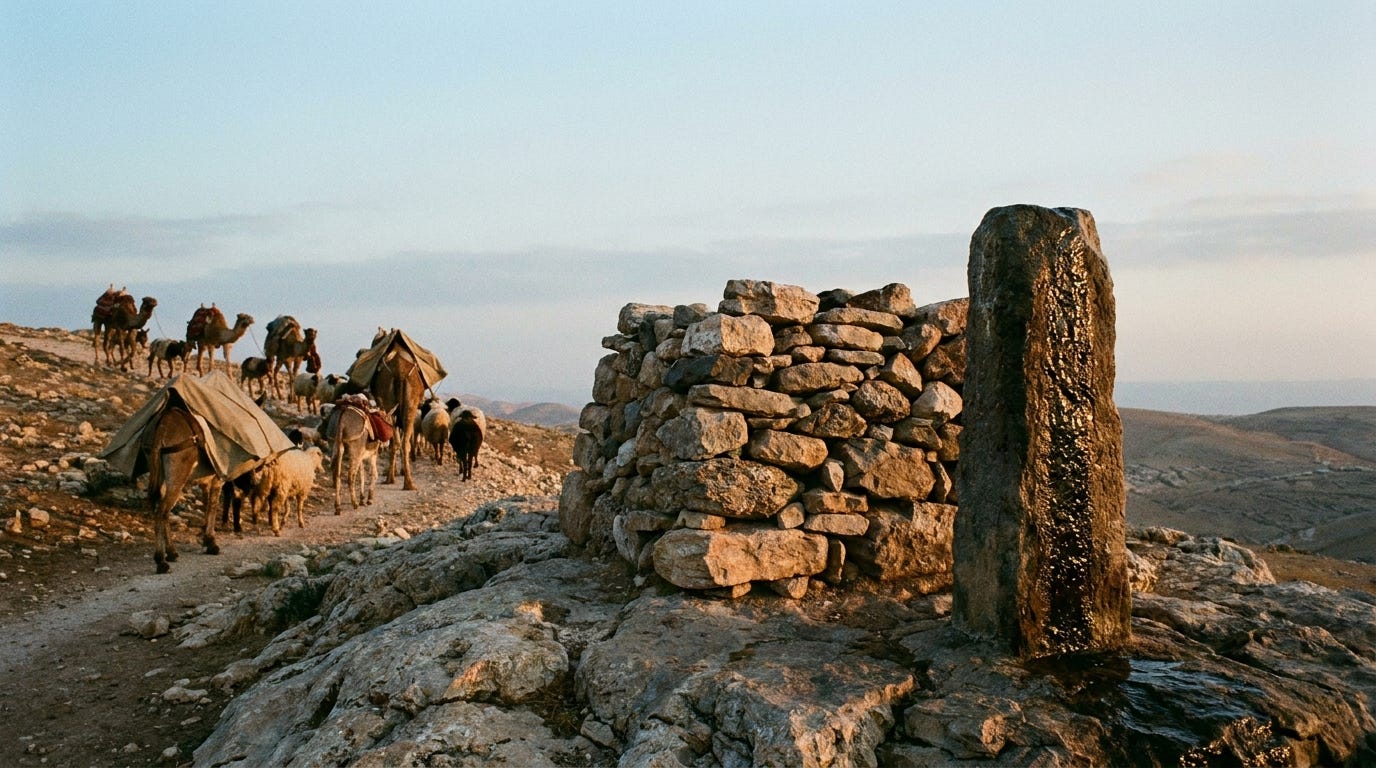
God sent Jacob to Bethel because Bethel was where He had met Jacob and made him a promise. Years earlier Jacob had slept there on a stone, running from Esau, and the LORD had said, "Look, I am with you, and I will watch over you wherever you go, and I will bring you back to this land" (Genesis 28:15). Jacob answered with a vow: "this stone I have set up as a pillar will be God's house" (Genesis 28:22).
God had brought Jacob back to the land, and Jacob had settled at Shechem. God remembered the stone and the vow, and He called Jacob home to them.
Idols buried under an oak
Jacob wanted no idol near the altar of the living God, so before the climb to Bethel he had his household hand theirs over. He said, "Get rid of the foreign gods that are among you. Purify yourselves and change your garments" (Genesis 35:2). Rachel had stolen her father's household idols (Genesis 31:19), and the plunder of Shechem was still in the tents.
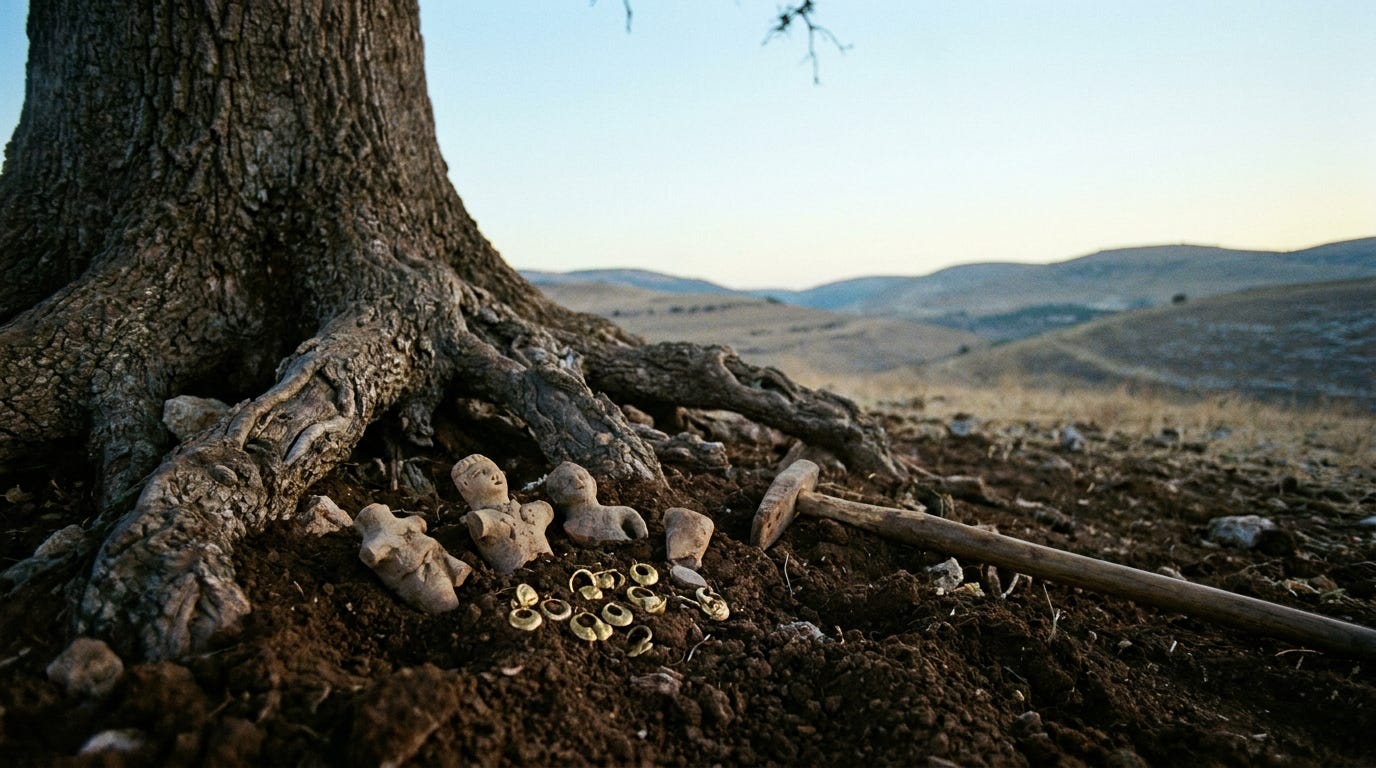
They handed over their gods and their earrings, "and Jacob buried them under the oak near Shechem" (Genesis 35:4). As they set out, "a terror from God fell over the surrounding cities, so that they did not pursue Jacob's sons" (Genesis 35:5). The family left its idols in the ground and walked to Bethel under God's own protection.
He has been with me wherever I have gone
Jacob meant that on the night he fled from Esau, alone with only his staff, God met him at Bethel and spoke to him, and then kept every word He said. He told his household, "I will build an altar there to God, who answered me in my day of distress. He has been with me wherever I have gone" (Genesis 35:3).
At Bethel God had said, "I will watch over you wherever you go" (Genesis 28:15). More than twenty years later Jacob stood in front of his wives, his children and his servants and told them, "He has been with me wherever I have gone" (Genesis 35:3). He had heard the promise in a dream, carried it through Laban's house and the night at the Jabbok, and now he spoke it back as testimony. Jacob had held that promise for more than twenty years, and he found every word of it true.
The God of Bethel
El-bethel means God of Bethel, and with that name Jacob honoured the God who met him there more than the place itself. "There Jacob built an altar, and he called that place El-bethel, because it was there that God had revealed Himself to Jacob as he fled from his brother" (Genesis 35:7).
The family wept at Bethel too. "Now Deborah, Rebekah's nurse, died and was buried under the oak below Bethel" (Genesis 35:8), and Jacob named the tree Allon-bacuth, which means oak of weeping. The altar and the grave stood a short walk apart, and the God who had answered Jacob in distress was with him at both.
Heaven opened over the Son of Man
Genesis 35:1–8 points to Jesus, the One in whom heaven opens over the place where God meets His people. At Bethel Jacob had seen a ladder and God's angels going up and down on it. Jesus told Nathanael, "you will all see heaven open and the angels of God ascending and descending on the Son of Man" (John 1:51).
Jacob's household buried their gods to go up to Bethel. Paul thanked God for believers who "turned to God from idols to serve the living and true God" (1 Thessalonians 1:9). Jesus is where heaven stands open now, and through Him anyone who turns from idols can come to God.
Go back to what He said
We are the people who remember what God has said. Go back today to something God has said to you, the verse that held you or the encouragement you weighed with others, and read it again. Then write down where He has kept it, the date and what happened, in the Doxa app, so that one day you can say with Jacob, "He has been with me wherever I have gone" (Genesis 35:3).
The God who met Jacob on the run called him back to the same stone more than twenty years later, and He had kept every word He spoke there.
Where has God already been with you, and what did He say to you there?
Keep exploring. If this raised a question, or brought back something God has said to you, take it further. Ask Doxa. It answers from Scripture, real stories, and your own journey, free in your browser. No signup to start.
Download Doxa, the app for recording, weighing and remembering prophetic encouragement.
Also please feel free to read the Doxa Deeper Dive below where we delve into the original language and historical context.
The Doxa Deeper Dive
Why Jacob Buried Earrings Under the Oak at Shechem (Genesis 35:1–8)
Originally published on the Doxa blog.
Generations after Jacob, Joshua stood at Shechem with all Israel and said, "get rid of the foreign gods among you and incline your hearts to the LORD, the God of Israel" (Joshua 24:23). Jacob had said almost the same words in the same town, and the people listening to Joshua were his children. Jacob's words on the road to Bethel stayed in Israel's memory for centuries, and God called His people back to Him with them again and again. He is the God who speaks first and keeps His word.
Foreign gods under the oak
Foreign gods translates elohei hannekar, gods that belong to a stranger, with nekar (H5236), foreign, from the root that means to treat as a stranger. Jacob said, "Get rid of the foreign gods that are among you" (Genesis 35:2). An English reader hears foreign as a place on a map. The Hebrew says these gods were strangers to Jacob's God and had no claim on his house.
Joshua used the same words at Shechem, and then he went to an oak there, as Jacob had. "Joshua recorded these things in the Book of the Law of God. Then he took a large stone and set it up there under the oak that was near the sanctuary of the LORD" (Joshua 24:26). Jacob buried the idols under an oak near Shechem. Joshua wrote down the covenant and raised a stone under an oak at Shechem, and he said, "it has heard all the words the LORD has spoken to us" (Joshua 24:27).
Jacob's command became the pattern for Israel's own covenant day at Shechem. Centuries later Samuel said it again: "put away the foreign gods and Ashtoreths among you, prepare your hearts for the LORD, and serve Him only" (1 Samuel 7:3). Every generation of Israel was called back to the same choice, and God kept calling.
Gold earrings in the ground
Jacob buried the earrings because they belonged with the idols. In Jacob's world, rings and pendants were often worn as charms tied to gods, and the household gave up "all their foreign gods and all their earrings" (Genesis 35:4) together. The word is nezem (H5141), a ring for the ear or the nose.
The same word marks two other moments in the story of Israel. Abraham's servant gave Rebekah "a gold ring weighing a beka" (Genesis 24:22) at the well, a sign that God had answered his prayer. At Sinai, Aaron said, "Take off the gold earrings that are on your wives and sons and daughters, and bring them to me" (Exodus 32:2), and he made a molten calf from them.
Israel first heard Genesis as a people formed at Sinai, and that is where the earrings meant most. Jacob's household handed over their earrings and buried them, and walked up to worship the God who had answered them. Their own parents had handed over their earrings and made a god out of them. Jacob's command, "Purify yourselves and change your garments" (Genesis 35:2), also sounded like Sinai, where the LORD told Moses to consecrate the people: "They must wash their clothes" (Exodus 19:10), for on the third day He would come down on the mountain. The story of their father showed them the way back from the calf.
A terror from God
The terror from God was a dread that God Himself sent on the cities around Shechem, and it kept them from attacking Jacob's family. "As they set out, a terror from God fell over the surrounding cities, so that they did not pursue Jacob's sons" (Genesis 35:5). The word is chittah (H2847), and it appears only here in Scripture.
Its root is chathath (H2865), to be shattered or dismayed. That is the verb God spoke to Joshua: "Do not be afraid; do not be discouraged, for the LORD your God is with you wherever you go" (Joshua 1:9). Moses used it too: "He will never leave you nor forsake you. Do not be afraid or discouraged" (Deuteronomy 31:8).
Jacob's household had good reason to be shattered after Shechem, and Jacob had said as much (Genesis 34:30). God laid the dismay on the cities instead, and His people walked to Bethel unharmed. The same root later carried His command to Joshua at the Jordan, with the same reason God gave Jacob at Bethel, that He is with His people wherever they go.
The God who answers in the narrow place
Jacob was saying that God had heard him and replied when he was hemmed in with no way out. Jacob said, "I will build an altar there to God, who answered me in my day of distress" (Genesis 35:3), with anah (H6030), to answer, and tsarah (H6869), tightness, a narrow place.
Israel turned Jacob's testimony into a prayer. "May the LORD answer you in the day of trouble; may the name of the God of Jacob protect you" (Psalms 20:1). The verb and the noun are Jacob's, and so is the name. The first readers of the Psalms sang his story whenever they prayed for their king in his day of trouble.
To know God is to remember where He answered and to say it out loud, and Jacob's house learned it on the road to Bethel. God told Jacob at Bethel, "I will not leave you until I have done what I have promised you" (Genesis 28:15), and He made the same promise to His people again and again until the church heard it: "Never will I leave you, never will I forsake you" (Hebrews 13:5).
We are the people who remember what God has said. When He answers you in a narrow place, write down what He said and the date in the Doxa app, and read it back to the people around you, as Jacob did. The God of Bethel still answers His people in the day of distress.
Keep exploring. If this raised a question, or brought back something God has said to you, take it further. Ask Doxa. It answers from Scripture, real stories, and your own journey, free in your browser. No signup to start.
Questions and comments are welcome below.
Download Doxa, the app for recording, weighing and remembering prophetic encouragement.