

Originally published on the Doxa blog.
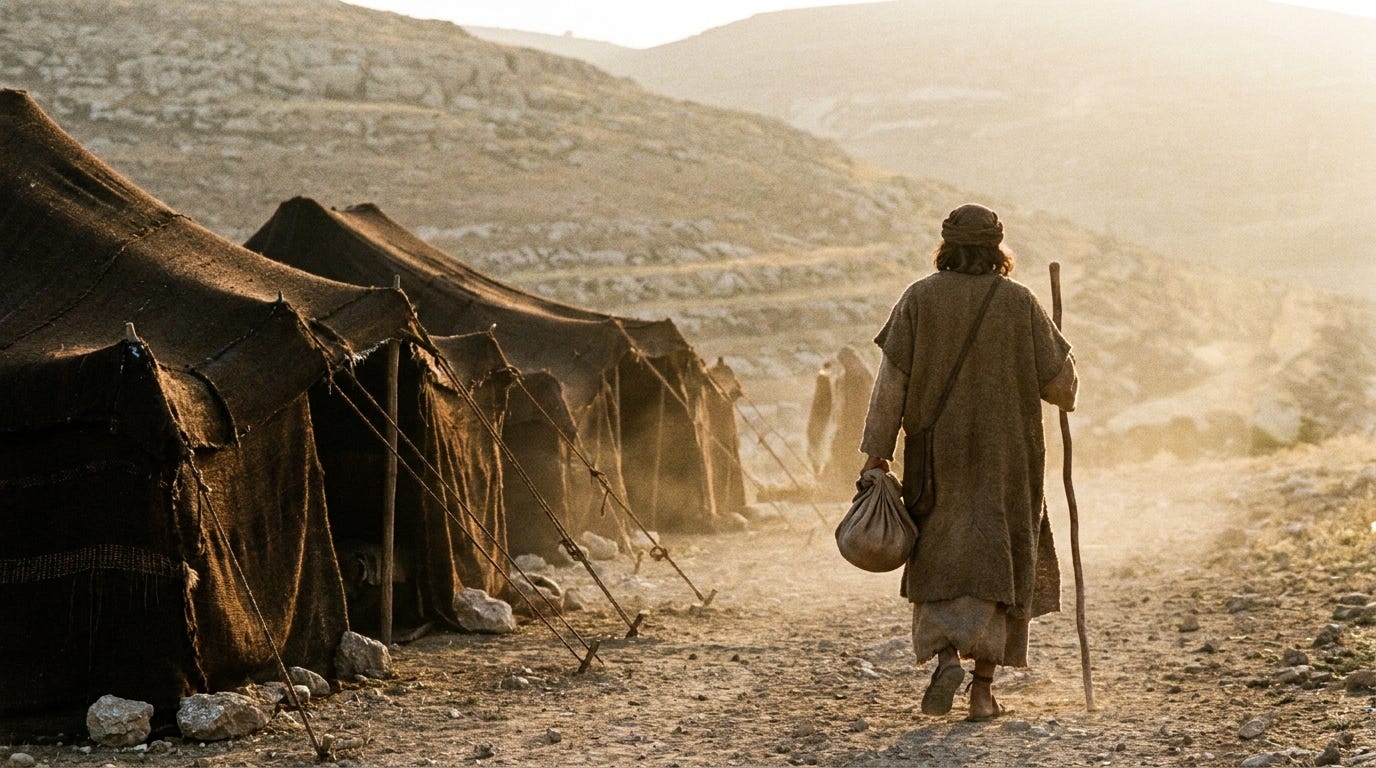
The blessing has been spoken and Isaac will not take it back. Esau walks out of his father's tent carrying something he means to keep.
Esau said in his heart
Esau planned to wait until his father died and then kill his brother. "Esau held a grudge against Jacob because of the blessing his father had given him" (Genesis 27:41), and inside himself he fixed the timing: "The days of mourning for my father are at hand; then I will kill my brother Jacob" (Genesis 27:41).
He said it in his heart, and by the next verse it has reached his mother's tent: "When the words of her older son Esau were relayed to Rebekah" (Genesis 27:42). The God who made the heart hears what is said in it: "Even before a word is on my tongue, You know all about it, O LORD" (Psalms 139:4). Esau never takes his anger to God, and in these verses the only voice he listens to is his own.
Obey my voice
Rebekah sent Jacob to her brother Laban in Haran to keep him alive until Esau's anger cooled. She tells him, "Look, your brother Esau is consoling himself by plotting to kill you" (Genesis 27:42), and then, "So now, my son, obey my voice and flee at once to my brother Laban in Haran" (Genesis 27:43). It is the third time in one chapter she has told Jacob to listen to her voice (Genesis 27:8, 27:13). To Isaac she gives another reason: "I am weary of my life because of these Hittite women" (Genesis 27:46).
Years before, Rebekah had gone to God herself. "So Rebekah went to inquire of the LORD" (Genesis 25:22), and He answered her about these same two boys: "the older will serve the younger" (Genesis 25:23). In this chapter she plans, persuades and sends, and she never once goes back to ask Him. Knowing God means going back to the One who spoke, and letting His voice be the one we follow.
I will bring you back
Genesis never records Rebekah seeing Jacob again. She promised him a short stay and a quick return: "Then I will send for you and bring you back from there" (Genesis 27:45). The stay lasted twenty years. "Thus for twenty years I have served in your household" (Genesis 31:41).
On the road north another promise to bring Jacob back was spoken, and this one came from God at Bethel: "I will bring you back to this land. For I will not leave you until I have done what I have promised you" (Genesis 28:15). Jacob carried that promise through twenty years of another man's flocks. Then "the LORD said to Jacob, 'Go back to the land of your fathers and to your kindred, and I will be with you'" (Genesis 31:3). God kept every syllable.
He will come back for us
Genesis 27:41–46 points to Jesus because Rebekah promised to send for her son and bring him home, and Jesus makes that promise to everyone who is His. "I will come back and welcome you into My presence, so that you also may be where I am" (John 14:3). He says it again on the same night: "I will not leave you as orphans; I will come to you" (John 14:18). To know God and be known by Him is to live on promises He has never failed to keep.
Hold His promise for the long road
Jacob crossed the Jordan with only his staff (Genesis 32:10) and a promise from God. Some of what God has said to you will take longer than a while. Write it down in the Doxa app, in His exact words and with the date, and read it back in the second year and the twentieth. The record will show who kept His promise.
We are the people who remember what God has said, and He brings His people home.
What has God promised you that you are still holding in a far country?
Keep exploring. If this raised a question, or brought back something God has said to you, take it further. Ask Doxa. It answers from Scripture, real stories, and your own journey, free in your browser. No signup to start.
Download Doxa, the app for recording, weighing and remembering prophetic encouragement.
Also please feel free to read the Doxa Deeper Dive below where we delve into the original language and historical context.
The Doxa Deeper Dive
How a Few Days Became Twenty Years for Jacob (Genesis 27:41–46)

Originally published on the Doxa blog.
Two Hebrew verbs in verses 41 and 42 come back at the very end of Genesis, in the fear of Joseph's brothers and in Joseph's kindness to them. Every human measure in this passage changes the same way once God keeps His own promise, and Israel remembered the change at its harvest altar.
A grudge and a comfort
Esau was comforting himself with the thought of killing his brother. The verb is nacham (H5162), the ordinary Hebrew word for comfort, in a reflexive form: he comforts himself, and the comfort he chooses is murder. "Look, your brother Esau is consoling himself by plotting to kill you" (Genesis 27:42). The verse before gives the feeling under it. Held a grudge is satam (H7852), hostility kept and nursed.
Genesis uses the same pair once more, about the next generation. When Jacob has died, Joseph's brothers are afraid: "What if Joseph bears a grudge?" (Genesis 50:15). That is satam again. Joseph answers, "Do not be afraid. Am I in the place of God?" (Genesis 50:19), and "Joseph reassured his brothers and spoke kindly to them" (Genesis 50:21). Reassured is nacham, the same comfort verb Esau turned on himself.
An English reader meets four different words: grudge, consoling, grudge, reassured. A Hebrew listener heard one pair twice. Jacob's story with his brother opens with a grudge and a comfort that plans a death, and the story of Jacob's sons closes with a feared grudge and a comfort that keeps a family alive. Between them stands the sentence that explains the change: "what you intended against me for evil, God intended for good" (Genesis 50:20). Joseph had held what God said to him through slavery and prison, and knowing God's purpose let him comfort the brothers who sold him. Rebekah's measure of time in verse 44 changed in the same way.
A few days
Rebekah expected a short visit. "Stay with him for a while" (Genesis 27:44), she tells Jacob, and the Hebrew behind for a while is yamim achadim, built from yom (H3117), day, and echad (H259), one: a few days.
The same two words come back two chapters later. "So Jacob served seven years for Rachel, yet it seemed but a few days because of his love for her" (Genesis 29:20). Rebekah had measured the absence by how long Esau's temper would last. A listener who heard her say a few days in chapter 27 hears the same words here, and now they measure seven years of work for the woman Jacob loved, the first seven of twenty. Jacob lived every one of those years under what God had said to him at Bethel: "I will not leave you until I have done what I have promised you" (Genesis 28:15). He carried that promise for twenty years, and when the road home led him back toward Esau, he prayed on what God had said.
The days of mourning
Esau's plan waited on his father's death, and Isaac outlived the whole exile, so when the days of mourning finally came, Esau and Jacob buried him together. Isaac had spoken like a dying man: "I am now old, and I do not know the day of my death" (Genesis 27:2). He lived on through all twenty years of Jacob's absence, and Jacob came home to him at Mamre (Genesis 35:27).
Genesis has a pattern for a father's burial. When Abraham died, two sons who had been sent apart came back to one tomb: "His sons Isaac and Ishmael buried him in the cave of Machpelah near Mamre" (Genesis 25:9). Burying a father was the sons' shared duty, and the book records who stood at the grave. Before the brothers met, Jacob prayed God's own words back to Him: "Please deliver me from the hand of my brother Esau" (Genesis 32:11), and then he reminded God of what He had said, "I will surely make you prosper" (Genesis 32:12). On the road, "Esau, however, ran to him and embraced him" (Genesis 33:4). The day Esau had named for murder arrived, and the record reads: "And his sons Esau and Jacob buried him" (Genesis 35:29). Israel heard that whole journey, out to Aram and home again, as the story of its own father.
My father was a wandering Aramean
Israel heard Jacob's flight as the opening line of the confession each worshipper spoke at the harvest altar. When an Israelite brought the first fruit of the land to the priest, the law gave them these words: "My father was a wandering Aramean, and he went down to Egypt few in number" (Deuteronomy 26:5). The father is Jacob. Aramean, Arammi (H761), names the people of the country Rebekah sent him to. Wandering is abad (H6), a verb that most often means to perish or be lost.
The people who first heard Genesis stood in the land with a basket of its fruit in their hands and said that their father had once been nearly lost in Aram. Hosea told it the same way: "Jacob fled to the land of Aram and Israel worked for a wife" (Hosea 12:12). Every harvest, Israel read the record back. God had told Jacob, "I will bring you back to this land" (Genesis 28:15), and the basket was the proof that He had.
The God of all comfort
Genesis 27:41–46 points to Jesus because Esau went looking for comfort in a plan to kill his brother, and in Christ God gives the comfort Esau never asked Him for. Paul blesses "the God and Father of our Lord Jesus Christ, the Father of compassion and the God of all comfort" (2 Corinthians 1:3), and says, "so also through Christ our comfort overflows" (2 Corinthians 1:5). Paul's word is paraklesis (G3874), comfort and encouragement in one word. Its verb, parakaleo (G3870), is the one the Greek Bible chose for nacham in Isaiah's "Comfort, comfort My people" (Isaiah 40:1).
To know God is to bring Him the grudge before it becomes a plan, and to hold what He has said for as long as the few days last. Record what God has said to you in the Doxa app, and date it, so that when the long road ends you can read back who brought you home. Israel did the same each harvest, standing at the altar with a basket of the land's fruit and telling the God who brought their father home what He had done.
Keep exploring. If this raised a question, or brought back something God has said to you, take it further. Ask Doxa. It answers from Scripture, real stories, and your own journey, free in your browser. No signup to start.
Questions and comments are welcome below.
Download Doxa, the app for recording, weighing and remembering prophetic encouragement.