

Originally published on the Doxa blog.
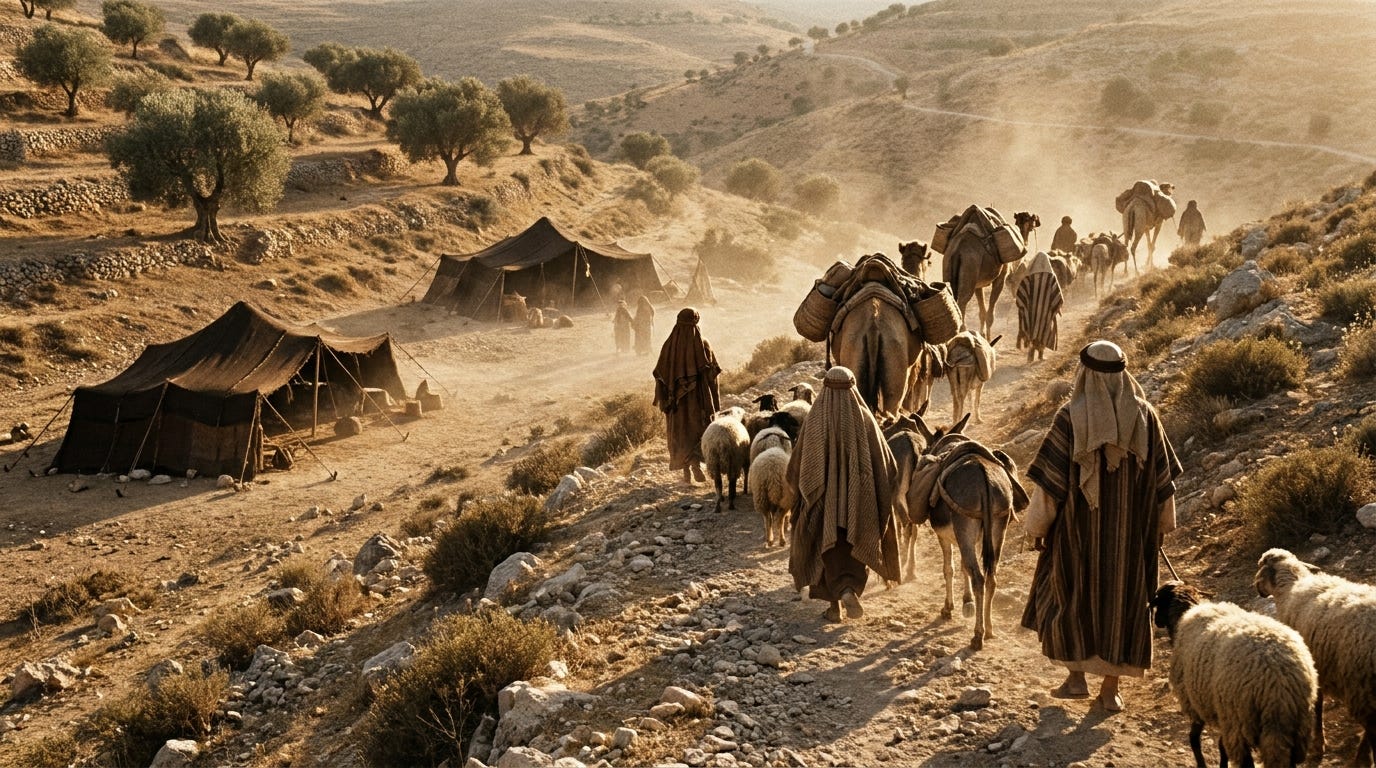
Jacob was on the road home to the brother who had planned to kill him, and the angels of God came out to meet him.
The camp of God
Jacob named the place Mahanaim, which means two camps, because the angels of God met him there and he saw that God's camp stood beside his own. "Jacob also went on his way, and the angels of God met him" (Genesis 32:1). "When Jacob saw them, he said, “This is the camp of God.” So he named that place Mahanaim" (Genesis 32:2).
Twenty years earlier, running the other way, Jacob had dreamed that "God’s angels were going up and down the ladder" (Genesis 28:12), and God told him, "I will bring you back to this land" (Genesis 28:15). Now he was coming back, and God was keeping that promise where Jacob could see it.
Four hundred men
Jacob was afraid because his messengers reported that Esau was coming to meet him with four hundred men. The last time the brothers were together, Esau had said in his heart, "then I will kill my brother Jacob" (Genesis 27:41). Now he was coming, "he and four hundred men with him" (Genesis 32:6).
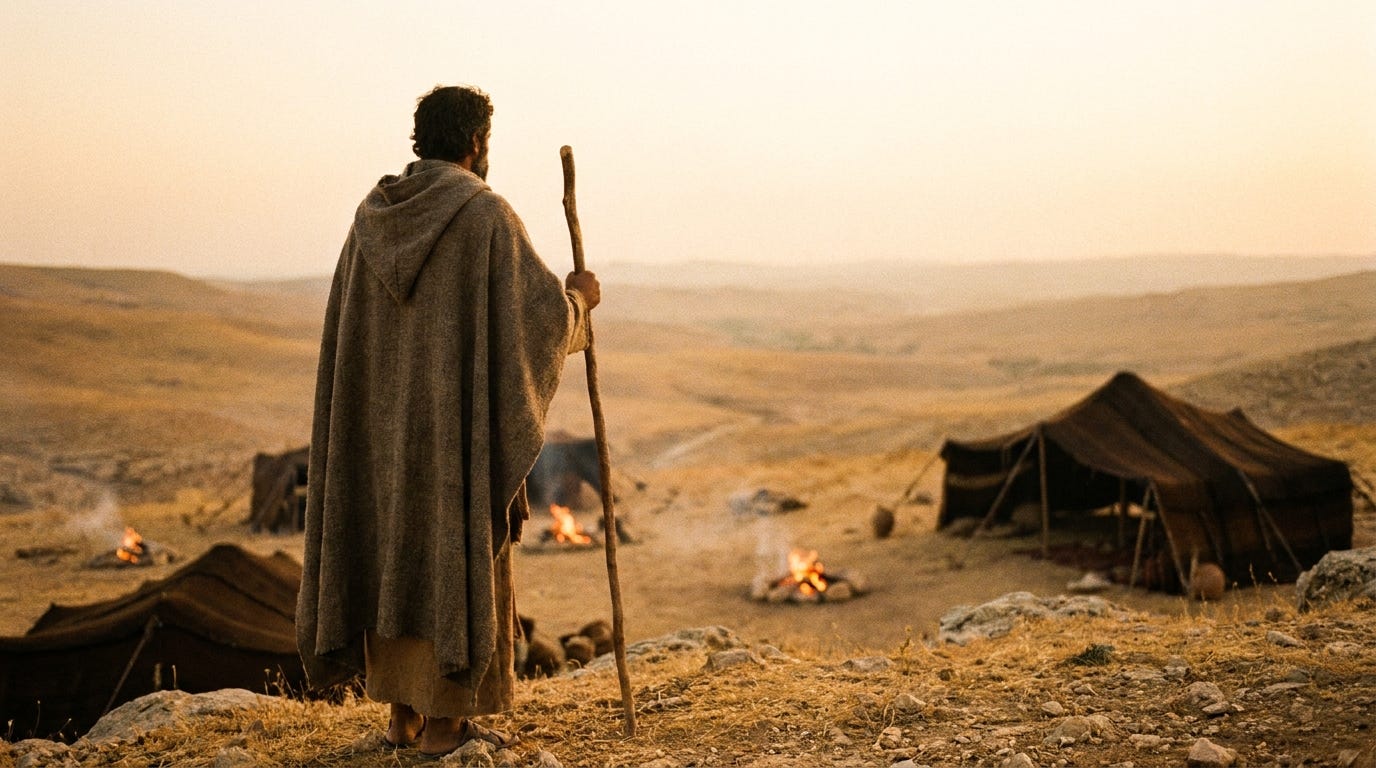
"In great fear and distress, Jacob divided his people into two camps" (Genesis 32:7). He had just named a place for God's camp. Now he made two camps of his own, so that one could escape if Esau attacked the other, and then he prayed.
But You have said
Jacob prayed God's own words back to Him. "O God of my father Abraham, God of my father Isaac, the LORD who told me, ‘Go back to your country and to your kindred, and I will make you prosper’" (Genesis 32:9). He asked plainly: "Please deliver me from the hand of my brother Esau, for I am afraid" (Genesis 32:11). And he ended where God had begun: "But You have said, ‘I will surely make you prosper, and I will make your offspring like the sand of the sea, too numerous to count.’" (Genesis 32:12).
Jacob was still afraid, and he told God so. For twenty years he had held what God said at Bethel and at Haran, and on the worst night of his journey home he brought it back to the One who said it. This is what it is to know the God who speaks: you remember what He told you, and when the news is bad you hand His promise back to Him and stand on it.
Kindness and faithfulness
Jacob's prayer points to Jesus because the two gifts Jacob said he did not deserve are what John saw in Christ. "I am unworthy of all the kindness and faithfulness You have shown Your servant" (Genesis 32:10). In Hebrew those are chesed and emet, the pair God later proclaimed as His own character to Moses, "abounding in loving devotion and faithfulness" (Exodus 34:6). John wrote of Jesus, "The Word became flesh and made His dwelling among us," and he saw Him "full of grace and truth" (John 1:14). The God whose camp met Jacob on the road came and pitched His tent among us.
Pray back what He said
We are the people who remember what God has said. Jacob carried a few sentences from God across twenty years and had them ready on the hard night. Write down what God has said to you, from Scripture or from an encouragement someone has shared, in the Doxa app, so you can read it back and pray it back to Him. Knowing Him grows that way, and He still keeps watch over His people: "The angel of the LORD encamps around those who fear Him, and he delivers them" (Psalms 34:7).
What has God said to you that you could pray back to Him today?
Keep exploring. If this raised a question, or brought back something God has said to you, take it further. Ask Doxa. It answers from Scripture, real stories, and your own journey, free in your browser. No signup to start.
Download Doxa, the app for recording, weighing and remembering prophetic encouragement.
Also please feel free to read the Doxa Deeper Dive below where we delve into the original language and historical context.
The Doxa Deeper Dive
Jacob Told God He Was Too Small for His Kindness (Genesis 32:1–12)
Originally published on the Doxa blog.
The Hebrew of Genesis 32 used one word for the angels who met Jacob and for the men he sent to Esau, and no English translation can show it.
Angels and messengers
Genesis 32 uses one word for both because mal'ak (H4397) means a messenger, someone sent to carry another's words, whether the sender is God or a man. "The angels of God met him" (Genesis 32:1) is mal'akhe Elohim. Two verses later, "Jacob sent messengers ahead of him to his brother Esau" (Genesis 32:3), and they are mal'akhim too. A Hebrew listener heard God send His messengers to Jacob first, and only then Jacob send his own down the road to Esau. Before Jacob said a word to his brother, God had already come to him.
The verb for met is paga (H6293), to come upon, to light on. It opened the Bethel story as well: "On reaching a certain place" (Genesis 28:11) is wayyifga bammaqom, he came upon the place. Twenty years earlier Jacob came upon a place and saw God's messengers on a ladder. Now God's messengers came upon him.
My master Esau
Jacob called Esau his master and himself a servant because that was how a lesser man wrote to a greater one in his world, and his messengers carried that letter word for word. "You are to say to my master Esau, ‘Your servant Jacob says…’" is how he framed it (Genesis 32:4). Letters from that region, like the Amarna tablets written to Pharaoh centuries later, open in exactly this shape: to the king, my lord, from your servant. Isaac had blessed Jacob, "May you be the master of your brothers" (Genesis 27:29). Now Jacob addressed that brother the way a vassal addressed a king.
The answer came back as a number. Four hundred men was a raiding band. When David hid from Saul, "About four hundred men were with him" (1 Samuel 22:2). A herdsman with wives and children knew what four hundred armed men on the road meant, and what Jacob did next he did with that number in his ears.
God's camp and Jacob's camps
Mahanaim means two camps. Mahanaim (H4266) is the dual of machaneh (H4264), a camp, and machaneh is the word Jacob used when he saw the angels: "This is the camp of God" (Genesis 32:2).
A Hebrew reader heard that word again and again in the next ten verses. Jacob "divided his people into two camps" (Genesis 32:7), machanoth, so "If Esau comes and attacks one camp, then the other camp can escape" (Genesis 32:8). In his prayer Jacob used the word again, this time in thanks: "with only my staff I came across the Jordan, but now I have become two camps" (Genesis 32:10). God's camp had met Jacob before he made his own two camps out of fear.
David put the same picture into a psalm. The verb behind machaneh is chanah (H2583), to pitch camp, and he wrote, "The angel of the LORD encamps around those who fear Him, and he delivers them" (Psalms 34:7). Jacob asked, "Please deliver me" (Genesis 32:11) with natsal (H5337), and David sang the same verb a few lines earlier: "I sought the LORD, and He answered me; He delivered me from all my fears" (Psalms 34:4).
Too small for His kindness
In Hebrew Jacob said one word, qatonti, from qatan (H6994), I am small: he told God he was too small for all the kindness and faithfulness God had shown him. "I am unworthy of all the kindness and faithfulness You have shown Your servant" (Genesis 32:10) reads, word for word, I am smaller than all the kindnesses and all the faithfulness.
Genesis had used that word for Jacob before. The adjective qatan (H6996) named him in the tent on the day of the stolen blessing: "she put them on her younger son Jacob" (Genesis 27:15). He was the small one, the second twin, and he had spent his life grasping past it. On the road home, with Esau coming, he took the word for himself and said it to God.
What he was too small for were chesed (H2617), loyal covenant love, and emet (H571), faithfulness that holds. Abraham's servant had spoken of the pair at a well, praising the LORD "who has not withheld His kindness and faithfulness from my master" (Genesis 24:27). Jacob said it to God directly, about himself, and he knew God by what God had done for him over twenty years.
Your brother Israel
Israel heard this story as their own, because centuries later they stood at Edom's border and sent messengers just as Jacob had. "From Kadesh, Moses sent messengers to tell the king of Edom, “This is what your brother Israel says" (Numbers 20:14). Same word for messengers, same brother, same careful words. Edom refused: "You may not travel through our land, or we will come out and confront you with the sword" (Numbers 20:18).
So the first hearers of Genesis knew Esau as a living neighbour, and God had told them how to treat him: "Do not despise an Edomite, for he is your brother" (Deuteronomy 23:7). They also knew what it was to live in camps. In the wilderness God ordered them, "In the middle of the camps, the Tent of Meeting is to travel with the camp of the Levites" (Numbers 2:17). Every night of their journey God's dwelling stood among their machanoth.
The camp that came to stay
The camp of God that met Jacob on the road came closer than Jacob ever saw. God had said of the tabernacle, "they are to make a sanctuary for Me, so that I may dwell among them" (Exodus 25:8). When John wrote that the Word "made His dwelling among us" (John 1:14), he chose skenoo (G4637), to pitch a tent, the tabernacle word. The God whose tent stood in the middle of Israel's camps came and lived among us in Jesus. Jesus told Nathanael, "you will all see heaven open and the angels of God ascending and descending on the Son of Man" (John 1:51). The messengers Jacob saw at Bethel and at Mahanaim gather around Him.
Jacob could pray as he did because he had kept what God said. Knowing God starts there: He speaks, and His people hold on to it until the day they need it. When God speaks to you through Scripture, or through an encouragement someone shares with you, record it in the Doxa app with the date, weigh it, and read it back when the report from the road is bad. The God who sent His messengers to meet Jacob knows you by name, and He keeps every word He has spoken.
Keep exploring. If this raised a question, or brought back something God has said to you, take it further. Ask Doxa. It answers from Scripture, real stories, and your own journey, free in your browser. No signup to start.
Questions and comments are welcome below.
Download Doxa, the app for recording, weighing and remembering prophetic encouragement.