

Originally published on the Doxa blog.
God had told Jacob, "I will watch over you wherever you go" (Genesis 28:15). Genesis 29 opens with Jacob on the road east carrying that promise and a staff, and nothing else.
Lifted feet on the road east
Jacob set off from Bethel with the promise God had spoken there to carry him. The BSB says he "resumed his journey" (Genesis 29:1), and the Hebrew behind it reads, word for word, that Jacob lifted up his feet. A few nights earlier he had been running from a brother who wanted him dead. Now the LORD had spoken to him, and the man walks on.
That is what holding a promise looks like on an ordinary day. On this road Jacob carries the words he heard at Bethel across hundreds of miles of dust to Haran.
A stone on the mouth of the well
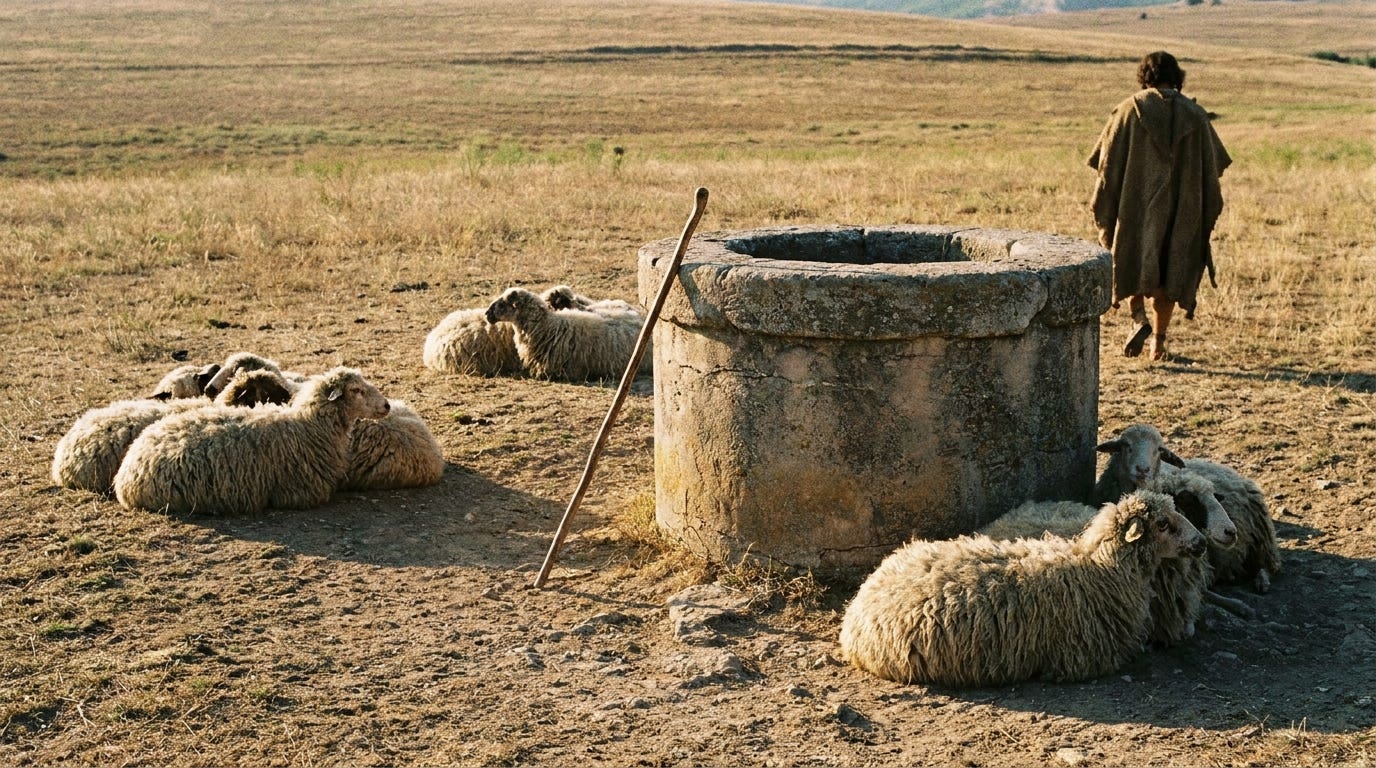
God brought Jacob to the one well where his uncle's daughter came to water her father's sheep, and Jacob reached it just before she did. Three flocks lay waiting beside it, and "a large stone covered the mouth of the well" (Genesis 29:2). The shepherds tell him they know Laban, and "here comes his daughter Rachel with his sheep" (Genesis 29:6).
A generation earlier, Abraham's servant stood at a well in this same country and prayed, "please grant me success today" (Genesis 24:12). Rebekah came, and the servant bowed and said, "the LORD has led me on the journey to the house of my master's relatives" (Genesis 24:27). Rebekah's son stands at the well now with no prayer recorded, and the LORD who spoke at Bethel is still keeping His word to him, step for step.
The shepherds say they cannot move the stone until every flock is gathered. Jacob sees Rachel, walks over, and "rolled the stone away from the mouth of the well" (Genesis 29:10) by himself.
Jacob kissed Rachel and wept
Jacob wept because the God who had promised to watch over him had brought him, alone and on foot, to his mother's own family. "Then Jacob kissed Rachel and wept aloud" (Genesis 29:11). Rachel runs home, Laban runs out to meet him, and Jacob tells him everything.
Laban's welcome sounds warm: "You are indeed my own flesh and blood" (Genesis 29:14). Genesis lets the line stand for now. Jacob will learn soon enough what kind of man his uncle is, and the God of Bethel will be with him through all of it.
Water at Jacob's well
Jacob at the well points to Jesus, who sat down at Jacob's own well in Samaria and offered water greater than any Jacob ever gave. John records it: "Since Jacob's well was there, Jesus, weary from His journey, sat down by the well" (John 4:6). A woman came to draw water, and she asked Him, "Are You greater than our father Jacob, who gave us this well and drank from it himself, as did his sons and his livestock?" (John 4:12)
Jesus answered her with a promise: "the water I give him will become in him a fount of water springing up to eternal life" (John 4:14). Jacob rolled one stone off one well so a flock could drink. Christ, the One greater than Jacob, gives water from within to everyone who comes to Him.
Write down where He met you
To know God is to find, again and again, that He was already on the road ahead of you, keeping what He said. When God's promise meets you at an ordinary well, on a Tuesday, in a car park, write down where it happened and what He had said in the Doxa app, so you can read it back on the long stretches and see His hand on every mile.
We are the people who remember that He said, "I will not leave you until I have done what I have promised you" (Genesis 28:15). The God of Bethel walked Jacob all the way to the well.
Where has God already been ahead of you on the road?
Keep exploring. If this raised a question, or brought back something God has said to you, take it further. Ask Doxa. It answers from Scripture, real stories, and your own journey, free in your browser. No signup to start.
Download Doxa, the app for recording, weighing and remembering prophetic encouragement.
Also please feel free to read the Doxa Deeper Dive below where we delve into the original language and historical context.
The Doxa Deeper Dive
Why Jacob Wept at the Well in Haran (Genesis 29:1–14)
Originally published on the Doxa blog.
Genesis 29 opens with a verb an English Bible smooths away, and the same verb returns ten verses later at the well. Between the two comes a question about peace that Jacob's whole journey with God turns on.
Feet lifted, then a voice
Jacob lifted up his feet in Genesis 29:1 means he set out again on his journey from Bethel. The Hebrew joins nasa (H5375), to lift or carry, with regel (H7272), foot. The BSB renders it "Jacob resumed his journey" (Genesis 29:1), which is accurate, and the picture goes missing. The medieval Jewish commentator Rashi heard a light step in it, a heart gone light after Bethel that made the feet light too.
Ten verses on, the same verb lifts Jacob's voice. "Then Jacob kissed Rachel and wept aloud" (Genesis 29:11) is, in Hebrew, he lifted up his qol (H6963), his voice, and bakah (H1058), wept. A Hebrew listener had heard that exact phrase two chapters before, from Esau, the day Jacob took his blessing: "Then Esau wept aloud" (Genesis 27:38). Hagar lifted up her voice the same way in the desert when she thought her son would die (Genesis 21:16).
So Jacob, who caused his brother's tears, now weeps the same words, and these tears come because God has kept a promise. The road that began with one man weeping over what Jacob stole ends, for now, with Jacob weeping over what God gave.
Is there peace for him
Jacob's question about his uncle's welfare asks after his shalom (H7965), his peace and wholeness. "Is he well?" (Genesis 29:6) is in Hebrew ha-shalom lo, is there shalom for him, and the shepherds answer with the single word shalom.
Follow that word back one chapter. Jacob's vow at Bethel hung on it: "so that I may return safely to my father's house, then the LORD will be my God" (Genesis 28:21). Safely is be-shalom, in peace. Jacob left home with none of it, a brother planning his death behind him. When Jacob asks after his uncle, the shepherds' first word in reply is the one word he had asked God for.
Then follow it forward. Twenty years on, "he arrived safely at the city of Shechem in the land of Canaan" (Genesis 33:18), and safely there is shalem (H8003), whole, from the same root. The vow asked for shalom, God gave it, and Genesis marks the day He did. An English reader sees well, safely and safely again and cannot tell that one word holds the whole arc together.
A capped well and a running uncle
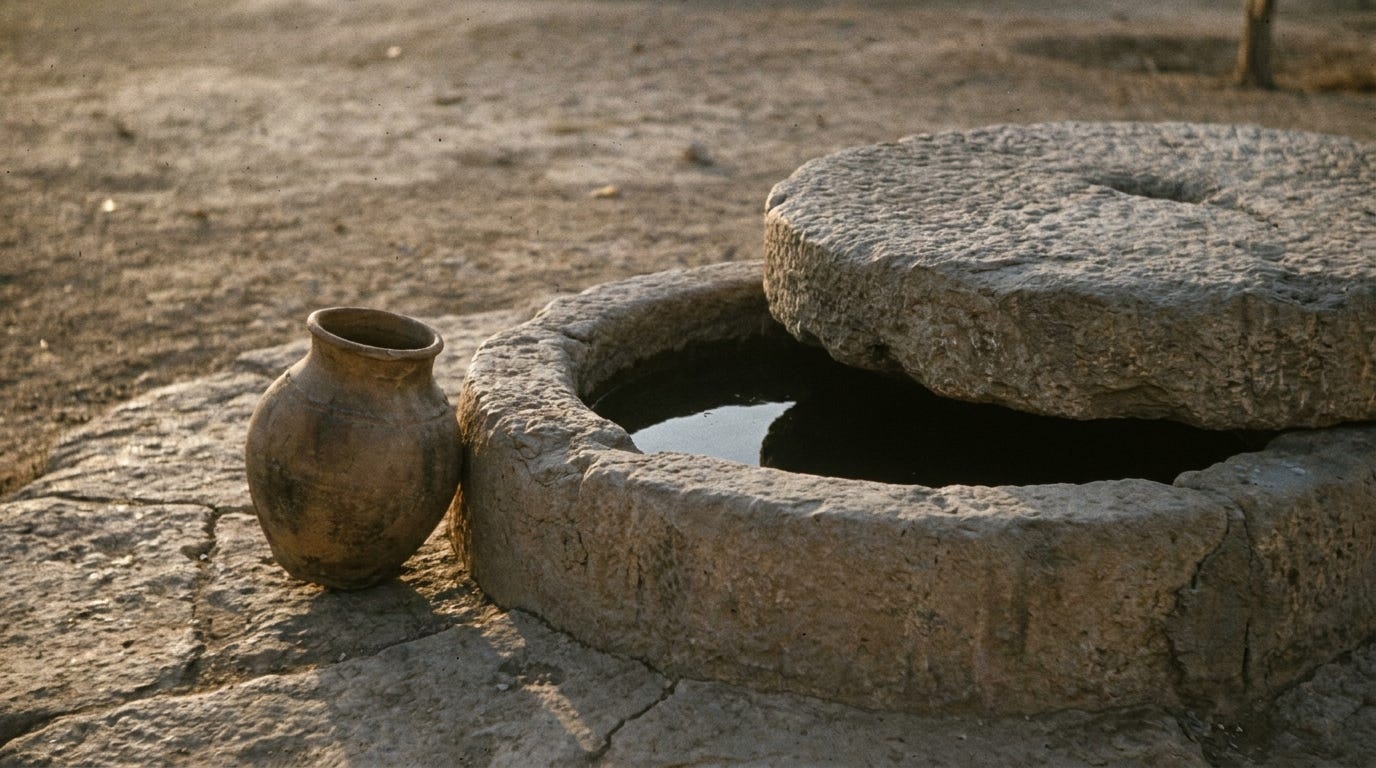
The stone kept the shared water safe, and custom kept it shut until every flock with a right to that well was there. In dry country a well was a family's wealth, so it was capped with a heavy even (H68), a stone, against blowing sand, waste and theft. The shepherds' rule, "We cannot, until all the flocks have been gathered" (Genesis 29:8), is that agreement, and it held each flock to its fair share. Jacob, newly arrived, sets the custom aside and rolls the stone off alone. His years away are framed by stones: at Bethel he stood one up where God had spoken (Genesis 28:18), here he rolls one off a well for his mother's family, and twenty years on he and Laban will pile stones as a witness between them (Genesis 31:48).
Laban runs out to meet him, and a first hearer remembered the last time Laban ran to a stranger at a well. "As soon as he saw the ring, and the bracelets on his sister's wrists" (Genesis 24:30), he went out to Abraham's servant, who had ten camels loaded with gifts. Jacob arrives with nothing. Later he says so himself: "with only my staff I came across the Jordan" (Genesis 32:10).
Laban's greeting is the old kinship formula, literally you are my etsem (H6106) and my basar (H1320), my bone and my flesh. It is the language of Adam over Eve, "bone of my bones and flesh of my flesh" (Genesis 2:23), and of the tribes coming to David at Hebron. Haran itself was a centre of moon-god worship, and Laban's household kept idols; he later demands of Jacob, "why have you stolen my gods?" (Genesis 31:30). Jacob has come to family who share his blood and keep other gods in the house.
My father was a wandering Aramean
Israel heard this chapter as the story of their own father arriving among strangers with nothing but a staff and a promise. Every family that brought firstfruits to the sanctuary was to say before the LORD, "My father was a wandering Aramean, and he went down to Egypt few in number" (Deuteronomy 26:5). The Aramean in that confession is Jacob, and Genesis 29 is the day he walks into Aram.
The prophets kept the memory too. Hosea told the northern kingdom, "Jacob fled to the land of Aram and Israel worked for a wife" (Hosea 12:12), and set it next to the LORD's rescue from Egypt in the following verse. Israel also knew a second well story. Moses fled from Pharaoh to Midian and sat down beside one, and when shepherds drove off the priest's daughters, "Moses rose up to help them and watered their flock" (Exodus 2:17). Israel heard Jacob's well and Moses' well as one pattern: a man with no home, a well in a strange land, and God already at work there before the man knew it.
He Himself is our peace
Genesis 29:1–14 points to Jesus because the shalom Jacob asked for at Bethel is given in full in a Person. Paul writes of Christ, "For He Himself is our peace" (Ephesians 2:14). Jacob's vow said that if God gave him shalom, the LORD would be his God. In Christ God gives the peace first, to people who arrive with nothing in their hands, and invites them to know Him.
To know God, for Jacob, was to watch Him keep what He said at Bethel, mile after mile, until the answer to his question about family in a strange land was the word he had asked for. We are the people who write down what He promised and mark the day He keeps it. Record the promises God gives you, with the date and His exact words, in the Doxa app, and mark that day as Genesis marked Shechem. He is the God who speaks, and He gives the peace He promised.
Keep exploring. If this raised a question, or brought back something God has said to you, take it further. Ask Doxa. It answers from Scripture, real stories, and your own journey, free in your browser. No signup to start.
Questions and comments are welcome below.
Download Doxa, the app for recording, weighing and remembering prophetic encouragement.