

Originally published on the Doxa blog.
God had promised to bring Jacob home, and on the night before he met his brother, Jacob counted out five hundred and fifty animals.
Five hundred and fifty animals
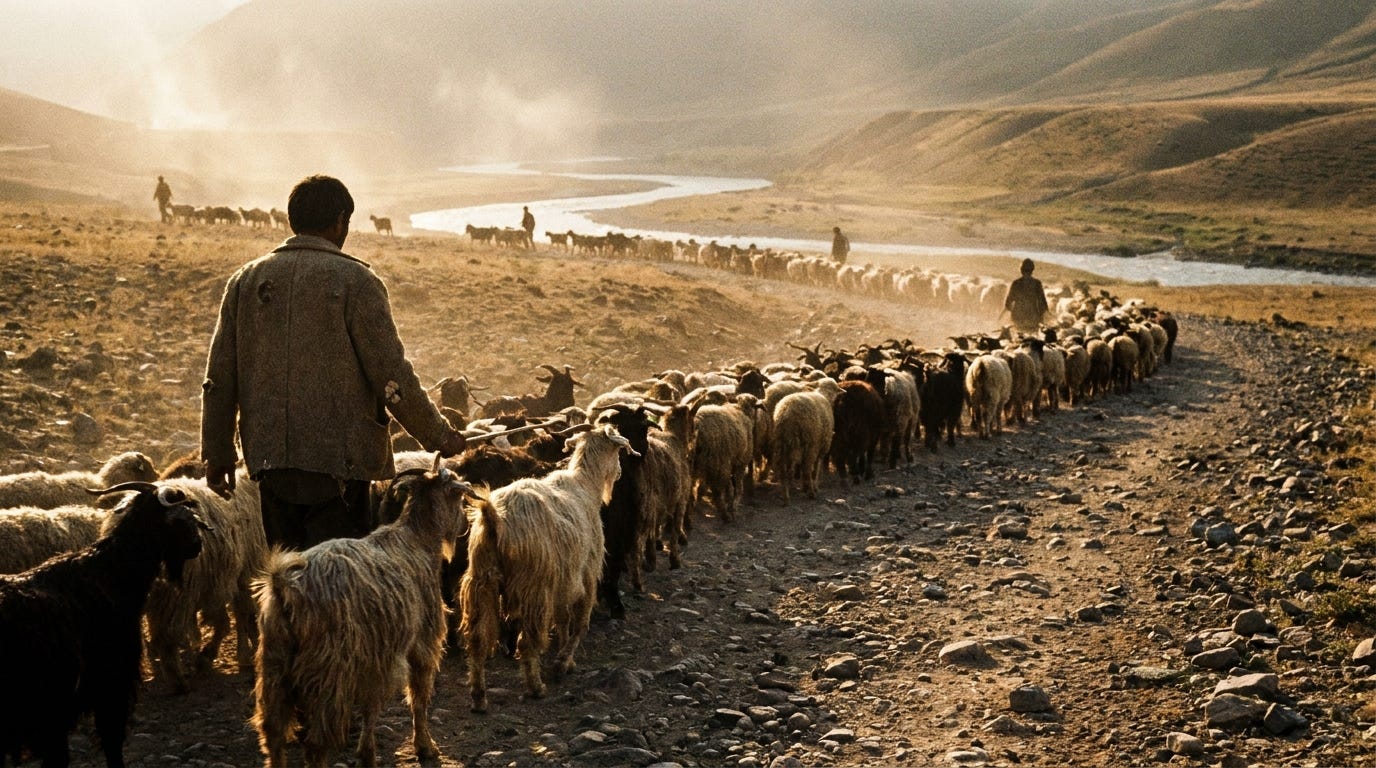
Jacob sent Esau a gift of more than five hundred animals, chosen from the flocks and herds he had built over twenty years with Laban. "Jacob spent the night there, and from what he had brought with him, he selected a gift for his brother Esau" (Genesis 32:13). There were two hundred female goats and two hundred ewes, each with twenty males, and then "30 milk camels with their young, 40 cows, 10 bulls, 20 female donkeys, and 10 male donkeys" (Genesis 32:15).
Ten she-goats to every male goat, ten ewes to every ram. A herdsman reading that list knew those flocks were breeding stock, wealth that would keep growing in Esau's hands for years. Only a few hours earlier Jacob had prayed, "Please deliver me from the hand of my brother Esau, for I am afraid" (Genesis 32:11). Then he went out among his animals in the dark and started choosing.
Jacob is behind us
Jacob sent the herds in separate droves so that Esau would meet one gift after another before he ever saw Jacob. He told his servants, "Go on ahead of me, and keep some distance between the herds" (Genesis 32:16), and he gave every herdsman the same lines to say: "They belong to your servant Jacob. They are a gift, sent to my lord Esau. And behold, Jacob is behind us." (Genesis 32:18).
Esau was on the road with four hundred men. The goats were meant to reach him first, and a servant would say his sentence. Then a gap, then ewes and rams, and another servant with the same sentence, then camels with their calves, then cattle, then donkeys, and every time the same name came at the end.
Perhaps he will accept me
Jacob hoped the gift would calm his brother's anger so that Esau would receive him. Genesis 32:20 records what he thought: "I will appease Esau with the gift that is going before me. After that I can face him, and perhaps he will accept me" (Genesis 32:20). The Hebrew word for appease is kaphar, to cover. Jacob meant to cover his brother's face with goats and camels.
Perhaps. That was as far as his plan could reach. Yet that same night Jacob had prayed, "But You have said" (Genesis 32:12), and twenty years before at Bethel God had told him, "I will watch over you wherever you go, and I will bring you back to this land" (Genesis 28:15). He held the promise and the plan side by side, and he lay down in the camp with both. Plenty of us know that night. We pray what God said, and then we lie awake arranging our own covering.
The gift God sent
Jacob's gift points to Jesus because God has sent a gift to us, and He sent it Himself. Jacob went toward his brother with a perhaps. John wrote that God "loved us and sent His Son as the atoning sacrifice for our sins" (1 John 4:10), and Paul told the church in Rome that "when we were enemies of God, we were reconciled to Him through the death of His Son" (Romans 5:10). The covering Jacob tried to build out of his own flocks, God provided in Christ, and He gave it to people who had nothing to send.
Hold what He said tonight
We are the people who remember what God has said. Jacob carried God's promise all the way to the river Jabbok, and his fear travelled with it. On the night you are afraid, read back what God has told you before you start counting goats. Write His promises down in the Doxa app, from Scripture and from encouragements others have shared with you, so His word is in front of you before your plan is. This is how we come to know God and be known by Him: we hold what He said, we bring Him our fear, and we find that He went ahead of us. That same night, by the Jabbok, God met Jacob Himself.
What has God said to you that you need to read back before you make tonight's plan?
Keep exploring. If this raised a question, or brought back something God has said to you, take it further. Ask Doxa. It answers from Scripture, real stories, and your own journey, free in your browser. No signup to start.
Download Doxa, the app for recording, weighing and remembering prophetic encouragement.
Also please feel free to read the Doxa Deeper Dive below where we delve into the original language and historical context.
The Doxa Deeper Dive
Jacob Used the Atonement Word for His Gift to Esau (Genesis 32:13–21)
Originally published on the Doxa blog.
The verb Jacob chose for calming Esau is the verb the Bible uses for atonement, and English translations cannot show it.
I will cover his face
In Genesis 32:20 appease translates kaphar (H3722), to cover, and Jacob's words were akapperah panav, I will cover his face. "I will appease Esau with the gift that is going before me" (Genesis 32:20). Genesis had used the verb once before, on the ark, where Noah was to "coat it with pitch inside and out" (Genesis 6:14): the pitch is kopher and the coating is kaphar. After Genesis, the same verb fills the law of Moses, where it means making atonement.
So the second time Scripture uses the atonement verb, a man was trying to cover his own past. Jacob had taken Esau's blessing in disguise, and Esau had said, "then I will kill my brother Jacob" (Genesis 27:41). Twenty years later Jacob tried to cover that wrong with herds of animals. A Hebrew listener heard the weight in that one verb: Jacob was trying to make atonement with his brother, and he had to supply the covering himself.
Five faces in two verses
The Hebrew word for face, panim (H6440), appears five times in Genesis 32:20–21, because Jacob's whole plan was about whose face he would see and how it would look at him. Read woodenly, verse 20 says: I will cover his face with the gift that goes before my face, and afterward I will see his face; perhaps he will lift up my face. Then verse 21: "So Jacob’s gifts went on before him" (Genesis 32:21), literally, the gift passed over before his face.
That same night Jacob met a different face. After wrestling until dawn, Jacob named the place Peniel and said, "Indeed, I have seen God face to face, and yet my life was spared" (Genesis 32:30). Peniel (H6439) means the face of God. Jacob had prepared all night for Esau's face, and before he saw it he saw God's. When the brothers finally met, Jacob said it out loud: "I have seen your face, and it is like seeing the face of God, since you have received me favorably" (Genesis 33:10).
A minchah for my lord
Jacob's gift was a minchah (H4503), the word for tribute a lesser man paid to a greater, and also for an offering brought to God. In Jacob's world, a weaker party paid a stronger one in goods and livestock. When Israel served Moab, "they sent him with tribute to Eglon king of Moab" (Judges 3:15), and later Mesha king of Moab "would render to the king of Israel a hundred thousand lambs and the wool of a hundred thousand rams" (2 Kings 3:4). Jacob's droves were that kind of payment, the tribute of a man who expected to stand before his brother as the weaker party.
The first minchah in the Bible was brought by two other brothers. "Cain brought some of the fruit of the soil as an offering to the LORD" (Genesis 4:3), and Abel brought his. When Cain was rejected, "his countenance fell" (Genesis 4:5), and God asked him, "If you do what is right, will you not be accepted?" (Genesis 4:7). Countenance is panim, and accepted comes from nasa (H5375), to lift. Jacob's hope, perhaps he will lift up my face, used the same pair of words. The Bible's first story of brothers ended in murder. Here a brother came toward his brother with a gift and a prayer.
Lift up His countenance
The first hearers of Genesis were Israel, gathered around a tabernacle where minchah and kaphar were daily words, and they heard Jacob's plan against what God had taught them. The law of the grain offering opened, "When anyone brings a grain offering to the LORD" (Leviticus 2:1), and the grain offering is minchah. Once a year they heard, "on this day atonement will be made for you to cleanse you, and you will be clean from all your sins before the LORD" (Leviticus 16:30).
They also knew where their covering came from. God had said of the blood, "I have given it to you to make atonement for your souls upon the altar" (Leviticus 17:11). Jacob chose his covering from his own flocks; Israel's covering was a gift from God's hand. And the priests blessed them with the very words Jacob had hoped to hear from Esau: "may the LORD lift up His countenance toward you and give you peace" (Numbers 6:26). In Hebrew it is yissa YHWH panav, the LORD lift His face. Israel heard Jacob's "perhaps" and knew that God had already promised to turn His face toward them.
The face turned toward us
The face Jacob hoped would turn toward him, God has turned toward us in His Son. Christ "entered heaven itself, now to appear on our behalf in the presence of God" (Hebrews 9:24). In the presence is prosopon (G4383), the face. Jesus stands before the face of God for us. John called Him the hilasmos (G2434) for our sins, the word the Greek Old Testament used for atonement, and he said God Himself sent Him (1 John 4:10).
Jacob had a promise from God and a plan of his own, and that night God taught him which one would carry him. Knowing God means learning to rest on what He has said and given. When God speaks to you through Scripture, or through an encouragement someone shares, record it in the Doxa app with the date, weigh it against Scripture, and read it back before you start building your own covering. The LORD has lifted up His face toward His people in Christ, and He keeps every word He has spoken.
Keep exploring. If this raised a question, or brought back something God has said to you, take it further. Ask Doxa. It answers from Scripture, real stories, and your own journey, free in your browser. No signup to start.
Questions and comments are welcome below.
Download Doxa, the app for recording, weighing and remembering prophetic encouragement.