

Originally published on the Doxa blog.
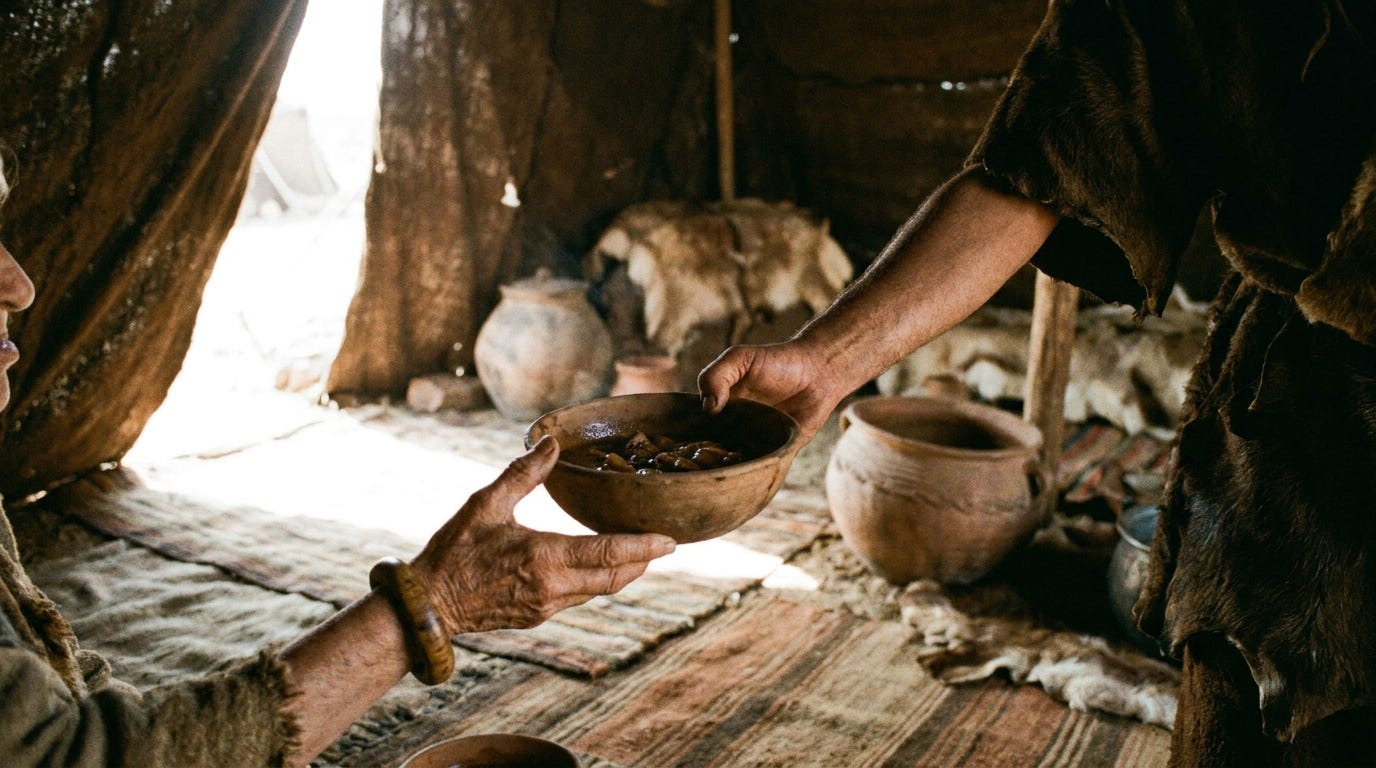
Jacob steps into the tent with a bowl in his hands. Goat skin is tied around his wrists and the back of his neck, and his brother's best clothes hang on him. He speaks first. "My father."
Isaac's answer comes back out of the dark: "Which one are you, my son?" (Genesis 27:18).
Why did Jacob say he was Esau?
Jacob said he was Esau because he believed the only way to receive the blessing was to become someone else. "I am Esau, your firstborn," he says (Genesis 27:19). Before the twins were born God had told Rebekah, "the older will serve the younger" (Genesis 25:23). Jacob walked into the tent carrying God's word about him and gave his father another man's name.
Then Isaac asks how the game was caught so fast, and Jacob reaches for God: "Because the LORD your God brought it to me" (Genesis 27:20). Your God. Jacob knows the LORD as his father's God, well enough to put His name inside a lie. Only later, running for his life, will he vow "then the LORD will be my God" (Genesis 28:21).
Did Isaac recognize Jacob's voice?
Yes. Isaac recognized Jacob's voice, and then he trusted his hands over it. "The voice is the voice of Jacob, but the hands are the hands of Esau" (Genesis 27:22). He tested everything he could reach. He touched the hands, asked a second time, ate, drank and smelled the clothes. "Isaac did not recognize him, because his hands were hairy like those of his brother Esau; so he blessed him" (Genesis 27:23).
Isaac was weighing what he heard. He weighed it against what he wanted and what he could feel, and the one thing God had said about his sons stayed outside the tent the whole time.
What did Isaac's blessing promise Jacob?
Isaac's blessing promised Jacob fruitful land, rule over his brothers, and the protection God had first spoken over Abraham. "May God give to you the dew of heaven and the richness of the earth" (Genesis 27:28). Then the last line: "May those who curse you be cursed, and those who bless you be blessed" (Genesis 27:29). That is the promise God gave Abraham in Haran, "I will bless those who bless you and curse those who curse you" (Genesis 12:3).
Isaac meant every word for Esau, and he spoke it over the son God had chosen before birth. God's word landed where He had said it would.
How does Genesis 27 point to Jesus?
Genesis 27 points to Jesus because He is the Son who brings us to the Father under His own fragrance and our own names. Jacob had to smell of Esau's field to be blessed. "Christ loved us and gave Himself up for us as a fragrant sacrificial offering to God" (Ephesians 5:2), and through Him "the blessing promised to Abraham would come to the Gentiles in Christ Jesus" (Galatians 3:14).
When Jesus met Nathanael He said, "Here is a true Israelite, in whom there is no deceit" (John 1:47). Nathanael asked the question Isaac could never answer in the dark: "How do You know me?" (John 1:48). Jesus had seen him under the fig tree. God sees us and knows us, and to know Him and be known by Him is the blessing itself.
Bring His word into the room
Isaac had God's word about his sons and left it outside. When someone shares an encouragement with you, or a strong feeling presses you to act, bring what God has already said into the room first. Write what He has said to you in the Doxa app, dated and in His exact words, so it is there to read when what you feel and what you want are pressing hardest. "test all things. Hold fast to what is good" (1 Thessalonians 5:21).
Twenty years later God asked Jacob, "What is your name?" and Jacob answered with the truth, Jacob (Genesis 32:27). God blessed him there. We are the people who remember what He has said, and He knows each of us by name.
What has God already said to you that you need to read again before you decide?
Keep exploring. If this raised a question, or brought back something God has said to you, take it further. Ask Doxa. It answers from Scripture, real stories, and your own journey, free in your browser. No signup to start.
Download Doxa, the app for recording, weighing and remembering prophetic encouragement.
Also please feel free to read the Doxa Deeper Dive below where we delve into the original language and historical context.
The Doxa Deeper Dive
Who Sends the Dew? The Prayer Word Jacob Borrowed to Lie (Genesis 27:18–29)

Originally published on the Doxa blog.
Jacob's excuse in verse 20 is built from a word that an Israelite listener had last heard in a prayer God answered.
What did Jacob mean when he said God brought him the game?
Jacob meant that God had arranged his success, and the verb he chose is the one Scripture uses for God's hand inside an ordinary moment. Jacob says, "Because the LORD your God brought it to me" (Genesis 27:20). The Hebrew verb is qarah (H7136), to cause to meet, to make something happen in front of someone.
Three chapters earlier the same verb was a prayer. Abraham's servant stood at the well in Nahor and prayed, "please grant me success today" (Genesis 24:12), literally make it happen before me today. Before he finished speaking, Rebekah came out with her jar. The noun from the same root turns up in Ruth: "she happened to come to the part of the field belonging to Boaz" (Ruth 2:3). Where English says she happened to come, a Hebrew listener heard the word for God arranging a meeting nobody planned.
So Jacob's lie borrows the language of answered prayer, the very prayer that brought his own mother into the family. And Israel heard something sharper still. They had stood at Sinai and been told, "You shall not take the name of the LORD your God in vain" (Exodus 20:7). Jacob's phrase is the commandment's phrase, the LORD your God, spoken over a goat stew to win a blessing by deceit.
Isaac's ears caught the lie. What finally overruled them was his nose.
Why did Isaac bless Jacob after smelling his clothes?
Isaac blessed Jacob after smelling his clothes because the scent of Esau's field settled the question his ears had raised, and the Hebrew word for that scent is the word for the aroma of sacrifice. "Ah, the smell of my son is like the smell of a field that the LORD has blessed" (Genesis 27:27). The noun is reach (H7381).
Its first use in the Bible is after the flood: "When the LORD smelled the pleasing aroma" of Noah's offering, He promised never again to curse the ground (Genesis 8:21). From there it runs through the whole sacrificial law, where the burnt offering is "a pleasing aroma to the LORD" (Leviticus 1:9). In Genesis 27 a son is accepted because he carries a scent that belongs to someone else.
The Greek Bible that Paul read rendered that Hebrew phrase, reach nichoach, the pleasing aroma, as osme euodias, an aroma of sweet smell. Paul took those two Greek words straight out of the sacrificial law when he wrote that Christ "gave Himself up for us as a fragrant sacrificial offering to God" (Ephesians 5:2). So the scent that settled Isaac's blessing belongs to a line that runs from Noah's altar through every burnt offering to the cross, and at the end of that line the Son offers Himself and the Father receives us in Him.
The field Isaac smelled leads straight into the blessing he spoke over it.
What does "the dew of heaven" mean in Genesis 27:28?
The dew of heaven means water that only God can send, the moisture that kept the land alive through its dry months. The blessing opens, "May God give to you the dew of heaven and the richness of the earth" (Genesis 27:28), and then names grain and new wine. In the hill country of Canaan the rain falls in winter and stops in spring. Through the long summer, heavy night dew off the Mediterranean is much of the water the vines and late crops receive. No farmer can dig for it or store it. It comes down in the dark, or it does not come.
The word is tal (H2919), and Scripture keeps it as a picture of God's own presence. Through Hosea God says, "I will be like the dew to Israel" (Hosea 14:5). The pair that follows, dagan (H1715), grain, and tirosh (H8492), new wine, became the standard words of covenant plenty: "your grain, new wine, and oil" (Deuteronomy 7:13).
How did Israel first hear Isaac's blessing?
Israel first heard Isaac's blessing as a claim about who gives the rain, made in a land whose neighbours gave the credit to Baal. The Canaanites around them served Baal as the storm god who rode the clouds and sent the dew and the harvest. Isaac's blessing names the Giver: "May God give to you the dew of heaven" (Genesis 27:28).
Centuries later Israel forgot it. Hosea's charge is a sentence about knowing God: "For she does not acknowledge that it was I who gave her grain, new wine, and oil" (Hosea 2:8). The Hebrew verb is yada (H3045), to know. They ate the very blessing Isaac spoke over their father and did not know who had given it.
They also watched the second half of the blessing come true in their own history. Under David, "all the Edomites were subject to David" (2 Samuel 8:14). Yet the verb of the blessing turns back on Jacob first. "Nations bow down to you" (Genesis 27:29) uses shachah (H7812), to bow low, the verb Scripture also uses for worship. The first time Genesis uses it of Jacob, he is the one bowing: "Jacob himself went on ahead and bowed to the ground seven times as he approached his brother" (Genesis 33:3). The blessing he took by deceit put him on his face before the brother he deceived.
The deceit in that tent left a mark on the family name, and Jesus reached for that mark when He met a man named Nathanael.
Why did Jesus call Nathanael an Israelite with no deceit?
Jesus called Nathanael an Israelite with no deceit because He was naming Jacob's story over a man who had none of Jacob's trick in him. "Here is a true Israelite, in whom there is no deceit" (John 1:47) uses the Greek dolos (G1388). The Greek Bible of His day used that same word when Isaac told Esau, "Your brother came deceitfully and took your blessing" (Genesis 27:35). Israel was the name God gave Jacob at the Jabbok, once Jacob had told the truth about who he was. Jesus then promised Nathanael Jacob's ladder: "you will all see heaven open and the angels of God ascending and descending on the Son of Man" (John 1:51).
Jacob learned what the blessing had said all along: every good thing in it came down from God, and he had to know the Giver for himself. We are the people who write down who sent the dew, so a dry summer cannot make us forget. Write down what God has said to you and what He has done for you in the Doxa app, with the date, so that on a dry day you can read who sent the dew. "O LORD, You have searched me and known me" (Psalms 139:1). He is the God who speaks, and He knows us by name.
Keep exploring. If this raised a question, or brought back something God has said to you, take it further. Ask Doxa. It answers from Scripture, real stories, and your own journey, free in your browser. No signup to start.
Questions and comments are welcome below.
Download Doxa, the app for recording, weighing and remembering prophetic encouragement.