

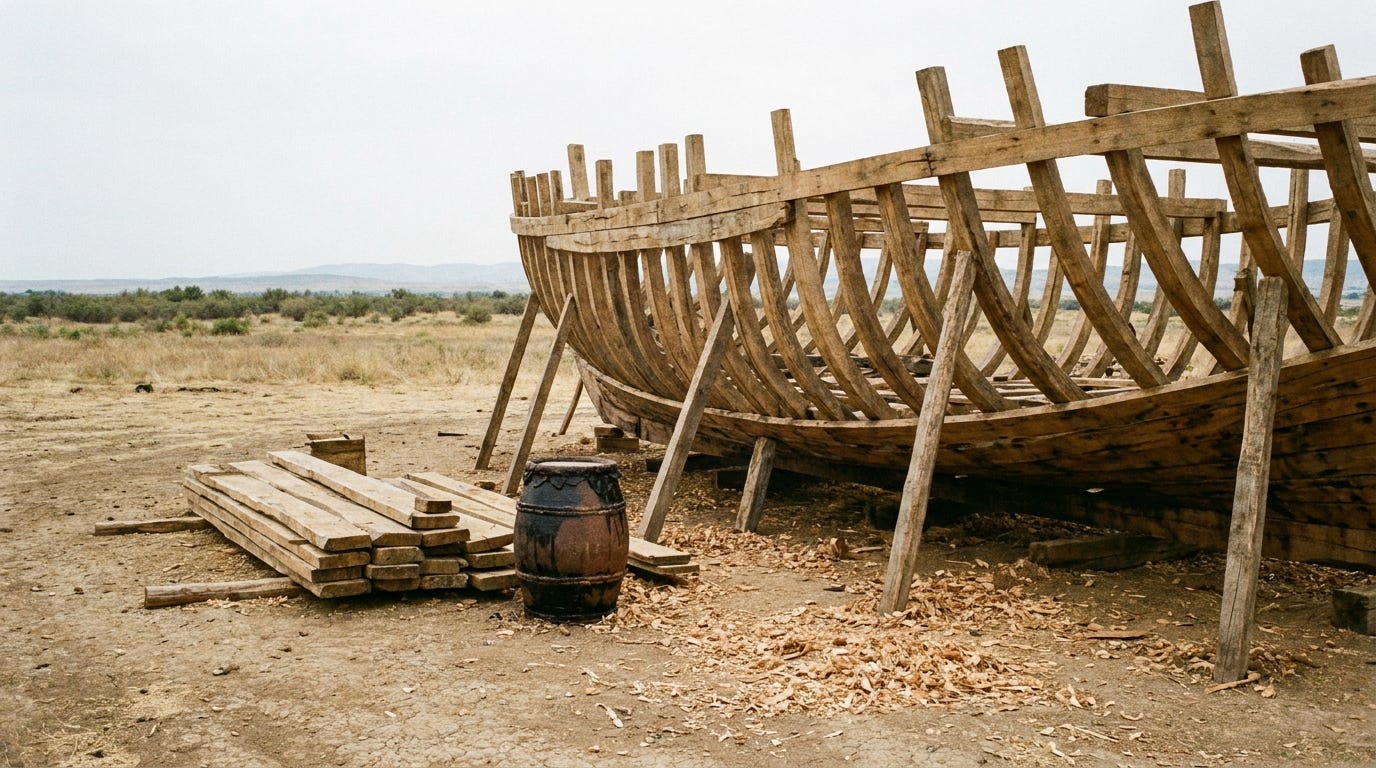
The world was rotten, and God told one man to build a boat.
Not near water. Not with a crew. Noah is handed a set of measurements, three hundred cubits by fifty by thirty, gopher wood, pitch inside and out, and word that a flood is coming (Genesis 6:14–17). Everyone around him is living exactly as the verse before described them, in a world “corrupt in the sight of God, and full of violence” (Genesis 6:11). And there in the middle of it stands a man the passage describes in words it has used only once before: “Noah was a righteous man, blameless in his generation; Noah walked with God” (Genesis 6:9).
Walked with God. The same thing said of Enoch one chapter earlier. It is the quiet backbone under everything Noah is about to do.
Then God says a word He has never said in the Bible until now. “But I will establish My covenant with you” (Genesis 6:18). Grace showed up for the first time in the last passage, when Noah found favor. Now covenant shows up for the first time here. Before a single plank is cut, before the rain, God binds Himself to this man and his household. The rescue is God’s promise; the building is Noah’s to do.
What does it mean that Noah walked with God?
It means he heard God and did what he heard. Look at how the passage ends: “So Noah did everything precisely as God had commanded him” (Genesis 6:22). Every dimension, every deck, the door in the side, the pitch on the seams. He had never seen rain like this, never seen a flood, and nothing yet to go on but a word from God and years of work ahead. He trusted the word more than the weather. That is what walking with God looks like on an ordinary Tuesday. You do the next thing He said while nothing around you confirms it.
Because the ark is a covering that carries people through the judgment rather than around it. The waters still came. The family still went through them. What kept them was the thing God told them to build and shut themselves inside. Centuries later Peter looked back at the days of Noah and saw a picture of us. Eight people “were saved through water” (1 Peter 3:20), and that same water, he says, is “the baptism that now saves you also”, “through the resurrection of Jesus Christ” (1 Peter 3:21). One family came through the flood inside the ark. Everyone who belongs to Jesus comes through the judgment inside Him. Hebrews puts Noah near the front of the faith chapter for exactly this, a man who “in godly fear built an ark to save his family” (Hebrews 11:7).
The Doxa Deeper Dive
Pitch and Atonement: The Hidden Word in Noah's Ark (Genesis 6:9-22)
The account of Noah runs on a handful of Hebrew words, and each one carries more than the English lets you hear. Put together, they show the ark for what it was, a covering God designed to carry people through His own judgment, and the rest of the Bible spends its pages unfolding that.
What do blameless and walking with God mean in Hebrew?
Noah is “a righteous man, blameless in his generation” (Genesis 6:9). Blameless is tamim (H8549): whole, complete, without blemish. It is the word later required of an animal brought for sacrifice, one fit to be offered. It marks Noah out as undivided, all of a piece, in a world that had come apart.
The passage then says Noah walked with God. The verb is halak (H1980) in the same reflexive form Genesis used one chapter earlier for Enoch, who “walked with God, and then he was no more, because God had taken him away” (Genesis 5:24). Two men in a row are said to walk this way with God, and then the flood falls on everyone who did not. Walking with God is the thread the whole passage hangs from.
What was the earth full of before the flood?
Twice the passage says the same thing. “The earth was corrupt in the sight of God, and full of violence” (Genesis 6:11), and again in verse 13. Violence is chamas (H2555): wrong done to another person, cruelty, the strong crushing the weak. This is what filled the world God had once called good. The flood is God answering a planet drowning in chamas long before any water rose.
Why does the word for the ark matter?
God tells Noah to build an ark, and the Hebrew word is one you will meet only one more time in the entire Old Testament. It is tevah (H8392). Every other ark, the ark of the covenant included, is a different Hebrew word altogether. Tevah appears here, then disappears until a mother in Egypt “got him a papyrus basket and coated it with tar and pitch” and set her baby son inside to save him from a king who wanted the Hebrew boys dead (Exodus 2:3). That basket is a tevah. Twice in all of Scripture God saves the future of His people by shutting them inside a tevah and carrying them over deadly water: Noah, then Moses. Both times a sealed wooden vessel stands between drowning and living.
What is the connection between the pitch and atonement?
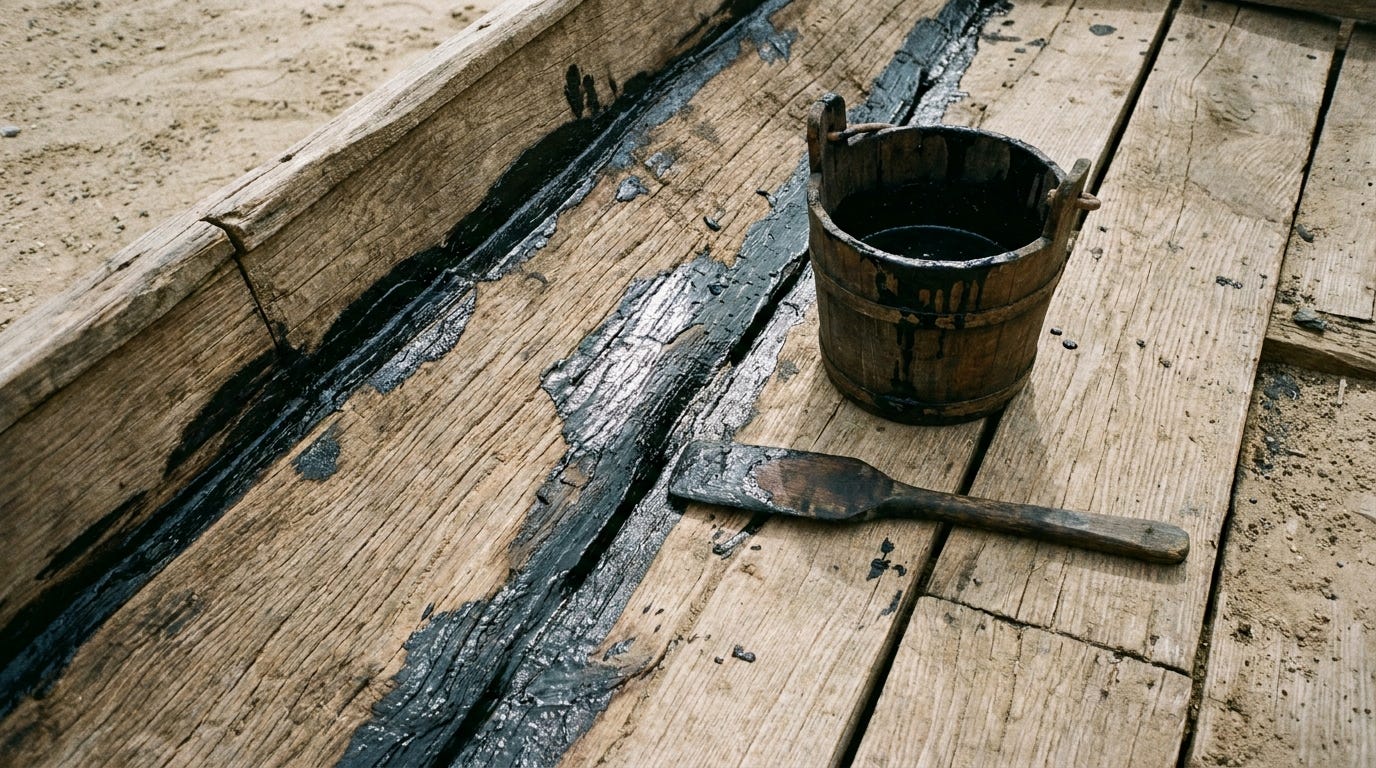
Here is the word the Doxa Daily Lift pointed at. God says, “coat it with pitch inside and out” (Genesis 6:14). The pitch is kopher (H3724), and the verb for coating it is kaphar (H3722). This is the only place in the Bible where that verb describes smearing tar on wood. Everywhere else, hundreds of times over, kaphar is the word for atonement: to cover, to make things right between a person and God. The Day of Atonement is Yom Kippur, built on this root. The mercy seat over the ark of the covenant is the kapporeth, the covering, the same root again. So the first time the Bible ever uses the atonement word, it is naming the layer that seals the waters of judgment out of the vessel and keeps the people inside alive. The picture comes long before the doctrine is taught. What saves you is a covering God provides, applied to the very thing you shelter in.
What is the first covenant in the Bible?
Before the rain, God says, “I will establish My covenant with you” (Genesis 6:18). Covenant is berith (H1285), and this is the first time the word appears in Scripture. It arrives as pure gift. Noah has built nothing yet and survived nothing yet; God simply binds Himself to rescue him. The last passage gave us the Bible’s first chen, favor, when Noah “found favor in the eyes of the LORD” (Genesis 6:8). This one gives us its first berith. Grace, then covenant, in two passages back to back, both landing on the same man before he had done a thing to earn either.
How does the ark point to Jesus?
The New Testament reads all of this as a picture waiting for its fulfilment. Peter looks back at the eight who “were saved through water” (1 Peter 3:20). That same water, he says, is “the baptism that now saves you also”, “through the resurrection of Jesus Christ” (1 Peter 3:21). The ark carried its people through the judgment and out the other side into a washed world. That is what baptism pictures and what the cross accomplished. Hebrews sets Noah among the great believers: “By faith Noah, when warned about things not yet seen, in godly fear built an ark to save his family” (Hebrews 11:7). He had a word and no weather, and he built.
Read the passage again with the Hebrew in your ears. A whole man walking with God, a world full of chamas, a tevah sealed with the atonement word and bound to a covenant, and one line to finish it: “So Noah did everything precisely as God had commanded him” (Genesis 6:22). The covering was God’s to design. The building was Noah’s to do.