

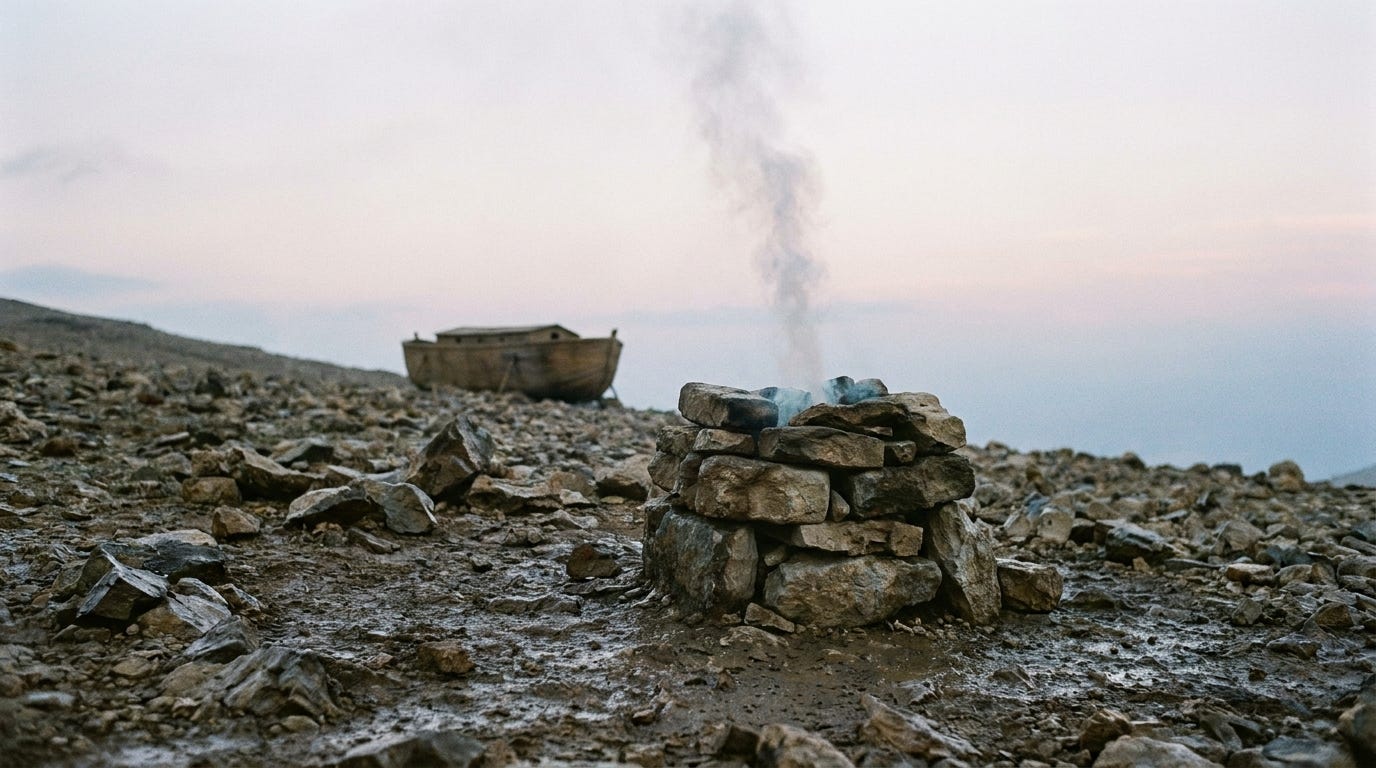
The ground had been dry for weeks, and Noah stayed in the ark.
Look at the dates he keeps. On the first day of the first month he pulls back the covering and sees dry ground (Genesis 8:13). By the twenty-seventh day of the second month the earth is completely dry (Genesis 8:14). Almost two months of solid ground under a wide-open door, and still Noah does not step out onto it.
He is waiting for one thing. A word.
“Then God said to Noah, ‘Come out of the ark’” (Genesis 8:15–16). Noah had boarded when God told him to, and he disembarks when God tells him to. He could see with his own eyes that it was safe, and he waited for God to say so before he set foot on the ground.
What is the first thing Noah does on dry ground?
He builds an altar. “Then Noah built an altar to the LORD” and gave back some of every clean animal he had carried through the flood (Genesis 8:20). The first free man on a new earth spends his first morning in worship, and it costs him. Those clean animals were breeding stock and food, the start of a herd on an empty planet. He puts them on the altar before he plants a single seed.
Why does God promise never to flood the earth again?
Read God’s reason slowly. “Never again will I curse the ground because of man, even though every inclination of his heart is evil from his youth” (Genesis 8:21).
Sit on that. The very thing that brought the flood, the human heart bent toward evil (Genesis 6:5), is now the reason God gives for mercy. Nothing about people has changed. Noah’s family carries the same crooked heart off the boat that the drowned world carried onto it. God’s promise rests on His own mercy. We are the same people we were before the water rose.
Then comes the promise you can count on. “As long as the earth endures, seedtime and harvest, cold and heat, summer and winter, day and night shall never cease” (Genesis 8:22). Every spring since has been God keeping that word.
How does Noah’s altar point to Jesus?
Notice when God makes the promise. He makes it “when the LORD smelled the pleasing aroma” of the offering (Genesis 8:21). The mercy is anchored to a sacrifice on an altar. That is where it rests. Centuries later Paul writes that Christ “gave Himself up for us as a fragrant sacrificial offering to God” (Ephesians 5:2), the same picture, filled out to full size. Noah’s altar was an early sign of the one offering that lets a holy God keep His promise to people whose hearts have not changed.
Underneath the whole scene is the practice this walk keeps coming back to. Noah heard, he waited, and he worshipped, and God recorded a promise you and I still live inside. When you come through a hard season, do what Noah did. Wait for God’s word before you move, and worship before you start building. Then write down what He promised, because seasons turn and memory leaks.
What has God said He will hold steady in your life, and have you thanked Him for it yet, or only asked Him for more?
The Doxa Deeper Dive
Noah's Altar: The Pleasing Aroma Behind God's Promise (Genesis 8:15-22)
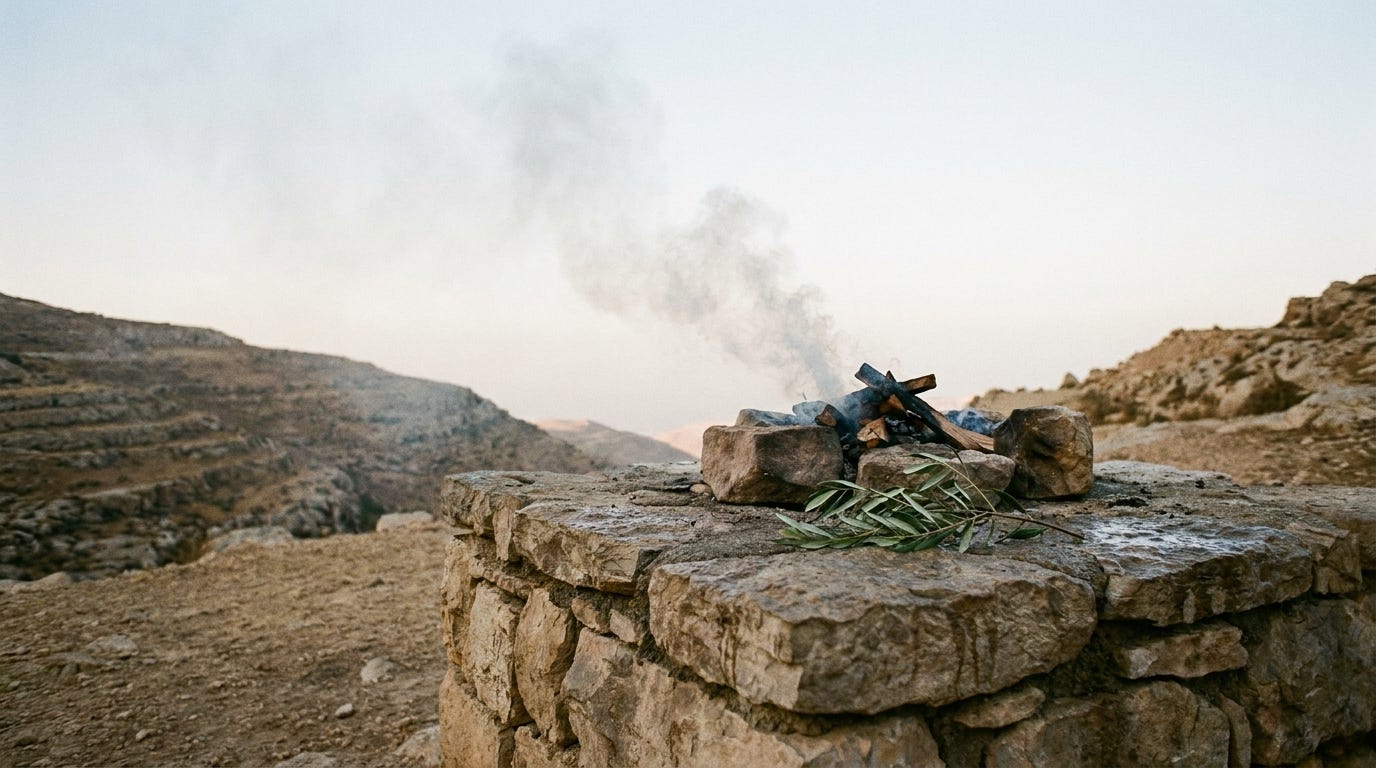
The flood ends the way it began, with God speaking and a man doing exactly what he is told.
Why did Noah wait for God to tell him to leave the ark?
The text is careful with its dates. Noah sees dry ground on the first day of the first month (Genesis 8:13); the earth is fully dry by the twenty-seventh of the second month (Genesis 8:14). Then, and only then, does God tell him, “Come out of the ark” (Genesis 8:16). Fifty-seven days of dry, walkable ground pass while the door stands open and Noah stays inside. He had entered at God’s command (Genesis 7:1), and he leaves at God’s command. The sight of dry land was one thing; the word of God was another, and Noah moved on the word.
Watch the language of the sending-out. God tells Noah to bring out every living creature “so that they can spread out over the earth and be fruitful and multiply upon it” (Genesis 8:17). Be fruitful, parah (H6509), and multiply, rabah (H7235), are the same two words God spoke over the first living creatures back on the fifth day (Genesis 1:22). Noah steps off the ark into a re-issued creation blessing. He is a second Adam on washed ground, sent to fill a world made empty.
What is an olah, and why is it the first thing built on the new earth?
“Then Noah built an altar to the LORD” (Genesis 8:20), and he “offered burnt offerings on the altar”. The word for burnt offering is olah (H5930), from a root meaning to go up. It names the offering burned whole, nothing held back, the smoke rising entirely to God. This is the first altar in the Bible and the first recorded act of worship after the flood. Noah takes from the clean animals, the very ones he had been told to bring aboard in extra pairs (Genesis 7:2), and gives them back. The provision he was handed becomes the worship he returns.
What does “pleasing aroma” actually mean?
“When the LORD smelled the pleasing aroma” (Genesis 8:21), the Hebrew is reyach nichoach (H7381 / H5207), a scent that soothes or quiets, nichoach sharing a root with the idea of rest. It becomes the fixed phrase for an accepted sacrifice all through Leviticus (Leviticus 1:9). The smoke of a life given up in worship rises to God and moves Him toward mercy. He answers it with a promise.
Why does God repeat the exact reason for the flood as His reason for mercy?
God’s reason for sparing the world is the same word that named His reason for drowning it. God resolves, “Never again will I curse the ground because of man, even though every inclination of his heart is evil from his youth” (Genesis 8:21). The word for inclination is yetser (H3336), the heart’s framing or bent. Now hear the verdict that had launched the flood: “every inclination of the thoughts of his heart was altogether evil” (Genesis 6:5). Same word, yetser, same diagnosis, word for word. In chapter 6 the bent yetser is the reason God sends the flood. In chapter 8 the bent yetser is the reason God swears never to send another. Humanity has not improved by a single degree across the voyage. The human heart is exactly what it was. What moved is the ground of God’s dealing with it. In chapter 6 He weighs the world against its yetser and judges it; in chapter 8 He looks past the yetser toward an altar and spares it.
Where does this land in Christ?
Follow the aroma forward. Paul tells the Ephesians to walk in love, “just as Christ loved us and gave Himself up for us as a fragrant sacrificial offering to God” (Ephesians 5:2), taking up the exact offering language of the reyach nichoach and setting it on the cross. Noah’s olah, the offering that goes up whole to God, is answered by the One who gave Himself up whole. Hebrews draws the line plainly: the blood of bulls and goats cannot take away sins (Hebrews 10:4), so Christ offered the sacrifice of His own body once for all (Hebrews 10:10). Genesis 8 poses the problem the rest of the Bible spends itself answering. How can a holy God bind Himself, in permanent mercy, to people whose yetser is still bent? The pleasing aroma of Noah’s altar was the first small answer. The pleasing aroma of the cross is the whole one.
And so the promise holds. “As long as the earth endures, seedtime and harvest, cold and heat, summer and winter, day and night shall never cease” (Genesis 8:22). Every harvest you have ever eaten is God keeping a word He spoke over a smoking altar on a wet mountainside, made sure in the end by a better altar still. Come out, and worship.
Originally published at https://doxa.app/blog/daily-lift-10-genesis-8-15-22