

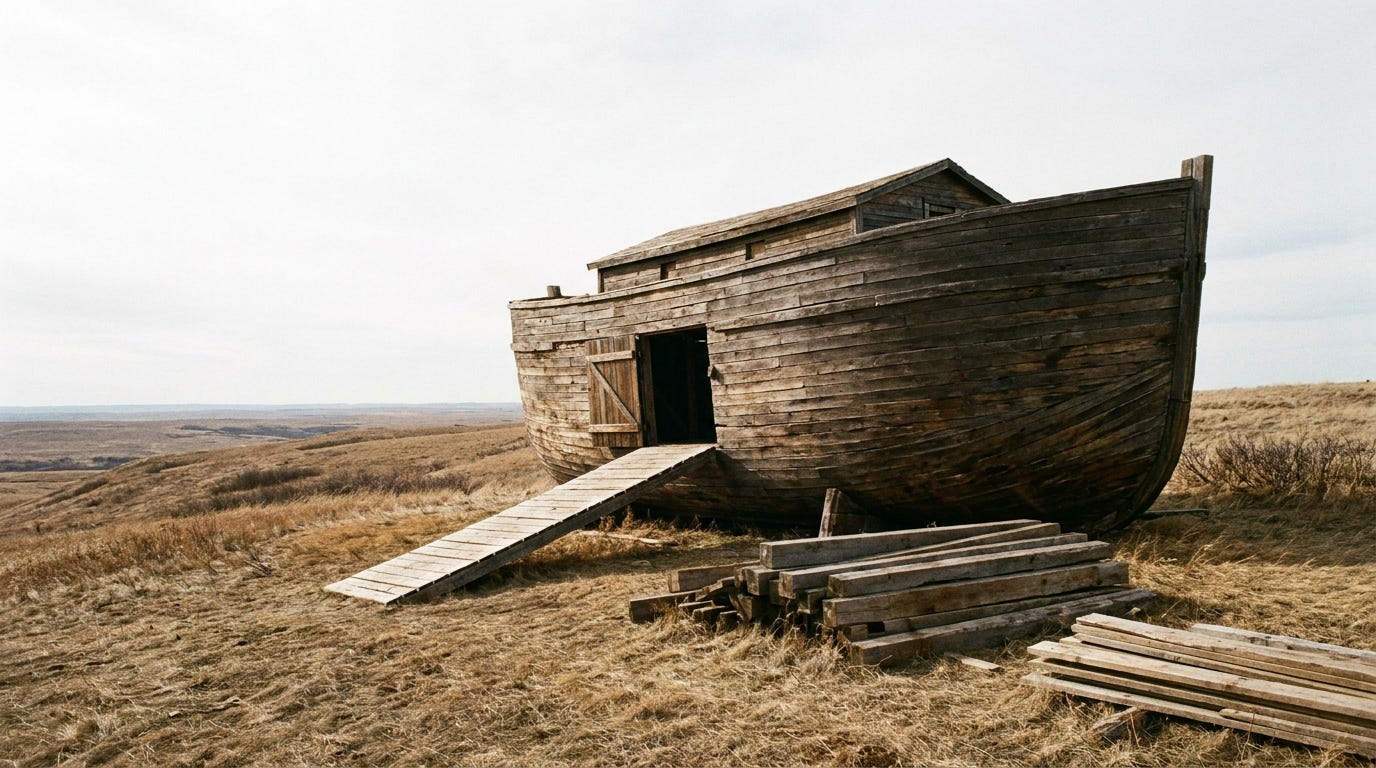
The animals came in pairs, the sky was still dry, and the door of the ark stood open on a hillside where no flood had ever risen.
Noah had done his part. “And Noah did all that the LORD had commanded him” (Genesis 7:5). He was six hundred years old, and he walked his wife, his three sons, and their wives up the ramp, with every kind of clean and unclean animal coming in behind them (Genesis 7:7–9). Years of obedience carried him all the way to the threshold. And then a small sentence turns the whole story.
“Then the LORD shut him in” (Genesis 7:16).
Read that again. Noah cut the timber, sealed the seams, gathered the animals, loaded the food. Noah could not shut that door against what was coming. The floodgates of the heavens were about to open and the fountains of the great deep were about to burst up from underneath (Genesis 7:11), and the one thing standing between his family and all that water was a door only God could close. So God closed it Himself.
Who shut the door of the ark?
The LORD did. It is the quiet hinge the passage swings on. Everything up to verse 16 is Noah working, building and gathering and obeying. Then the text stops crediting Noah and starts crediting God, and it stays that way while the waters rise for forty days and the ark lifts off the ground (Genesis 7:17). Noah’s hands got him in. God’s hand kept him in.
That is the shape of walking with God on any ordinary day. You do the next thing He told you, the plank in front of you, the obedience you can actually see. What holds you when the deep breaks open is His grip on you. Your own grip was never going to hold that door, and it does not have to.
How does the shut door point to Jesus?
Centuries later Jesus spoke about His people the way Genesis speaks about Noah. He called Himself the gate anyone is saved by walking through, and He promised that no one could snatch them out of His Father’s hand (John 10:28–29). Same picture, opened wider. One family came through the flood because God shut them inside a wooden box and would not let the water in. Everyone who belongs to Jesus comes through the last judgment because God has shut them inside His Son and will not let them be lost. The door you are counting on is one God closes and keeps closed.
Noah stepped into the ark before he had felt a single drop, on nothing but a word from God and the sound of his own hammer. What has God told you to step into while the sky still looks clear? Do the part you can, walk through the door, and let Him do the shutting.
Originally published at https://doxa.app/blog/daily-lift-8-genesis-7
The Doxa Deeper Dive
Genesis 7 is written in the vocabulary of Genesis 1, run backward.
Read the two chapters side by side and the flood reads as God taking the world back apart in the order He built it. The chapter that made the world used certain words for water, for breath, for making. Genesis 7 picks up the same words and reverses each one. This is un-creation, and it is deliberate.
Why does Genesis 7 read like Genesis 1 in reverse?
Start with the verb God chooses for what He is doing. He says He will “wipe from the face of the earth every living thing I have made” (Genesis 7:4), and by the end it is done: “every living thing on the face of the earth was destroyed”, and “they were blotted out from the earth” (Genesis 7:23). The Hebrew is machah (H4229), to wipe, to erase, to blot out, the word you would use for scrubbing writing off a page. The Maker is erasing what He made. Six days of God calling things into being, and now the same God methodically wiping the page clean. Genesis 1 fills the earth with living creatures; Genesis 7 empties it, in the reverse order that it filled, until only the ark is left.
What is the great deep that burst forth?
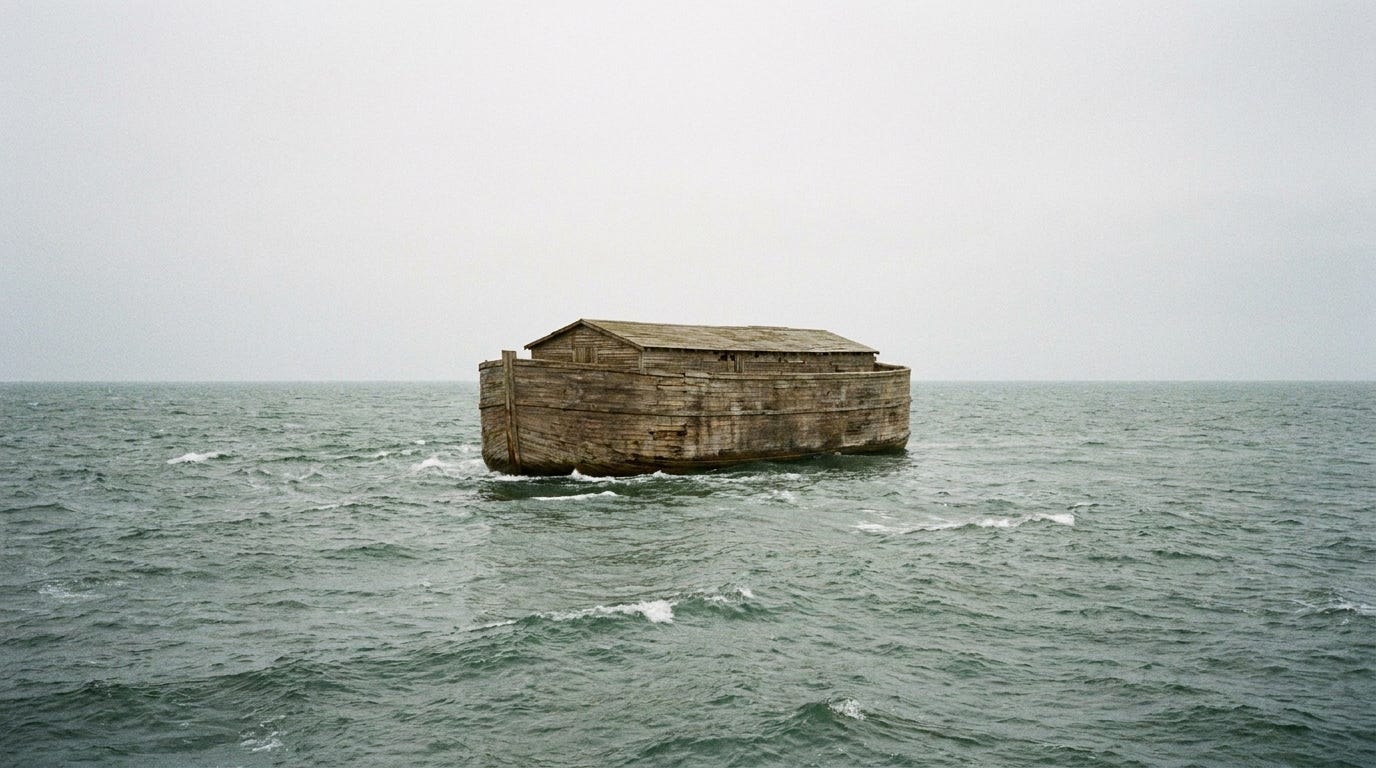
The water comes from two directions at once. “All the fountains of the great deep burst forth, and the floodgates of the heavens were opened” (Genesis 7:11). That phrase, “the great deep”, is tehom (H8415), and it is the second word in the Bible’s story. Before God made anything, “the earth was formless and void, and darkness was over the surface of the deep”, and the Spirit of God hovered over that tehom (Genesis 1:2). On the second day God split those primeval waters, holding some above and some below, and opened a pocket of dry sky and land for life to happen in (Genesis 1:6–7). Genesis 7 unlatches both at once. The waters above pour down and the waters below climb up, and the space God had opened between them closes. The world drowns because the boundary God set on the second day is pulled, and the deep comes back to take its old ground.
Whose breath is the breath of life?
Then the chapter reaches back past the second day to the sixth. Everything died, it says, “everything that had the breath of life in its nostrils” (Genesis 7:22). Breath here is neshamah (H5397), and there is one earlier use of it: God “breathed the breath of life into his nostrils, and the man became a living being” (Genesis 2:7). The same word, the same nostrils. What God once leaned down and breathed into the first man, the flood quietly draws back out of every creature that carried it. Creation was God putting His breath into dust. The flood is that breath returning to Him, and the dust settling back under the water.
Who shut the door, and why does it matter?
Here the reversal breaks, because Genesis 7 is doing more than erasing. Riding on top of the drowned world is one sealed wooden box holding a breeding pair of every living kind, and seven pairs of the clean ones brought aboard in advance (Genesis 7:2–3). That box is a seed bank for the whole living world. When the water goes down, everything needed to fill the earth again, and to build the first altar on the far side (Genesis 8:20), is already inside. Genesis 7 runs creation backward so that Genesis 8 can start it forward again from the ark.
And what guarantees that seed survives is one act, and it is God’s. “Then the LORD shut him in” (Genesis 7:16). The verb is sagar (H5462), to close, to shut fast. Noah loaded the ark; God sealed it, against the very tehom He was about to unleash. The same hand that opened the floodgates closed the door and held it. Un-creation and rescue run on the same divine hand, and only the sealed-in survive.
This is the oldest salvation picture in the Bible, and the New Testament reads it exactly this way. Peter looks at the eight people “saved through water” and calls the flood a picture of baptism (1 Peter 3:20–21). Paul writes that anyone in Christ is a new creation, the old order drowned and a new one brought up out of the water (2 Corinthians 5:17). Jesus is the door God shuts and will not reopen to the flood. When the present world is unmade at the last, the people God has sealed into His Son will rise into a washed earth the way Noah’s ark rose over a drowned one.
The flood is God un-making the world, and the ark is the first proof that His un-making always carries a seed of the world to come.
Originally published at https://doxa.app/blog/daily-deeper-dive-8-genesis-7