

Originally published on the Doxa blog.
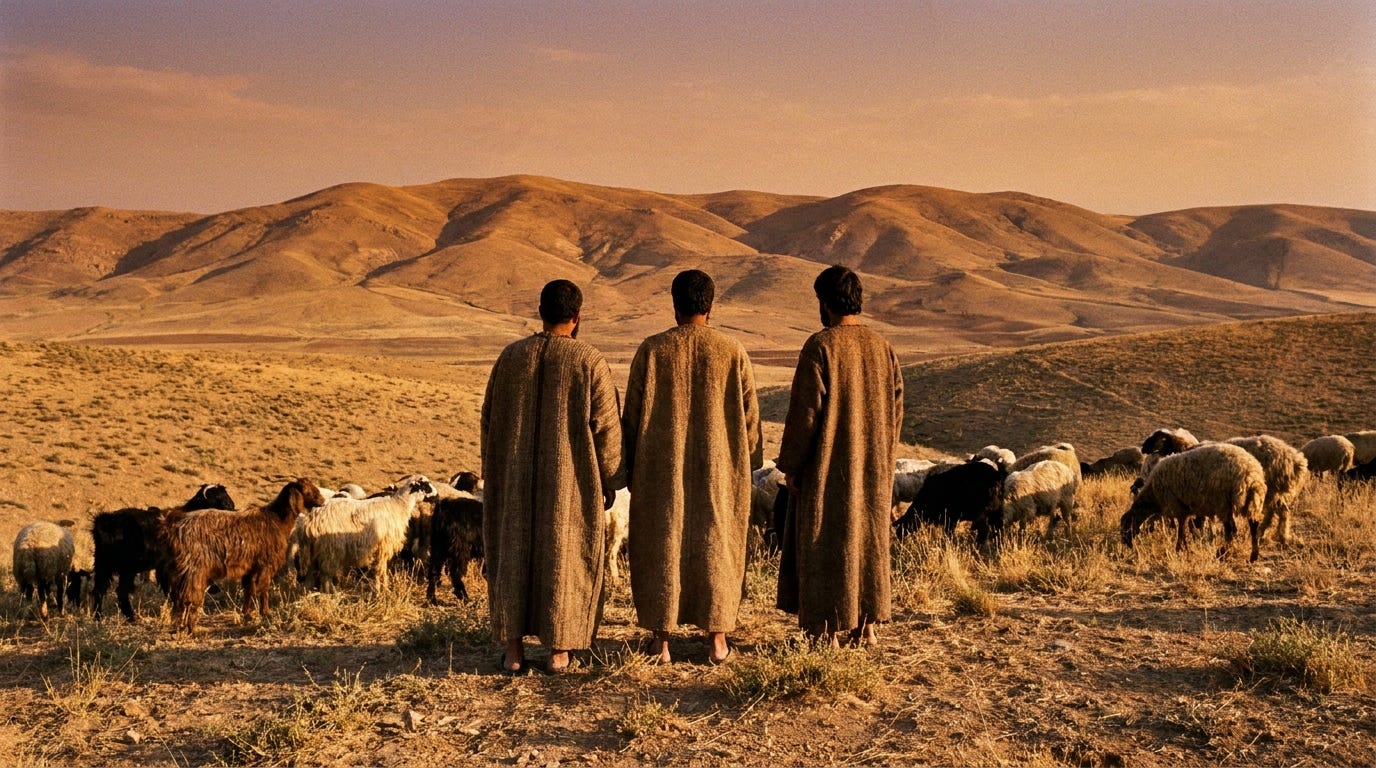
Jacob sent for Rachel and Leah to come out to the field where his flocks were, and told them God had spoken.
Laban's face had changed
Jacob left Laban because Laban's family had turned against him and the LORD told him to go home. Laban's sons were saying, "Jacob has taken away all that belonged to our father and built all this wealth at our father's expense" (Genesis 31:1). "And Jacob saw from the countenance of Laban that his attitude toward him had changed" (Genesis 31:2).
Then the LORD spoke to him: "Go back to the land of your fathers and to your kindred, and I will be with you" (Genesis 31:3). Twenty years before, at Bethel, Jacob had made a vow that began, "If God will be with me and watch over me on this journey" (Genesis 28:20). Now God answered that vow in His own words. His uncle's face had cooled, and God's promise stayed exactly as He spoke it.
Out in the field
Jacob told his wives what God had done for him over twenty years and what God had said to him in a dream. "I can see from your father's countenance that his attitude toward me has changed; but the God of my father has been with me" (Genesis 31:5). Laban had changed his wages ten times, he said, and "God has not allowed him to harm me" (Genesis 31:7).
Then he told them the dream, down to his own reply: "In that dream the angel of God said to me, 'Jacob!' And I replied, 'Here I am'" (Genesis 31:11). He had kept that night in his memory, and now he spoke it aloud to the two women whose lives it would uproot. This promise would move a whole household across the Euphrates, so the whole household needed to hear it.
Do whatever God has told you
Rachel and Leah agreed to leave, because what Jacob told them matched what they had lived. "Do we have any portion or inheritance left in our father's house?" they asked (Genesis 31:14). "Are we not regarded by him as outsiders?" (Genesis 31:15). Their father had sold them and spent what was paid for them. Then they said, "So do whatever God has told you" (Genesis 31:16).
The sisters had fought for years over Jacob's love and over sons. In this field they spoke with one voice. They heard what God had said, weighed it against what their father had done to them since the day he sold them, and put their children's future on it.
I will be with you
God's promise to be with Jacob reached its fullest form in Jesus, who made the same promise to everyone who follows Him. On a mountain in Galilee, Jesus sent His disciples out to the nations and said, "And surely I am with you always, even to the end of the age" (Matthew 28:20).
Jacob left Haran with flocks, wives and children, and what kept them on the road was God's promise to be with him. In Jesus, God Himself came to be with His people, and He has not left them since.
Tell it to someone who walks with you
Jacob kept what God said to him, and when the time came he told it to the people who had to walk with him. We are the people who remember what God has said. When He speaks to you through Scripture or an encouragement someone shares, write it down in the Doxa app with the date, then read it to someone who walks with you and let them weigh it at your side. The God who said "I will be with you" to Jacob in Haran (Genesis 31:3) is with you today. Keep what He says to you, and you will come to know Him as Jacob did, the God who keeps every word.
Who could you tell this week about something God has said to you?
Keep exploring. If this raised a question, or brought back something God has said to you, take it further. Ask Doxa. It answers from Scripture, real stories, and your own journey, free in your browser. No signup to start.
Download Doxa, the app for recording, weighing and remembering prophetic encouragement.
Also please feel free to read the Doxa Deeper Dive below where we delve into the original language and historical context.
The Doxa Deeper Dive
God Told Jacob 'I Will Be With You' Before He Said I AM (Genesis 31:1–16)

Originally published on the Doxa blog.
In the Hebrew of Genesis 31, the same small word describes Laban's face and God's promise, and the verb inside that promise is the one God later gave Moses as His name.
No longer with him
The Hebrew of Genesis 31:2 says Laban's face was no longer "with" Jacob as it had been "yesterday and the day before", and the very next verse uses the same word "with" for God's promise. Jacob looked at the panim (H6440), the face, of Laban, and it was not im (H5973), with him, temol (H8543) shilshom (H8032), "as yesterday and three days ago", the Hebrew way of saying "as it had always been". The BSB gives the sense well: "his attitude toward him had changed" (Genesis 31:2).
Then God spoke: "Go back to the land of your fathers and to your kindred, and I will be with you" (Genesis 31:3). "With you" is im again. When Jacob explained it to his wives he put the two side by side: Laban's face was not toward him as before, "but the God of my father has been with me" (Genesis 31:5). An English reader sees "attitude" in one verse and "with" in the next and never hears that one Hebrew word set a man's turning face beside God's steady presence. Jacob measured what he could see, and God told him what he could not.
The name from the bush
The words "I will be" in Genesis 31:3 are ehyeh, a form of hayah (H1961), to be, the same form God used at the burning bush when He promised Moses, "I will surely be with you" (Exodus 3:12), and then gave His name: "I AM WHO I AM" (Exodus 3:14). In Hebrew that name is ehyeh asher ehyeh.
God had said "I will be with you" to Isaac (Genesis 26:3), then to Jacob, then to Moses. When Moses asked for His name, God answered with the verb of that promise. His name and His presence came in the same word, so every Israelite who heard Genesis 31:3 read aloud heard the Name tucked inside it.
Scripture uses im again in a name. The child promised in Isaiah carries it in his name, Immanuel (H6005), built from im, "us" and El, God. Matthew wrote, "they will call Him Immanuel" (which means, "God with us") (Matthew 1:23). The promise God gave Jacob in Haran became a person. In Haran that promise had a price attached, and Rachel and Leah knew what it was.
What was paid for us
Rachel and Leah said their father had sold them because he took Jacob's fourteen years of work as their bride price and kept all of it. A groom paid a bride price, the mohar (H4119), to the bride's family, and marriage records from that region often set part of it aside for the bride herself, her security if her husband died. Jacob had no silver, so he paid in years.
The sisters asked, "Are we not regarded by him as outsiders?" (Genesis 31:15). The word is nokri (H5237), foreigner, the word for a stranger with no family claim. They went on, "Not only has he sold us, but he has certainly squandered what was paid for us" (Genesis 31:15). Sold is makar (H4376), the verb for selling goods or slaves, and squandered is akal (H398), to eat: their father had eaten up their kesef (H3701), silver. So when they said "all the wealth that God has taken away from our father belongs to us and to our children" (Genesis 31:16), they were naming God as the one who had paid them the portion their father ate.
My father was a wandering Aramean
Israel first heard this chapter as their own story, because every Israelite family that brought its firstfruits to the LORD said, "My father was a wandering Aramean" (Deuteronomy 26:5). The father in that confession is Jacob, who spent twenty years in Aram serving an Aramean.
Their own fathers had served a master who changed the terms too. Pharaoh took away their straw and ordered, "require of them the same quota of bricks as before" (Exodus 5:8). Then God spoke at the bush: "I have indeed seen the affliction of My people in Egypt" (Exodus 3:7). The verb is raah (H7200), to see, the same verb the angel used in Jacob's dream: "for I have seen all that Laban has done to you" (Genesis 31:12).
Jacob left with flocks God had taken from Laban (Genesis 31:9). Israel left Egypt with silver and gold: "In this way they plundered the Egyptians" (Exodus 12:36). God had told Abram it would happen: "afterward they will depart with many possessions" (Genesis 15:14). The people at Sinai heard in Genesis 31 that the God who saw them in Egypt had seen their father in Haran first, and had brought him out the same way.
The face that turns toward you
God's face is how Scripture speaks of knowing Him, and on his way home Jacob met God face to face, and then Esau. At Peniel he said, "I have seen God face to face, and yet my life was spared" (Genesis 32:30). Meeting Esau, he said, "I have seen your face, and it is like seeing the face of God" (Genesis 33:10). Israel's priests blessed the people with the same word panim: "may the LORD lift up His countenance toward you and give you peace" (Numbers 6:26).
Laban's face turned away from Jacob, and God lifted His face toward His people. Paul wrote that God "made His light shine in our hearts to give us the light of the knowledge of the glory of God in the face of Jesus Christ" (2 Corinthians 4:6). We come to know Him as He turns His face toward us in Jesus and speaks, and as we keep what He says. When He says "I will be with you" to you through Scripture or an encouragement, record it in the Doxa app with the day it came, read it back when the faces around you change, and tell the people who walk with you, as Jacob told Rachel and Leah. The God whose name is I AM is with His people still.
Keep exploring. If this raised a question, or brought back something God has said to you, take it further. Ask Doxa. It answers from Scripture, real stories, and your own journey, free in your browser. No signup to start.
Questions and comments are welcome below.
Download Doxa, the app for recording, weighing and remembering prophetic encouragement.