

Originally published on the Doxa blog.
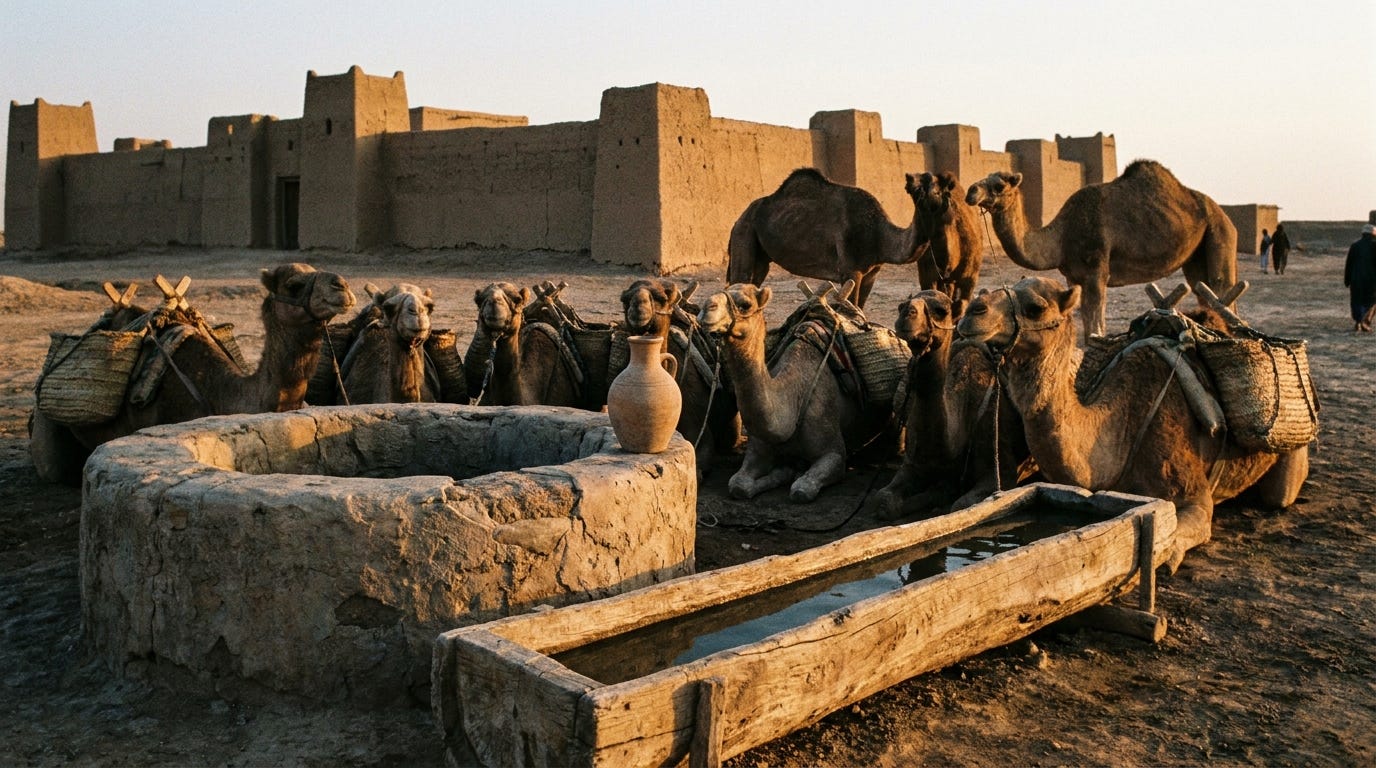
Ten camels knelt in the dust outside the town of Nahor as the light went. Abraham's servant had come hundreds of miles north to Aram-naharaim, and he stopped at the well "at the time when the women went out to draw water" (Genesis 24:11).
He carried gold, a sworn oath, and Abraham's account of a God who had promised to send His angel ahead. He had no plan beyond that. So he prayed.
What did Abraham's servant pray at the well?
"O LORD, God of my master Abraham" (Genesis 24:12), he began, and asked God to "please grant me success today, and show kindness to my master Abraham" (Genesis 24:12).
Then he asked for something specific. A girl would come down to the spring and he would ask her for a drink. If she answered, "Drink, and I will water your camels as well" (Genesis 24:14), she would be the one. "By this I will know that You have shown kindness to my master" (Genesis 24:14).
That was a big ask. A camel at the end of a desert crossing can drink more than twenty gallons, and he had ten of them. He was asking for a stranger who would volunteer an evening of hauling water up from a spring, one jar at a time.
How did God answer the servant's prayer?
"Before the servant had finished praying, Rebekah came out with her jar on her shoulder" (Genesis 24:15). She gave him his drink, offered the camels water in nearly the words he had prayed, and "ran back to the well to draw water, until she had drawn water for all his camels" (Genesis 24:20).
Centuries later God said this about His people through Isaiah: "Even before they call, I will answer, and while they are still speaking, I will hear" (Isaiah 65:24).
The servant stood by the trough and said nothing. "Meanwhile, the man watched her silently to see whether or not the LORD had made his journey a success" (Genesis 24:21). He had asked God for a sign, and now he weighed what he saw against what he had asked, all the way to the question of whose daughter she was. When she said she was the granddaughter of Nahor, Abraham's brother, he had his answer.
What does the servant's worship teach about knowing God?
"Then the man bowed down and worshiped the LORD" (Genesis 24:26). His first words were about God: "Blessed be the LORD, the God of my master Abraham, who has not withheld His kindness and faithfulness from my master" (Genesis 24:27). Then he added a sentence that was new for him: "As for me, the LORD has led me on the journey to the house of my master's relatives" (Genesis 24:27).
That morning he knew God as his master's God. By nightfall he could say what God had done for him on the road. He heard Abraham's account, tested it with one plain request, watched carefully, and named what God had done before a single camel was unloaded. This is how a borrowed knowledge of God becomes your own, and it is why we keep what He does: so that we know Him, and find that He has known us all along.
How does Rebekah at the well point to Jesus?
In Genesis and Exodus, wells are where brides are found: Rebekah here, Rachel for Jacob, Zipporah for Moses. In John's Gospel Jesus, "weary from His journey, sat down by the well" (John 4:6). A Samaritan woman came out for water at noon, and He asked her for a drink (John 4:7). Abraham's servant asked a woman for water and found a bride for his master's son. Jesus asked a woman for water and told her, "He would have given you living water" (John 4:10). The Son came to the well Himself.
What has God already answered for you?
We know this prayer and its answer because the servant told it. Later that night he repeats the whole account to Rebekah's family. When God answers you, record it the same day in the Doxa app: what you asked, what happened, and the date. Then read it back the next time you have to pray for something you cannot arrange yourself.
What did you ask God for that He answered before you had finished asking?
Keep exploring. If this raised a question, or brought back something God has said to you, take it further. Ask Doxa. It answers from Scripture, real stories, and your own journey, free in your browser. No signup to start.
Download Doxa, the app for recording, weighing and remembering prophetic encouragement.
Also please feel free to read the Doxa Deeper Dive below where we delve into the original language and historical context.
The Doxa Deeper Dive
Did Rebekah Just Happen By? Chance and Kindness in Genesis 24:10–27
Originally published on the Doxa blog.
The servant's first request at the well is translated "please grant me success today" (Genesis 24:12). The Hebrew is shorter and stranger: haqreh-na lefanai hayyom, make it happen before me today. The verb is qarah (H7136), to meet, to befall, to happen.
What does "grant me success" mean in Genesis 24:12?
Qarah is the word Hebrew uses for what English calls chance. Its noun, miqreh (H4745), is the thing that simply happens. When Ruth goes out to glean, the English reads, "she happened to come to the part of the field belonging to Boaz" (Ruth 2:3). The Hebrew stacks the verb and the noun together, her chance chanced upon the field, and the rest of the book shows God arranging every step of it.
The servant takes that word for chance and puts it inside a prayer. He asks God to make the meeting happen. Whatever the women at the spring would have called it that evening, he had named in advance who arranges such things.
The same phrase comes back one generation later, in a much worse mouth. Jacob, dressed in his brother's clothes, explains to his blind father how he found the game so fast: "Because the LORD your God brought it to me" (Genesis 27:20). The Hebrew is hiqrah YHWH elohekha lefanai, the same causative form of qarah with the same lefanai, before me. An English reader sees two unrelated sentences. A Hebrew listener heard the servant's prayer turned into Jacob's alibi: one man asked God to make something happen and then watched to see if He would, and the other claimed God had made it happen to cover a lie already told.
Why did the servant ask for such a specific sign?
A traveller in that world could expect a drink of water from a stranger at a well. Watering his animals was his own job. The spring outside Nahor's town also lay below ground level: Rebekah "went down to the spring, filled her jar, and came up again" (Genesis 24:16), so every jar for the trough meant a climb with the weight on her shoulder.
So the servant asked for a sign that tested character. The woman he wanted would show Abraham's own kind of hospitality. At Mamre, when three strangers appeared, Abraham "ran from the entrance of his tent to meet them" (Genesis 18:2), and then "Abraham hurried into the tent" (Genesis 18:6). At the well Rebekah "quickly lowered her jar" (Genesis 24:18), "quickly emptied her jar into the trough and ran back to the well" (Genesis 24:20). The servant had prayed for a girl who would run the way his master ran.
How did Israel first hear the gold ring in Genesis 24:22?
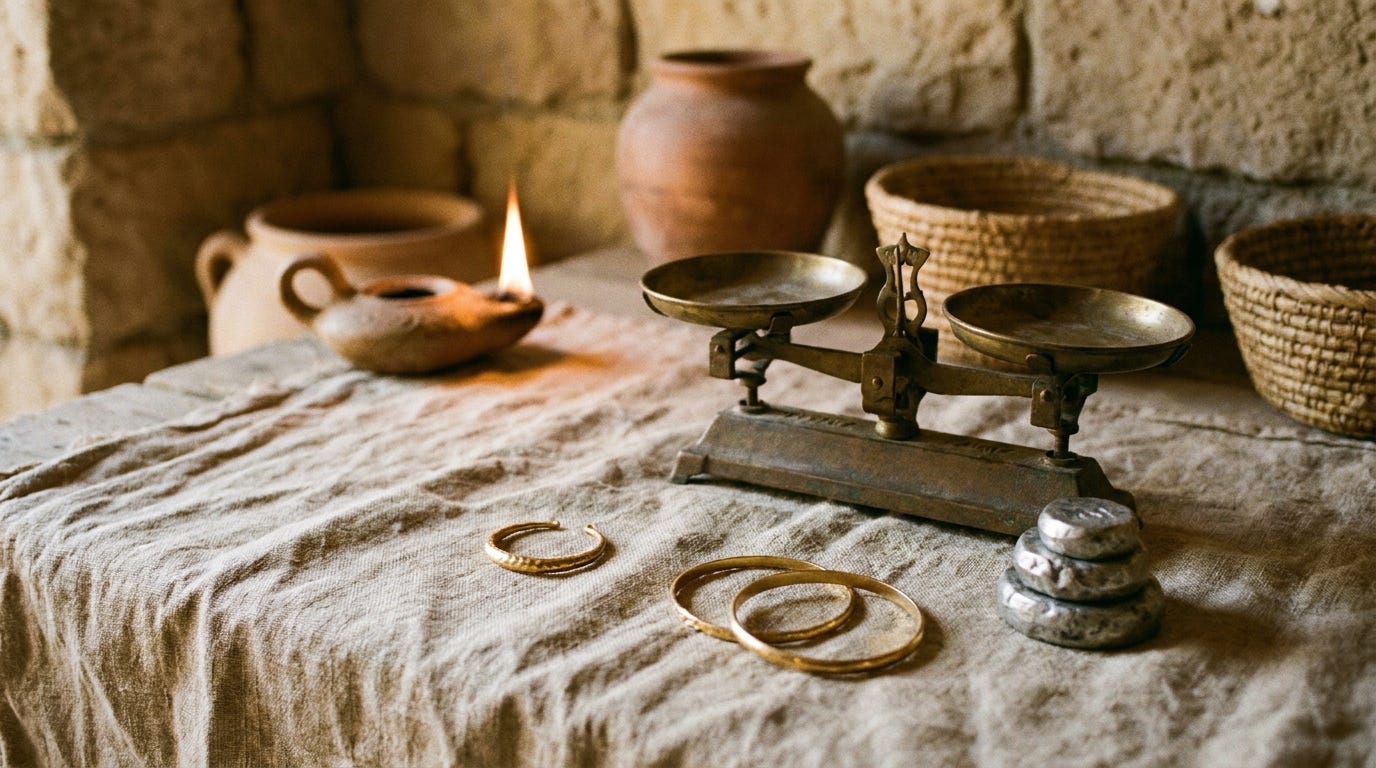
After the camels drank, the servant brought out "a gold ring weighing a beka" (Genesis 24:22). The word beqa (H1235) appears only twice in the Hebrew Bible. The other place is the census at Sinai, where every man counted gave "a beka per person, that is, half a shekel, according to the sanctuary shekel" (Exodus 38:26). The law behind that census called it "a ransom for his life when he is counted" (Exodus 30:12).
Genesis was first read to that people. Every man listening had weighed out a beka of silver to be counted among Israel, and their tabernacle stood on the silver they gave. When they heard that Isaac's bride received a beka of gold at the well, they heard their own offering in the story of the woman who would carry the promised line. She was marked with the measure they had paid to belong to Him, in the story of a servant who was about to know Abraham's God for himself.
Why did the servant bless God for kindness and faithfulness?
Chesed (H2617), the loyal, covenant kindness BSB here translates kindness, comes three times in this passage: twice in the servant's requests, and once in his thanks. When the answer comes he blesses God "who has not withheld His kindness and faithfulness from my master" (Genesis 24:27), and adds a second word, emet (H571), faithfulness, truth, the quality of something that holds when you lean on it. Here is where Scripture first sets the two words side by side.
Israel heard that pair again at Sinai, from God Himself. On the mountain, with Moses hidden in the rock, God announced His own name and described Himself as "abounding in loving devotion and faithfulness" (Exodus 34:6). The Hebrew is rav-chesed ve-emet, the same two words. A servant at a nameless spring in Aram had blessed God for exactly what God would later say about Himself on the mountain, and it was the same God either way.
John reaches for that pair when he describes Jesus. "The Word became flesh and made His dwelling among us. We have seen His glory, the glory of the one and only Son from the Father, full of grace and truth" (John 1:14). Three verses later: "the law was given through Moses; grace and truth came through Jesus Christ" (John 1:17). Moses heard chesed ve-emet proclaimed in a cloud. The servant saw it at a well. In Jesus it lived among us.
What does the servant show about knowing God?
At the well the servant asked God to show him "the one You have appointed" (Genesis 24:14). That verb is yakach (H3198), which usually belongs in a law court: to argue a case, to decide between two parties. It is the verb in "Come now, let us reason together" (Isaiah 1:18). The servant was asking God to rule on the matter, and then he waited for the ruling.
The verb yada (H3045), to know, runs through his prayer and his watching. "By this I will know" (Genesis 24:14), he prays. In verse 21 BSB says he watched "to see whether or not the LORD had made his journey a success" (Genesis 24:21); the Hebrew infinitive there is lada'at, to know. He asked to know, and then he stood silent long enough to know.
When he did know, his language changed. He began the evening with "God of my master Abraham" and ended it with "As for me, the LORD has led me" (Genesis 24:27). The verb is nachah (H5148), the one David uses in "He guides me in the paths of righteousness" (Psalms 23:3). The servant set out knowing about God through Abraham. He stood at the door of his master's relatives knowing God, and known by Him, at the end of a road God had led him down.
Keep a record of where God has led you, the place, the date, and what He did, in the Doxa app. Then "the LORD has led me" (Genesis 24:27) is a sentence you can say again with the evidence in front of you, and the God you are getting to know has a history with you that you can read.
Keep exploring. If this raised a question, or brought back something God has said to you, take it further. Ask Doxa. It answers from Scripture, real stories, and your own journey, free in your browser. No signup to start.
Questions and comments are welcome below.
Download Doxa, the app for recording, weighing and remembering prophetic encouragement.