

The family packs up for Canaan and stops halfway.
After Babel scatters the nations across the earth, Genesis does something quiet. It picks one family out of the crowd and follows it home. "This is the account of Terah" (Genesis 11:27). Terah fathered Abram, Nahor and Haran; Haran fathered Lot, then died "in Ur of the Chaldeans" (Genesis 11:28) while his own father was still alive, in the city where the family had always lived. Two of the sons marry. And then a line that stops you cold: "But Sarai was barren; she had no children" (Genesis 11:30).
That is the family the whole Bible is about to hang on. A father who has already buried a son. A daughter-in-law who cannot have one. On paper, this line has already run out before it starts.
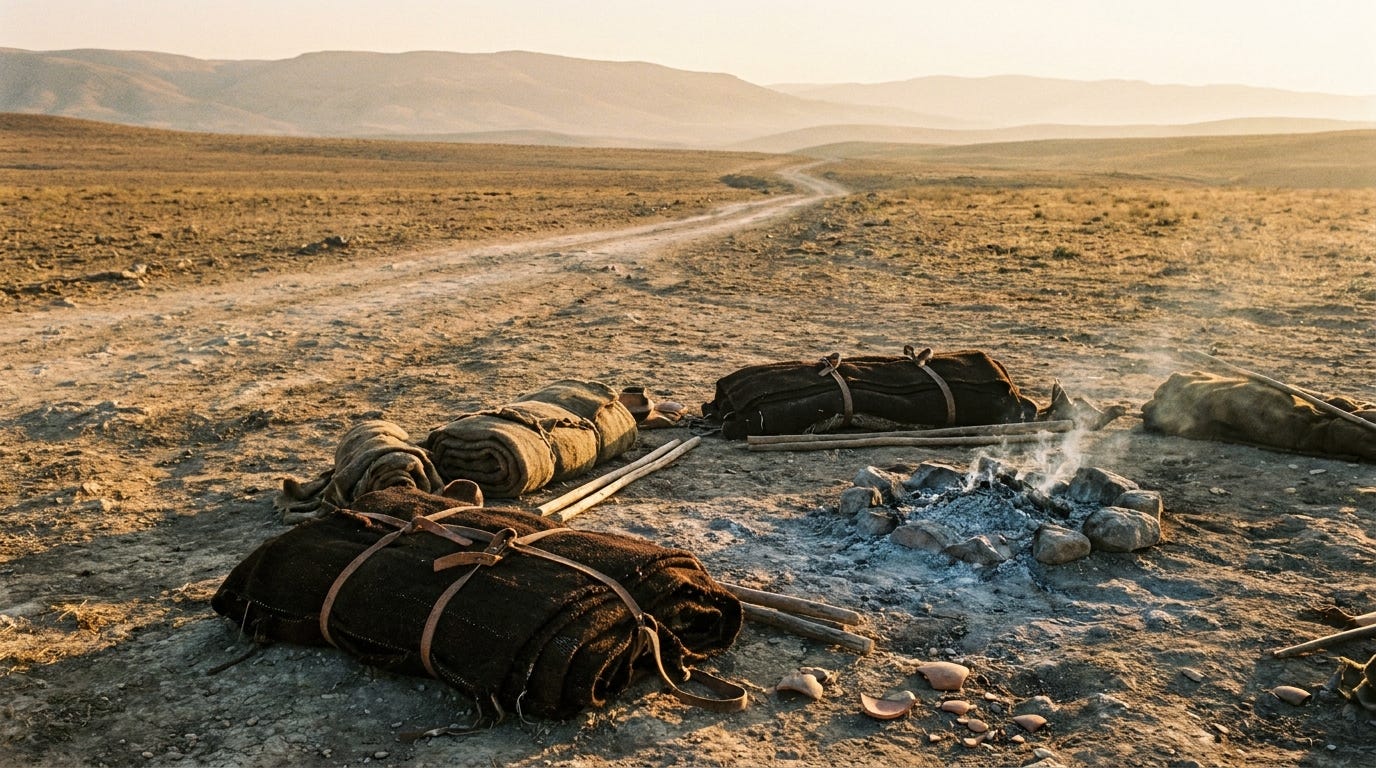
Then Terah moves. He gathers Abram, Lot and Sarai and "they set out from Ur of the Chaldeans for the land of Canaan" (Genesis 11:31). Watch where they land. "But when they arrived in Haran, they settled there." Canaan was the destination. Haran was halfway. They aimed at one place, stopped in another, and there Terah lived out his years and died at two hundred and five (Genesis 11:32).
What is Genesis doing with a barren wife and a stalled journey?
It is showing us a family with nothing left of its own. Sarai's womb is closed. Terah's feet stop short of the land. The generation that should carry a future is pointed at Canaan and settled in Haran, going nowhere.
That is the exact spot where God speaks. Turn one page and a voice breaks into the silence: "Leave your country, your kindred, and your father's household, and go to the land I will show you" (Genesis 12:1). The promise starts precisely where Abram's strength, Sarai's body and Terah's resolve have all run dry. To know the God who speaks is to trust Him right here, where nothing but His word is holding the future up. He will build a nation from a barren womb and finish the journey Terah abandoned in Haran.
How does this reach all the way to Jesus?
Barren is where God likes to begin. Paul says Abraham came to trust "the God who gives life to the dead and calls into being what does not yet exist" (Romans 4:17), and he learned it standing next to Sarai. The child who finally comes is life pulled out of a closed womb, the first of a long line of impossible births that runs to a virgin in Nazareth and an empty tomb outside Jerusalem. The family that could not continue itself became the family through whom "all the families of the earth will be blessed" (Genesis 12:3), and God kept that word the whole way to Christ.
What this means when your own road has stalled
Here is the lift. You may be sitting in your own Haran right now, stopped halfway to something God once set in your heart, certain the door has shut. This passage was written for that seat. The family looked finished, and God had not yet said a word.
So do what the story quietly asks. Remember what He actually said, and hold it up against what you can see. Write down the word God gave you for the road, especially the part that looks impossible now, so that on the days you feel settled in Haran you can read it back and trust the One who has not finished with you. What did He say to you that you have quietly started treating as over? Get it down today.
The Doxa Deeper Dive
Sarai Was Barren: Why God Empties a Family Before He Calls It (Genesis 11)

A new chapter of Scripture usually opens on a beginning. This one opens on an ending. Before Genesis 11:27-32 introduces the man God will build a nation from, it takes the family apart, and the Hebrew makes the emptying deliberate. A son buried. A womb closed. A journey abandoned. Read closely, the passage is God clearing away everything the promise could have leaned on, so that when He speaks in the next chapter there is nothing left to lean on but His word.
What does "the account of Terah" set up?
The passage opens, "This is the account of Terah" (Genesis 11:27). The word is toledoth (H8435), a generations-record, the recurring seam that hands the story of Genesis from one keeper of the promise to the next. But this toledoth does something the others do not. It opens with a death: "During his father Terah's lifetime, Haran died in his native land" (Genesis 11:28). The name Terah (H8646) is itself uncertain, linked by many to wandering or delay, and the record that carries his name is a record of loss and stalling. Genesis is naming the family exactly, and the name it gives them is heavy with loss and delay.
Where is Ur of the Chaldeans, and why does it matter?
Twice the passage anchors the family in "Ur of the Chaldeans" (Genesis 11:28), Ur (H218) of the Kasdim (H3778). Ur was no backwater. It was one of the great cities of ancient Sumer, wealthy, literate, and devoted to the moon-god. That detail matters because the Bible later says so plainly. Joshua reminds Israel that "your fathers, including Terah the father of Abraham and Nahor" (Joshua 24:2) "worshiped other gods." The family God is about to call are idolaters in a pagan city, with no claim on Him at all. Whatever comes next will be God reaching down to them, pure initiative on His side.
Why does the Bible stop to say Sarai was barren?
Right at the centre sits the sentence the story turns on: "But Sarai was barren; she had no children" (Genesis 11:30). The word is aqar (H6135), barren, and the Hebrew doubles down, stating outright that she had no child, so no reader can miss it. Genesis plants that line as a theological flag at the head of the whole promise. The wife of the man God will make into a great nation cannot have a single child. Sarai (H8297), whose name God will later change to Sarah (H8283), princess, mother of nations, begins as a closed door. Genesis wants the impossibility on the record before the promise is ever spoken, so that when Isaac is finally born, nobody can mistake whose doing it was.
What does it mean that the family settled in Haran?
Then the family moves, and the wording of the move is the quiet tragedy of the passage. They "set out from Ur of the Chaldeans for the land of Canaan. But when they arrived in Haran, they settled there" (Genesis 11:31). The destination was Canaan (H3667); what they did instead was yashab (H3427), to sit, to dwell, to settle down and stay. They aimed at Canaan and yashab in Haran, and there Terah died. A word study catches something English hides here too. The son who died back in Ur was Haran (H2039), while the city they stopped in is Charan (H2771), a different Hebrew word that only sounds the same to us. The family that lost a son named Haran now sits down in a place that echoes his name, halfway to the land, going no further under its own strength. When God finally speaks, the same journey is finished with a different verb, "So Abram departed, as the LORD had directed him" (Genesis 12:4). Terah settled. Abram, once he had heard, went.
How does this point to Jesus?
Everything the Hebrew has stacked up, death, barrenness, idolatry, a stalled road, is the ground God chose to plant His promise in. The next verses are pure gift. God tells Abram, "I will make you into a great nation, and I will bless you" (Genesis 12:2), and then widens the promise to the whole world, that "all the families of the earth will be blessed through you" (Genesis 12:3). A childless couple from a pagan city are told they will father nations and bless the world, and the only reason it can happen is the God who speaks it. Paul names the God Abraham learned to trust: "the God who gives life to the dead and calls into being what does not yet exist" (Romans 4:17). The closed womb of Sarai is the first note of a song that runs through Scripture, life brought out of deadness, and it does not resolve until a virgin conceives in Nazareth and a sealed tomb opens outside Jerusalem. Paul says the promise to Abram was always aimed there: the offspring is "One, who is Christ" (Galatians 3:16). The blessing for all the families of the earth is Jesus.
Why does this matter for knowing God?
Because this passage teaches us where the God who speaks likes to start. He starts with a family that has run out, so the promise rests on His word and nothing else. To know Him is to trust that His speaking, not your strength, is what holds your future up. Which means the practice this whole walk is built on matters most exactly when you feel settled in your own Haran, stopped short of something He once said. Record what He told you. Read it back on the days it looks impossible. Hold it against the closed door in front of you, and remember that the God who filled a barren womb and carried a stalled family all the way to Bethlehem has not finished speaking over you. He calls into being what does not yet exist. That is the God this walk is teaching you to know.
Keep exploring. If this raised a question, or brought back something God has said to you, take it further. Ask Doxa. It answers from Scripture, real stories, and your own journey, free in your browser. No signup to start.
Questions and comments are welcome below.