

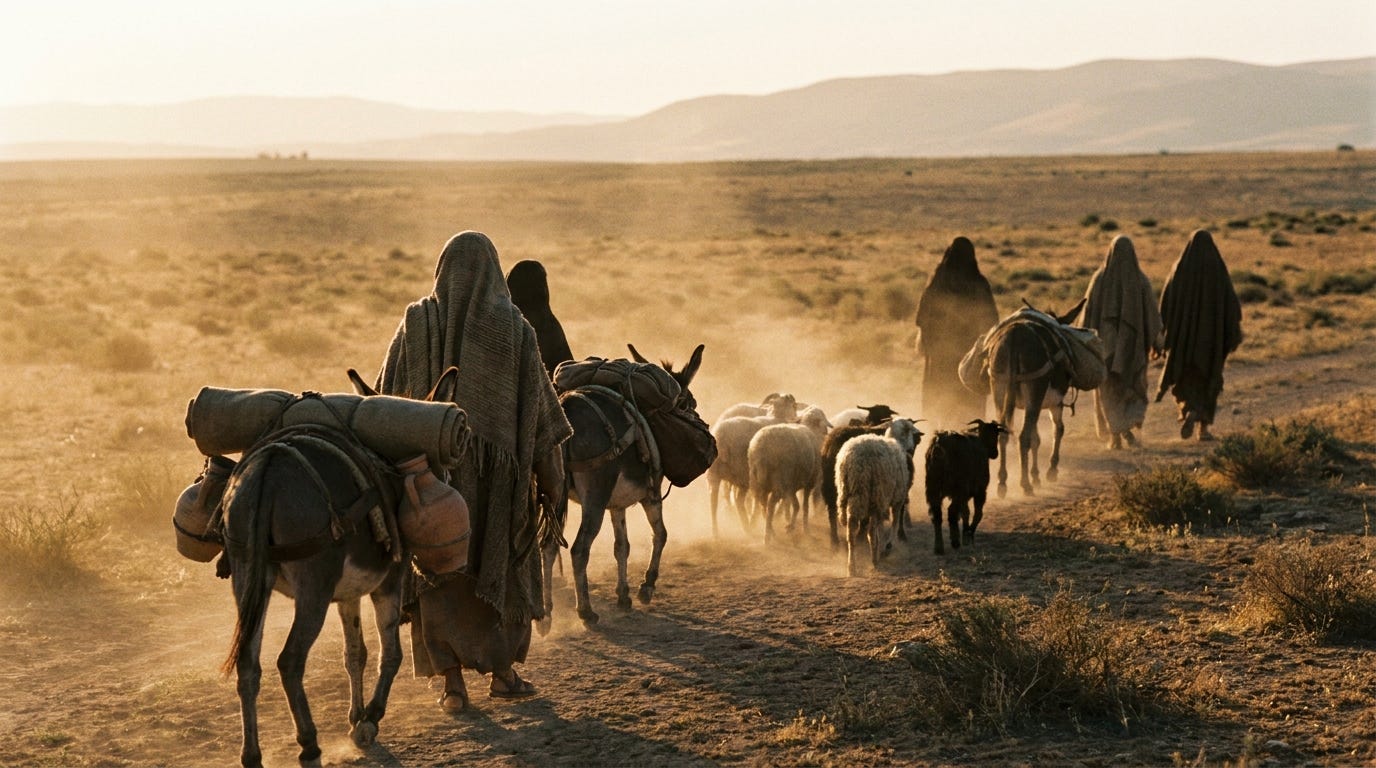
The word comes with no map.
Abram is settled in Haran, the place his father Terah aimed past and never left. Then a voice breaks into that settled life: "Leave your country, your kindred, and your father's household, and go to the land I will show you" (Genesis 12:1). Look at what God spells out and what He leaves blank. The country to leave, the kindred, the father's house, all of it is named. The destination is left as the land God will only show him on the way, a place Abram will see once he is already walking. The whole future hangs on one voice he cannot see.
And the promise attached to it is enormous for a man with a barren wife: "I will make you into a great nation, and I will bless you; I will make your name great, so that you will be a blessing" (Genesis 12:2). Then it widens past Abram altogether: "all the families of the earth will be blessed through you" (Genesis 12:3). A childless man in a pagan town is told the whole world will be blessed through his line.
What does Abram do with a word like that?
He goes. "So Abram departed, as the LORD had directed him" (Genesis 12:4). Seventy-five years old, he gathers Sarai, Lot and everything they own and sets out for a country God still has not named (Genesis 12:5). This is what it looks like to know the God who speaks: you weigh the word against everything you can see, and then you move on the word. Terah settled in Haran and died there. Abram heard, and went.
Watch where he stops. At the Oak of Moreh at Shechem the LORD appears and says, "I will give this land to your offspring" (Genesis 12:7). Abram is standing in a land full of Canaanites, owning none of it, with no offspring at all, and God calls it his children's. So Abram builds an altar there. He moves on toward Bethel, builds another, and "called on the name of the LORD" (Genesis 12:8). Those altars are markers. Abram is pinning the word to the ground at the exact spot God spoke it, so he can come back and remember what was said here on the days the promise runs slow.
How does one man's journey reach all the way to Jesus?
That last line, "all the families of the earth will be blessed through you," is the promise the whole Bible is chasing. Paul reads it and says the offspring God meant was finally "One, who is Christ" (Galatians 3:16). The blessing for every family on earth walked out of Abram's line and into a manger in Bethlehem. And the way Abram received it, hearing a word and leaving on it before he could see the end, is the very faith Hebrews holds up: "By faith Abraham, when called to go to a place he would later receive as his inheritance, obeyed and went, without knowing where he was going" (Hebrews 11:8).
What this means when God has spoken and you cannot see the land
Here is the lift. You may be carrying a word from God that came with no map, a sense of where He is taking you and no clear sight of how you will get there. Abram shows you what to do with it. Build your altar. Write the word down at the place He gave it, plainly, with the date, so it is fixed somewhere outside your own memory. Then read it back on the days the land is still out of sight, and let it hold you the way it held a man of seventy-five walking toward a country he had never seen. What has God said to you that you once set out on, and have you written it down where you can find it again? Get it on the page today.
The Doxa Deeper Dive
Go From Your Country: The Command That Made Abram a Nation (Genesis 12)
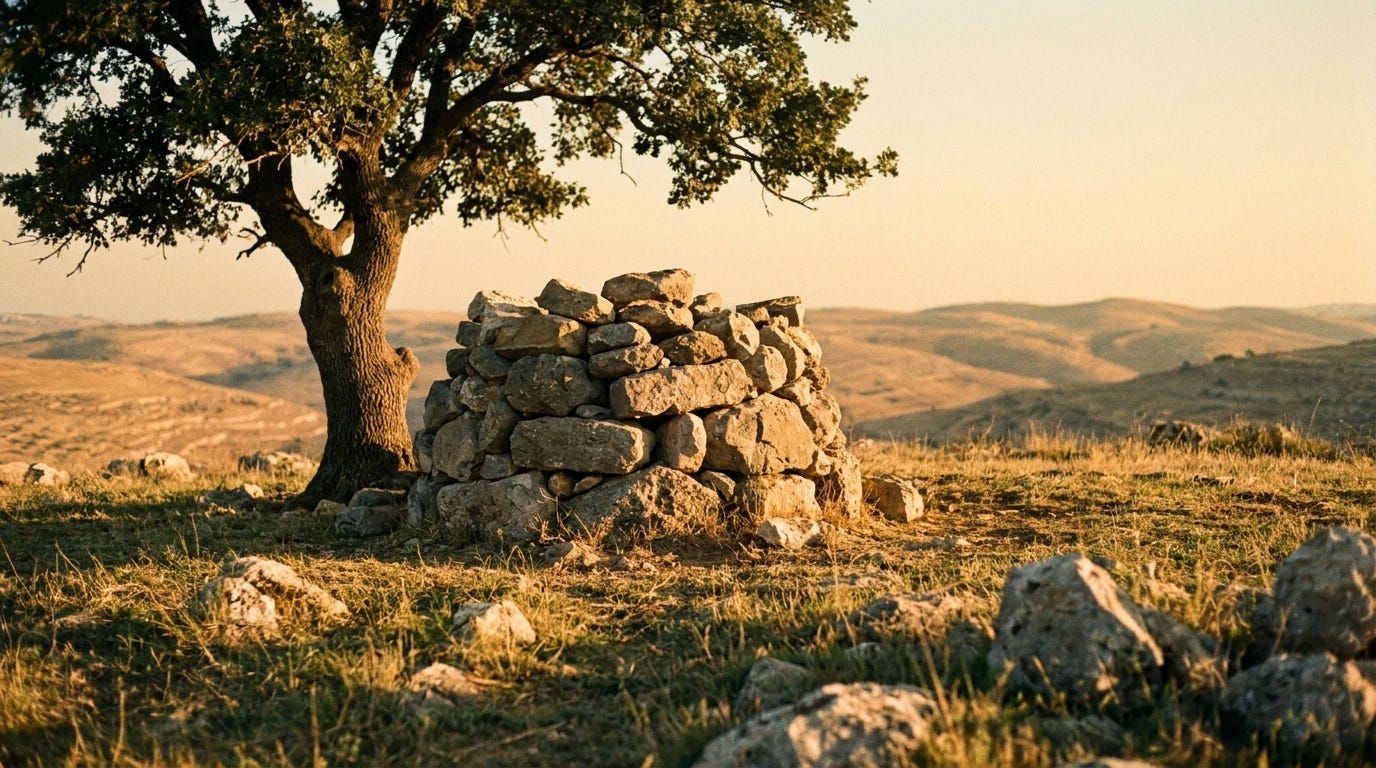
A whole nation begins with a command and no address.
What does the command lech-lecha ask of Abram?
The call opens, "Leave your country, your kindred, and your father's household, and go to the land I will show you" (Genesis 12:1). The verb at its heart is halak (H1980), to walk or go, and it comes in a pointed, doubled form, lech-lecha, that presses the command back on Abram himself: go, and go now. Before that one command God stacks three losses, each dearer than the last: the country, the moledet (kindred), and the beth av (father's house), the widening circles of everything that told Abram who he was. Then the destination is left blank, the land God will only show him once he is walking. Abram is ordered to walk away from every source of identity and safety he owns, toward a place he will only see once he is already moving. The command is bare on purpose. The one thing holding it up is the God who spoke it.
Why is the promise so much larger than one man?
Then comes the promise, and it is staggering for a man whose wife the previous chapter called barren. God says, "I will make you into a great nation" (Genesis 12:2). The word for nation is goy (H1471), a whole people with a land and a future, pledged to a couple with no child. And a second word tolls again and again through these two verses: barak (H1288), to bless, the deliberate reversal of the curse that has hung over the story since Eden. God will bless Abram, make his shem (H8034), his name, great, and make him a blessing to others. One chapter back, the men of Babel tried to make a name for themselves by building a tower (Genesis 11:4). Here God simply hands the great name to a man whose only task was to go.
Whose families get blessed, and why does the word matter?
The promise then breaks past Abram entirely: "all the families of the earth will be blessed through you" (Genesis 12:3). The word for families is mishpachah (H4940), the clans of the world, and the earth here is adamah (H127), the ground, the very word for the ground God cursed after the fall (Genesis 3:17). The same ground turns the other way here. The ground that was cursed will carry blessing again, and the blessing will travel through this one family. Paul reads the promise and refuses to leave it general. The "offspring" God kept naming, zera (H2233), seed, was finally "One, who is Christ" (Galatians 3:16). The blessing meant for every clan on earth turned out to be a person, born of Abram's line.
What did Abram do when he reached the land?
Abram obeyed, and the text keeps score of it: "So Abram departed, as the LORD had directed him" (Genesis 12:4). He was seventy-five. He came into Canaan (H3667) and travelled as far as the Oak of Moreh at Shechem (Genesis 12:6). Moreh (H4176) means teacher, and Abram's first halt in the land is a place whose name points to instruction. There "the LORD appeared to Abram" (Genesis 12:7) and said He would give the land to Abram's offspring. Abram is standing among Canaanites, owning nothing, still childless, and God calls the ground his descendants'. His answer is a mizbeach (H4196), an altar. He builds one at Shechem, moves on toward Bethel, builds another, and "called on the name of the LORD," qara (H7121) (Genesis 12:8). To call on the name is to worship and to say aloud whose word he is walking on. The altars become a map of the promise, a stone record left at every place God had spoken, so Abram could return to it.
How does this teach us to know the God who speaks?
Read the whole passage as one motion and the practice this walk is built on is right there in Abram's feet. God speaks a word Abram cannot verify. Abram weighs it, and rather than settle like his father he sets out on it. Then, where God confirms the word, he records it in stone and calls on the LORD's name, fixing the moment somewhere outside his own memory. He hears the word, weighs it, trusts it enough to move, and marks it so he can hold it when the promise runs slow. And it is slow. Abram will wait twenty-five years for the child this chapter already assumes, and the altars are how the word stays in front of him across that wait.
Everything Abram holds at the end of this chapter is a word. No land is his yet, no child, and the road ahead is still unnamed. He builds his life on the word anyway, and the altars say he decided it was enough. Hebrews names that faith: "By faith Abraham, when called to go to a place he would later receive as his inheritance, obeyed and went, without knowing where he was going" (Hebrews 11:8). The God who calls into being what does not yet exist starts a nation, and in time a Saviour, with nothing in hand but His own promise and a man willing to walk on it.
So build your altar. When God gives you a word, write it down at the place He gave it, with the date, and come back to it. That is how a promise survives the long years between the hearing and the seeing. It is how Abram came to know God, and how God means to be known by you.
Keep exploring. If this raised a question, or brought back something God has said to you, take it further. Ask Doxa. It answers from Scripture, real stories, and your own journey, free in your browser. No signup to start.
Questions and comments are welcome below.