

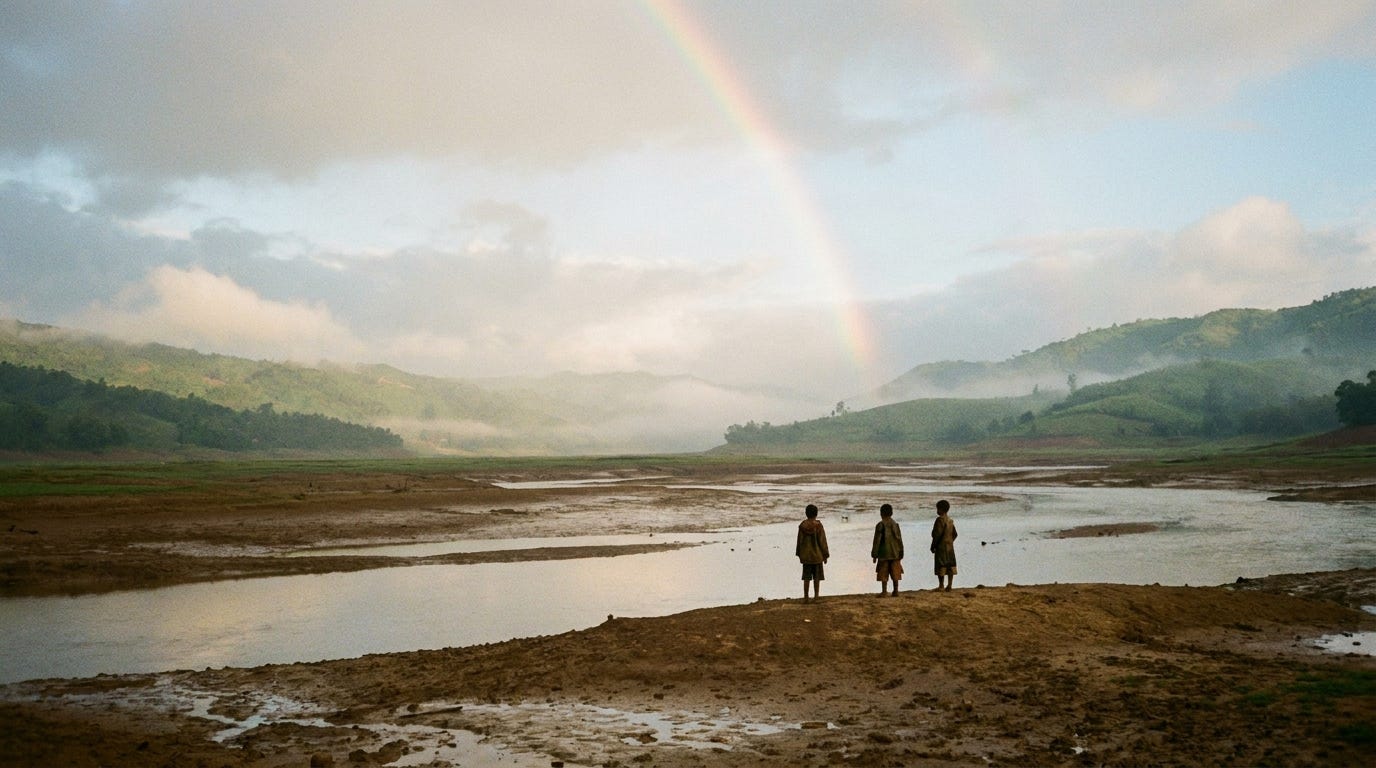
The rain has stopped for good, and Noah is standing under an open sky.
The ark is behind him. The altar he built is still smoking on the hillside (Genesis 8:20). God has already blessed him and drawn a line around human life (Genesis 9:1-6). Now God speaks one more time, and this time He makes a promise.
What covenant does God make with Noah?
God binds Himself to the whole earth. "Behold, I now establish My covenant with you and your descendants after you" (Genesis 9:9), and the promise reaches wider than Noah's family. It covers "every living thing that came out of the ark" (Genesis 9:10), every animal, every bird. The centre of it is one sentence: "Never again will all life be cut off by the waters of a flood" (Genesis 9:11).
Watch who is doing the work. Every verb belongs to God. He speaks, He establishes, He promises, and Noah stands and listens. This is a promise God makes about how He will treat the world, and He lets Noah hear Him make it. To know the God who speaks is to hear Him tie Himself to His own word, and to take Him at it.
Why does God put a rainbow in the sky?
Then God gives a sign to go with the promise. "I have set My rainbow in the clouds, and it will be a sign of the covenant between Me and the earth" (Genesis 9:13). Look at what the sign is for. God says that whenever He forms clouds over the earth and the rainbow appears, "I will remember My covenant" (Genesis 9:15). The rainbow is God's own reminder to Himself. He is the one who looks up when the storm gathers, sees the colours arc across the sky, and remembers what He swore.
The God who forgets nothing still hangs a sign in the clouds and says that when the rain comes, He will see it and remember His promise. He records His own word where He cannot miss it. The same God who "remembered Noah" while the water was still high (Genesis 8:1) now writes His promise across the whole horizon.
How does the rainbow point to Jesus?
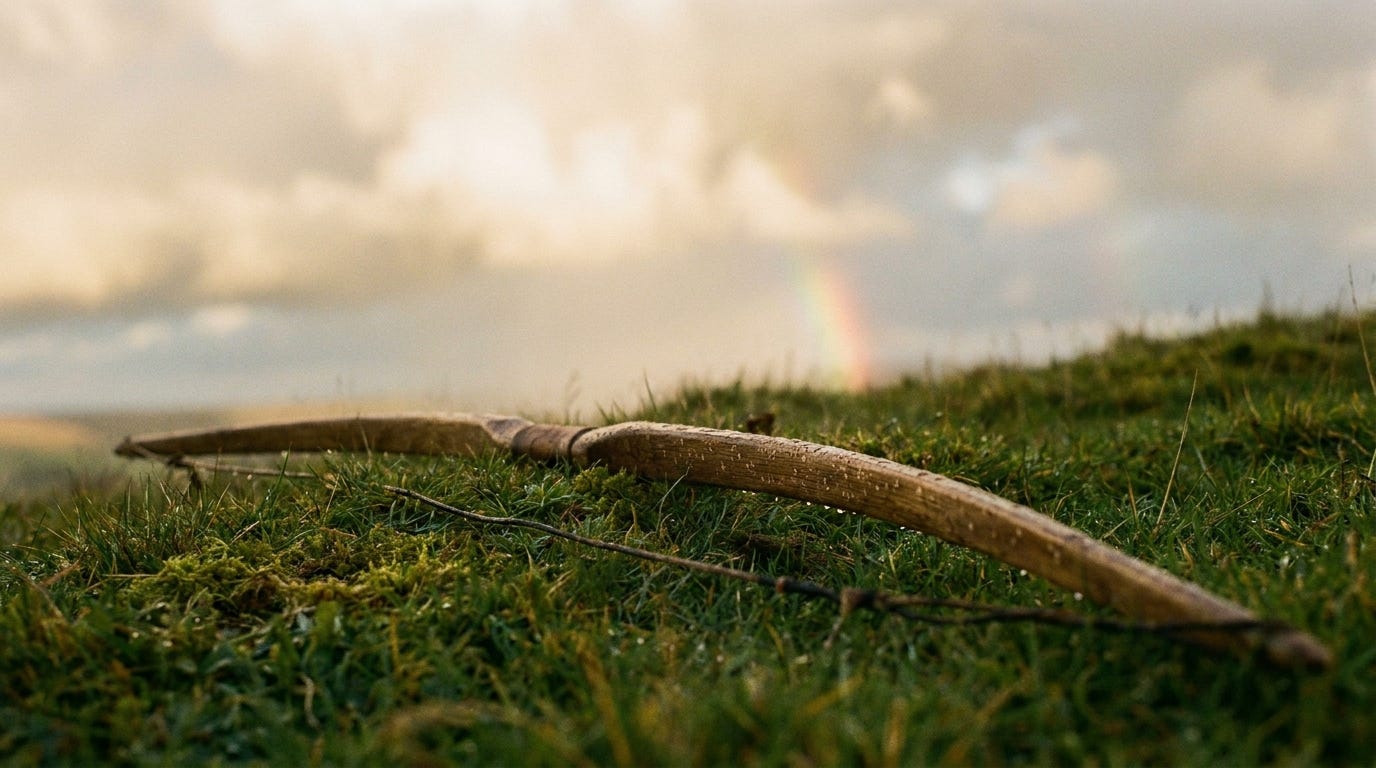
The word translated rainbow is the ordinary Hebrew word for a war-bow, the kind an archer draws in battle. God takes the bow of the storm and hangs it up in the clouds, its arc turned away from the earth. The judgment is spent. Much later God spoke through Isaiah and tied this very promise to something larger: "For to Me this is like the days of Noah, when I swore that the waters of Noah would never again cover the earth" (Isaiah 54:9), and He called it a covenant of peace that "will not be broken" (Isaiah 54:10). That peace has a name. The writer of Hebrews points to Jesus, whom God raised "through the blood of the eternal covenant" (Hebrews 13:20). The rainbow was the first sign of a God who keeps His word forever, and the cross is where He paid to keep it.
So here is the lift. God put His promise where He would see it, out in the open, across the whole sky. When God says something to you, do the same with it. Write it down. Put it somewhere the next storm cannot make you forget it. The rainbow shows you how a promise is meant to be kept, on record and in plain sight, ready for the day the clouds come back.
When the sky over your life goes dark, what has God already told you that you need in front of your eyes again? And where could you write it down today, so that the next time the rain starts, you remember what He swore?
The Doxa Deeper Dive
The Rainbow Is a War Bow: Why God Hung It Up Unstrung (Genesis 9:8-17)
God ends the flood story the way He runs the whole of it, by speaking and then keeping His word.
Who makes this covenant, and who keeps it?
The passage turns on one Hebrew word, berith (H1285), covenant, which appears again and again across these ten verses. A berith in the ancient world was a binding agreement, usually cut between two parties who both took on terms. This one works differently, in a way worth sitting with. God says, "I now establish My covenant with you" (Genesis 9:9). The verb is qum (H6965), to raise up or confirm, here in the form that means God Himself sets it standing.
Every verb in the covenant has God as its subject. He establishes it, He gives it, He sets its sign, He remembers it. God asks Noah for nothing in return and lays no condition on him. Noah's only part is to hear what God has decided to do. That one-sidedness is the heart of the passage, and it is the first thing this scene teaches about knowing God. The God who speaks here is a God who binds Himself. He puts Himself under obligation to a family that had just come through judgment and to every animal breathing on the earth. To know Him is to know that His promises rest on His own faithfulness, and to hear a word like that is to be handed something you can stand on for the rest of your life.
What is the sign, and who is it for?
God attaches a sign to the promise. "This is the sign of the covenant" (Genesis 9:12); the word is oth (H226), a mark or token, the same word used for the mark God set on Cain (Genesis 4:15) and later for the sabbath (Exodus 31:17). "I have set My rainbow in the clouds" (Genesis 9:13). The word for rainbow is qeshet (H7198), and it is the everyday Hebrew word for the war-bow, the weapon an archer bends and draws. Almost everywhere else in the Old Testament qeshet is an instrument of battle. Here God takes the bow of the storm, unbends it, and hangs it in the clouds with its arc turned away from the earth. The weapon of the flood is laid down and put on display.
Then comes the line that should stop a reader. When the clouds gather and the rainbow appears, God says, "I will remember My covenant" (Genesis 9:15). The verb is zakar (H2142), to remember, and it is the same verb that opened Noah's rescue: "God remembered Noah" while the flood still covered the world (Genesis 8:1). In Scripture, when God remembers His covenant, He is moving to keep it. The word carries action. His remembering Noah in Genesis 8 was the wind over the water and the falling flood. So the sign is set where God will see it, and He says that when He sees it He will remember. He hangs His own promise on the wall of the sky.
This is where the passage speaks straight into the practice of recording and remembering. We write down what God says because we forget, and the record calls us back to it. God forgets nothing, and He still gives Himself a sign and says He will look at it and remember. Our remembering is a small copy of His. When you write down what God has told you and read it back on a dark day, you are doing in miniature what God does with the whole horizon. This habit is patterned on God Himself, the God who records His own covenant and keeps it in plain view.
Why call it everlasting?
By the end, God names the covenant's length. He calls it "the everlasting covenant" (Genesis 9:16); the word is olam (H5769), age-long, perpetual, without a foreseen end. This is the first covenant in Scripture that God calls olam, and it runs forward through the whole book. When Isaiah wanted to promise Israel that God's mercy would hold through anything, he reached back to this exact scene: "For to Me this is like the days of Noah, when I swore that the waters of Noah would never again cover the earth" (Isaiah 54:9), and then, "My covenant of peace will not be broken" (Isaiah 54:10). The flood promise became the pattern for every promise God would make after it.
Where does the bow finally point?
The everlasting covenant of Genesis 9 finds its end in Christ. Zechariah sang at the birth of his son that God had come "to remember His holy covenant" (Luke 1:72), the same zakar faithfulness now moving toward a manger. The writer of Hebrews names the peace the bow first pictured: "the God of peace, who through the blood of the eternal covenant brought back from the dead our Lord Jesus" (Hebrews 13:20). The bow God hung up over Noah was a sign that judgment had been spent; at the cross that judgment fell on God's own Son, and the peace was made to last forever.
The bow appears once more, at the very end. When John was shown the throne of heaven, he saw "a rainbow that gleamed like an emerald encircled the throne" (Revelation 4:3), the qeshet of Genesis wrapped clean around the seat of God. Ezekiel had seen the same thing, the glory of God shining "like that of a rainbow in a cloud on a rainy day" (Ezekiel 1:28). The sign God gave a frightened family on a muddy hillside turns out to circle His throne for eternity. The promise made after the flood is stitched into the centre of heaven.
Read Genesis 9 slowly and you meet the God who speaks and keeps what He says. He makes the covenant alone, He signs it with a laid-down weapon, He remembers it every time the sky darkens, and He carries it all the way to the throne. To know this God is to trust that the word He has given you will still be standing when the next storm breaks, because He is the kind of God who writes His promises where He will always see them.