

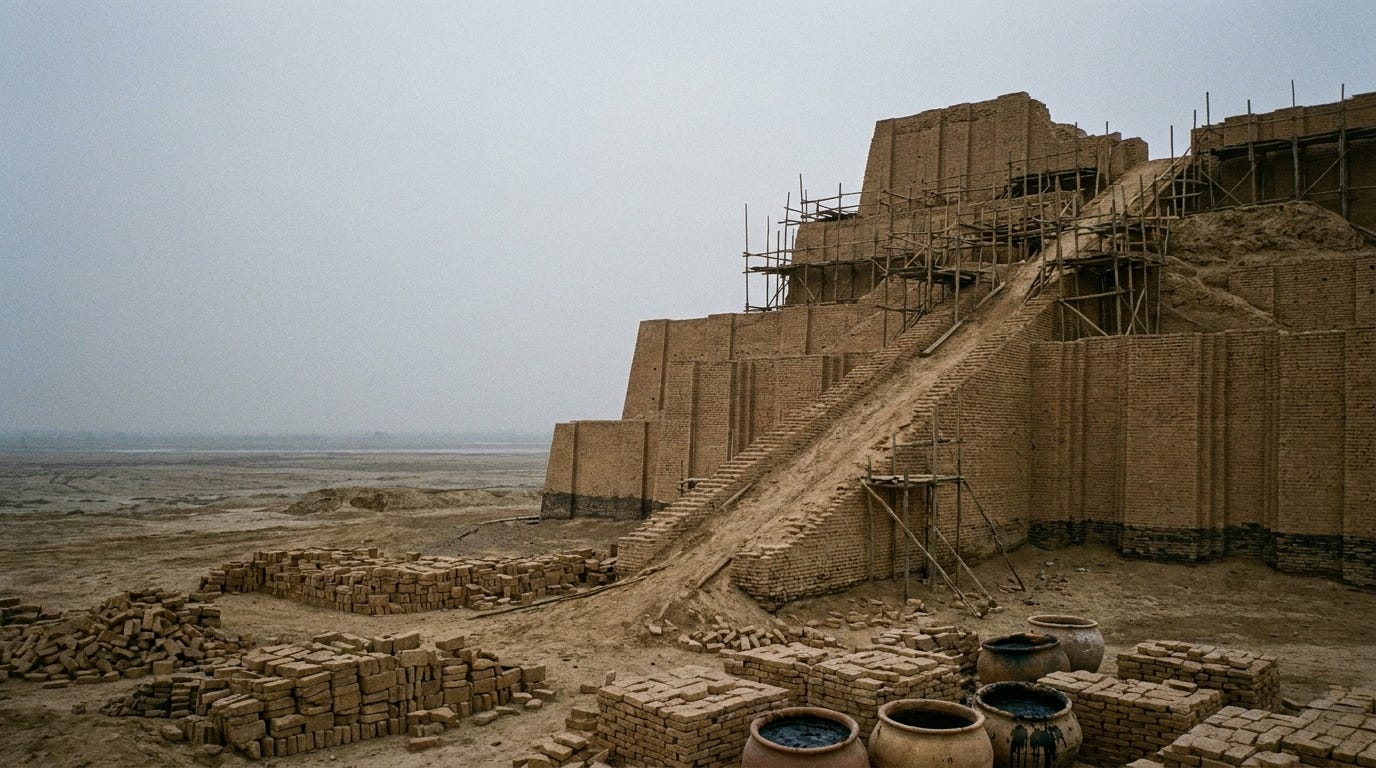
The whole world spoke one language, and the people were on the move. They came to a plain in the land of Shinar and settled, and someone said, let us make bricks and bake them hard. Then the plan grew. They said to one another, "let us build for ourselves a city with a tower that reaches to the heavens, that we may make a name for ourselves and not be scattered over the face of all the earth" (Genesis 11:4).
Read that last line slowly, because it is the whole problem. God had already told this family what to do. He blessed Noah as he came off the ark: "Be fruitful and multiply and fill the earth" (Genesis 9:1). Fill it. Spread across it. The people at Shinar had that word, and they poured a monument to the reverse of it. They would stay in one place. They would make a name they owned. They would climb to the heavens on a stair of their own baking.
What was really wrong with building the tower?
The problem was the refusal. God had spoken, and a whole civilisation heard Him and decided it would rather not listen. They wanted to be known on their own terms, by a name they made rather than by the God who made them. That is the negative of everything this walk is about. To know God is to take what He has said and shape your life around it. Babel took what God said and built the opposite in brick.
Then comes one of the quietly funny lines in Scripture. "Then the LORD came down to see the city and the tower that the sons of men were building" (Genesis 11:5). The tower was meant to reach the heavens, and God has to come down to find it. From where He sits it is very small. He is not threatened. He sees a people who will do themselves harm with their own unity, and He does the merciful thing. "Come, let Us go down and confuse their language" (Genesis 11:7). "That is why it is called Babel, for there the LORD confused the language of the whole world" (Genesis 11:9). The scattering they were so afraid of is what saves them from themselves.
How does Babel connect to Jesus?
Watch what God does in the very next breath. He walks up to one old man, Abram, and says, "I will make your name great" (Genesis 12:2). The name Babel grasped at, God hands over as a gift, to a man who simply believed Him. And the scattering runs all the way to a room in Jerusalem, where the Spirit falls and Galileans are suddenly heard in every language under heaven, "declaring the wonders of God" (Acts 2:11). At Babel God broke the one language so pride could not finish its tower. At Pentecost He fills every language so the good news can reach every nation those scattered people became. The name we could not build for ourselves is the one God gave His Son, "the name above all names" (Philippians 2:9).
So here is the lift. God offers to know you, and to hold you by a promise you never had to manufacture. The only question is what you will do with what He has said. You can build the reverse of it in brick, or you can write it down and let it stand over your life.
What has God already told you that you have quietly been building around instead of on? Name it today.
The Doxa Deeper Dive
Babel Means Confused: The Pun Hidden in the Tower's Name (Genesis 11:1-9)
Genesis 11 tells the last great story before Abram, and it is built on a pun that the English cannot quite carry. The people set out to make a name. They end up with a name that means the opposite of the one they wanted. To hear the chapter properly, you have to hear it in Hebrew.
What does the name Babel actually mean?
The city is called Babel (H894). In Babylonian, the name meant something grand, bab-ilu, the gate of god, a fitting title for a temple-tower reaching the sky. Genesis refuses that reading and gives its own, tying the name by sound to the Hebrew verb balal (H1101), to mix, mingle, or confuse. "That is why it is called Babel, for there the LORD confused the language of the whole world" (Genesis 11:9). The word they wanted to hear as gate of god, the narrator hears as babble. Their monument to their own greatness gets a name that means jumble. The pun is the verdict.
Why does making "a name" matter so much here?
The whole project is aimed at one Hebrew word. When they say "make a name for ourselves" (Genesis 11:4) they reach for shem (H8034), which means far more than a label. A shem is your reputation, your memorial, the thing spoken of you after you are gone, the mark that says you mattered and lasted. To make your own shem is to secure your own remembrance, to be known on your own terms without reference to anyone above you. The second half of their aim is just as telling: they build so that they will not be scattered over the earth. God had told Noah's family to fill the earth (Genesis 9:1); Babel aimed its whole engineering against that word. This is a people determined to be known while refusing to be known by the One who speaks.
What was the "one language," and why did God confuse it?
The chapter opens, "Now the whole world had one language and a common form of speech" (Genesis 11:1). The Hebrew literally says one saphah (H8193), one lip, and one set of words. That shared lip is what multiplied their power. "If they have begun to do this as one people speaking the same language, then nothing they devise will be beyond them" (Genesis 11:6). United speech in the service of a people who will not listen to God becomes a force that can carry any project, including a ruinous one. So God targets the lip. He confuses the saphah, and the machine stops. It looks like judgment, and it is mercy of a hard kind, because a people this united and this deaf to God would have done real harm with an unbroken run at their tower.
Why does the text dwell on bricks and a tower?
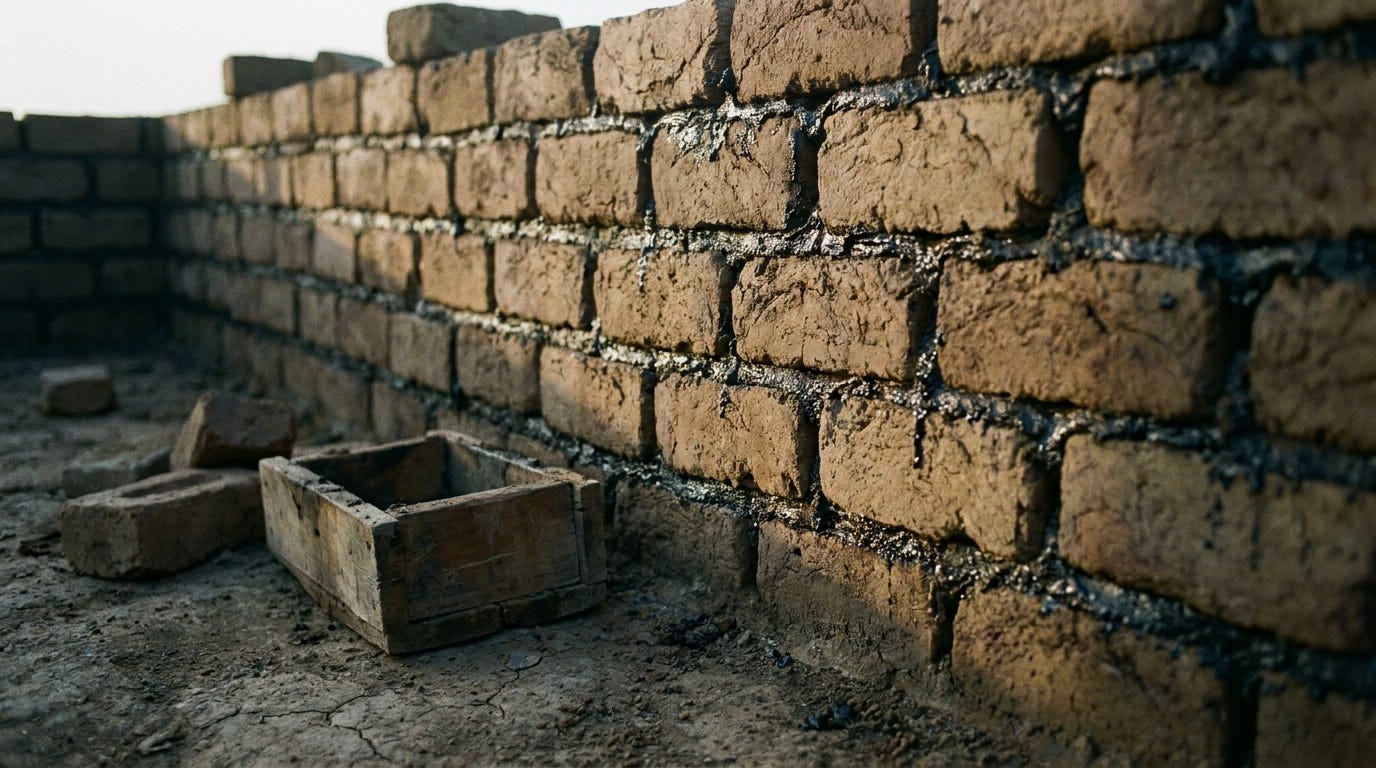
Genesis lingers on the building method. "Come, let us make bricks and bake them thoroughly. So they used brick instead of stone, and tar instead of mortar" (Genesis 11:3). The lebenah (H3843), the mud brick, is a manufactured stone, man-made where the surrounding hill country offered God-made rock. On the plain of Shinar (H8152), the region that becomes Babylon, everything is engineered from scratch, even the stone. Onto it they raise a migdal (H4026), a tower meant to reach the heavens. The picture is a self-made ascent to God's own realm, built of self-made stone, by people who will not do the one thing God actually asked. The tower stretches for the heavens, and the LORD "came down to see the city and the tower" (Genesis 11:5) to find it. The height that was meant to close the distance to God only shows how far off the whole project was.
What happened to the scattering they feared?
Their nightmare was to be puwts (H6327), scattered, dispersed across the land. It is the exact fate they get. "So the LORD scattered them from there over the face of all the earth" (Genesis 11:8). On its own the scattering sounds like a curse. In the flow of Genesis it is how the blessing starts to move, filling the earth as God had wanted from Noah onward and turning the seventy nations of the previous chapter into the field the promise will one day be sent across.
How does Genesis 11 point to Jesus?
Watch the seam between the chapters. Babel grasps for a great shem and is scattered. In the very next scene God says to Abram, "I will make your name great" (Genesis 12:2). The great name comes as a gift here, handed to a man who believes God and goes where he is told. And the confusion of tongues finds its answer at Pentecost, where Jews from every nation heard the apostles and each asked how "each of us hears them in his own native language" (Acts 2:8). At Babel the one lip is broken so pride cannot build; at Pentecost the many tongues are gathered so the gospel reaches every ear. The tower that could not reach heaven is answered by the Son who came down from it and was then given "the name above all names" (Philippians 2:9), the name at which every knee will bow. The name Babel could not make is the name into which God now writes anyone who trusts Him.
Why does this matter for knowing God?
Babel is the clearest picture in Genesis of the alternative to knowing the God who speaks. These people heard His word and built the reverse of it, because they wanted a name of their own more than they wanted to be known by Him. And it collapsed into babble. A life ordered around self-made remembrance ends where Babel ended. So take what God says the way Babel would not. Do not build monuments against His word; write it down, weigh it, and let it set your direction.
Keep exploring. If this raised a question, or brought back something God has said to you, take it further. Ask Doxa. It answers from Scripture, real stories, and your own journey, free in your browser. No signup to start.
Questions and comments are welcome below.