

There is one verse tucked into the roll call of Hebrews 11 that is easy to read past. It skips the sea-parters and the lion-mouth-shutters to talk about people who wandered, hid, and died with nothing to show for it. Heaven calls it the verse that overturns everything.
Hebrews 11:38: “The world was not worthy of them.”
Axios: a courtroom word
The Greek is hōn ouk ēn axios ho kosmos. Axios is a weighing word, the kind used on a set of scales to describe something of equivalent measure. The writer is rendering a courtroom verdict: the entire ordered world system, the kosmos, did not carry enough weight to balance against them.
Read that against what the world actually saw. Refugees. Failures. Fugitives sleeping rough. People whose lives, by every visible measure, had come apart. The world looked at them and passed judgment. Heaven looked at the same people and reversed it: the world didn’t deserve them.
That reversal is the entire point of the verse.
Wandering that wasn’t lostness
“They wandered” translates planōmenoi, from planáō, the root behind the English word planet. Planets earned that name because they appeared to drift across the sky with no fixed path, unlike the fixed stars. Applied to people, it’s a word for looking aimless. Rootless. Off course.
But the author of Hebrews uses it as praise. The wandering was the shape faithfulness took in a world that had no room for it.
Geography that names names without naming them
“Deserts and mountains, caves and holes in the ground” reads like a list until you notice the writer is pointing at specific people without saying their names. Elijah fleeing Jezebel into the wilderness, hiding in a cave at Horeb. David in the caves of Adullam and En Gedi, a fugitive from his own king. Believers hiding in desert caves during the Maccabean persecution generations later.
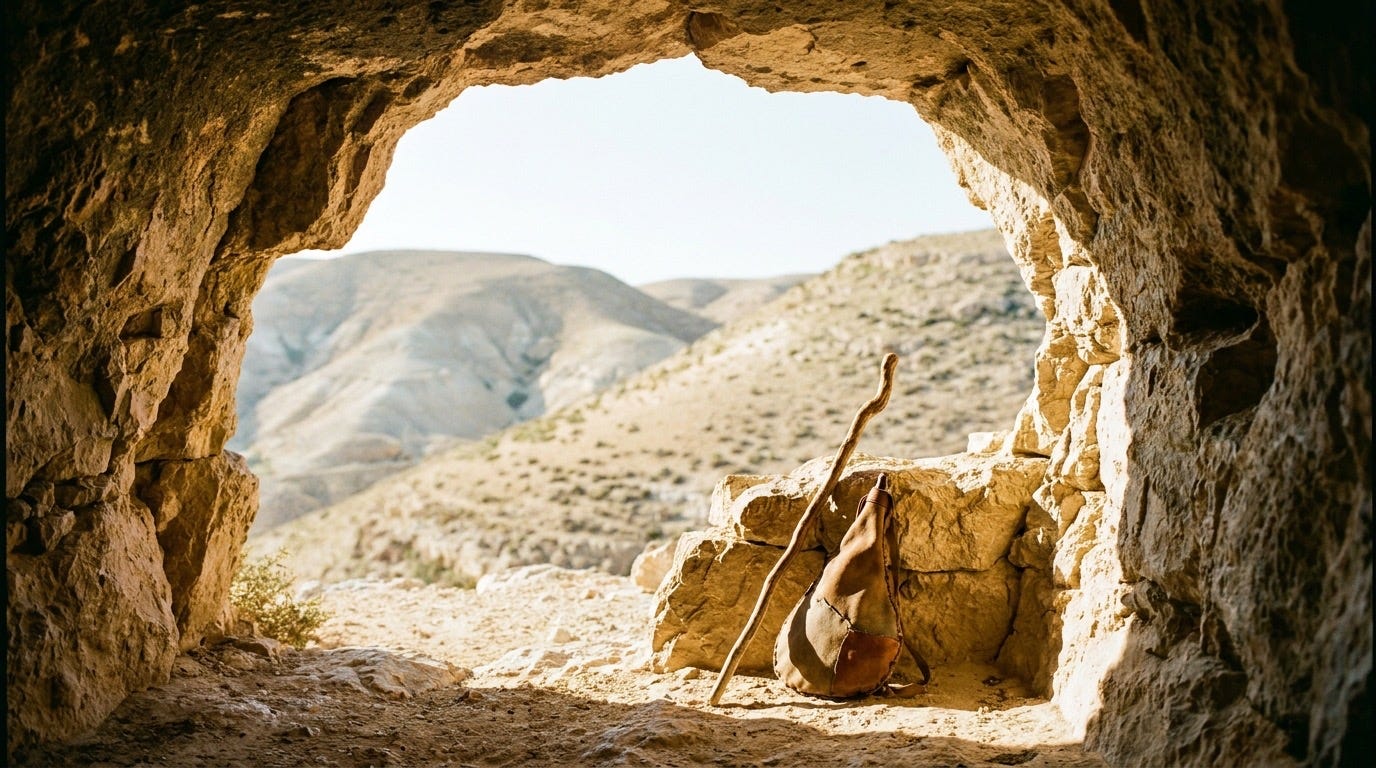
The author never names them. He just lets the geography talk. Caves. Holes. The margins of every map. And then drops the verdict like a thunderclap: the world was not worthy of them.
The part that should unsettle the way you measure your own life
Here’s what makes this theologically extraordinary. A few verses earlier, Hebrews 11:13 says these same people “died in faith, without having received the things they were promised.” They wandered. They hid. They died before the arrival. And Scripture holds them up as the definition of what faith looks like.
That dismantles a quiet assumption a lot of us carry: that hiddenness or an apparent lack of fruit means something has gone wrong, that unanswered means unfaithful. The ones in caves were not a lesser category of believer than the ones who parted seas. Same caliber of person. The world simply had no category to put them in.
If you are in a chapter that looks more like a cave than a conquest, you have not been demoted. You may be exactly where heaven is keeping its most careful record.
Recognize it. Then take hold of it.
This is where the verse stops being ancient history and starts being an invitation. Heaven’s record of you is not the same as the world’s verdict on you, and you are allowed to disagree with the verdict.
That’s a record to keep, built from the words that changed you, the moments you knew He showed up, the promises still standing between the calling and its arrival. Record it before the wandering makes you doubt it. Revisit it, hold onto it, and let it outweigh the chapters when the world’s scales say you don’t measure up.
That’s what The Encouragement Vault in Doxa is for: a record of what’s actually true about you, not just the good days, so that when a chapter looks like a cave, you have something more durable than the world’s verdict to stand on.
The world was not worthy of them. It may not have room for you either, in this chapter. Keep the record anyway.
Doxa is built to help you remember what God has said and done, even in the chapters that look like wandering. Keep your own record in The Encouragement Vault, and revisit it with Scripture and 1,700+ real stories of God’s faithfulness in The Grace Record. Get started free.
Originally published at https://doxa.app/blog/the-world-was-not-worthy-of-them
Thank you for opening up new insights in the way we see people / people are seen We don't see with God's eyes, feel with God's heart.