

Originally published on the Doxa blog.
The king came to Abraham's tents with the commander of his army beside him. Abimelech of Gerar had reason to take this foreigner seriously. Before Isaac was born, God had come to him in a dream and said, "You are as good as dead because of the woman you have taken" (Genesis 20:3). He had kept a close eye on Abraham since the night of that dream.
So he opened with what he had seen, "God is with you in all that you do" (Genesis 21:22), and then a king with an army asked a man who lived in tents for a promise: "swear to me here before God that you will not deal falsely with me or my children or descendants" (Genesis 21:23). Abraham's answer is two words in Hebrew. "I swear it" (Genesis 21:24).
What happens in Genesis 21:22–34?
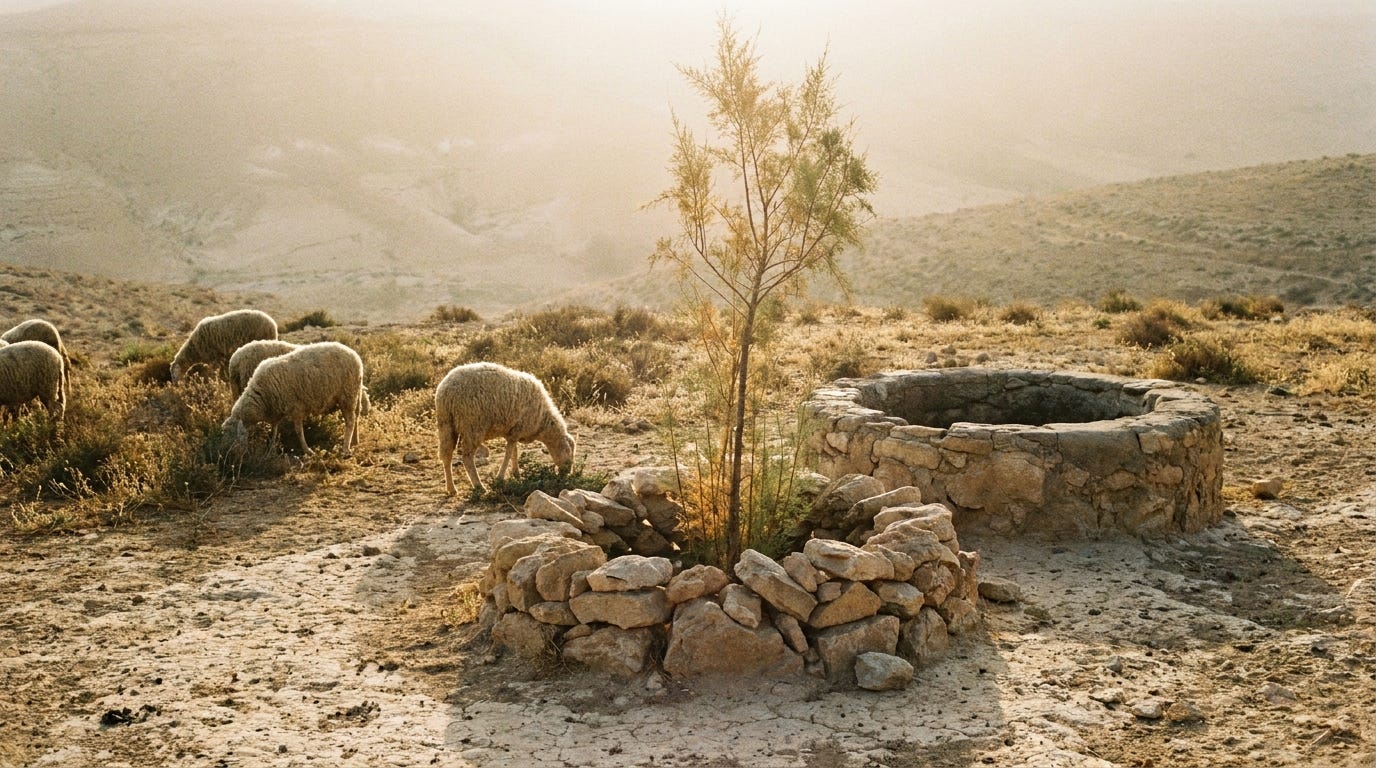
Then Abraham raised a complaint of his own. Abimelech's servants had seized a well that Abraham's men had dug (Genesis 21:25). In the dry country of the Negev a well decided whether a flock lived through the summer. Stephen said it plainly centuries later: God "gave him no inheritance here, not even a foot of ground" (Acts 7:5). The whole land was promised to him, and he was arguing over a hole full of water.
Abimelech said this was the first he had heard of it (Genesis 21:26), and the two men made a covenant. Then Abraham did something odd. He set seven ewe lambs apart from his flock, and when the king asked why, he said, "You are to accept the seven ewe lambs from my hand as my witness that I dug this well" (Genesis 21:30).
Why did Abraham give Abimelech seven lambs?
The lambs were evidence. Once the king had taken them in front of his commander, nobody in Gerar could say later that the well belonged to someone else. Then Abraham gave the place a name. "So that place was called Beersheba, because it was there that the two of them swore an oath" (Genesis 21:31).
The name outlived both men. After Abraham died, the Philistines filled his wells with dirt, and Isaac dug them out again "and he gave these wells the same names his father had given them" (Genesis 26:18). A generation on, the record was still there to be found.
Then Abraham planted a tamarisk tree in Beersheba, "and there he called upon the name of the LORD, the Eternal God" (Genesis 21:33). People plant trees where they mean to stay. God had already told Abraham that his descendants would wait four hundred years for this land and that he himself would be buried before then (Genesis 15:13–15). So he called on God by the name the promise needed. A man who would die before it came true leaned on the God who does not die.
Abraham learned that name for God at Beersheba because he kept hold of what God had told him, years after it was said. The keeping showed. A Philistine king with no stake in Abraham's faith had already seen that God was with him in all he did, and at the well Abraham called on that God by name, as a man who knew Him and was known by Him.
How does Genesis 21 connect to Jesus?
The letter to the Hebrews looks back at oaths like this one: "Men swear by someone greater than themselves, and their oath serves as a confirmation to end all argument" (Hebrews 6:16). Then Hebrews turns to God's promise to Abraham: "since He had no one greater to swear by, He swore by Himself" (Hebrews 6:13). Abraham called on the Eternal God beside a well he had to defend. We call on the same God through the Son who "has become the guarantee of a better covenant" (Hebrews 7:22).
If God has told you something that will take years to come true, write it down with today's date, the way Abraham put a name on the well; that is what the Doxa app is for. When the wait runs long, read it back and call on Him as the God who will still be there at the end of it.
What has God said to you that will take longer than this year to come true?
Keep exploring. If this raised a question, or brought back something God has said to you, take it further. Ask Doxa. It answers from Scripture, real stories, and your own journey, free in your browser. No signup to start.
Download Doxa, the app for recording, weighing and remembering prophetic encouragement.
Also please feel free to read the Doxa Deeper Dive below where we delve into the original language and historical context.
The Doxa Deeper Dive
El Olam: Why God Was First Called Eternal at a Disputed Well (Genesis 21)
Originally published on the Doxa blog.
A Hebrew listener heard Beersheba as two words, and the second one has two meanings. Be'er (H875) is a well. Sheva is the number seven, sheba (H7651), and it shares its three consonants with shaba (H7650), the verb for swearing an oath. English has to choose between well of seven and well of the oath. The Hebrew never chooses, and the story is built so that a listener hears both.
Why does swearing an oath sound like seven in Genesis 21?
Follow the root through the scene. Abimelech asks Abraham to swear (verse 23). Abraham answers with the same verb (verse 24). Then come the seven ewe lambs, three times over in verses 28 to 30, and in verse 31 the place is named Be'er Sheva (H884) "because it was there that the two of them swore an oath" (Genesis 21:31). The listener hears oath, oath, seven, seven, seven, and then a name that holds both. The number Abraham counted out and the promise he spoke are one sound.
The same verb carries the land promise through the rest of the Bible. Abraham later says the LORD "spoke to me and promised me on oath, saying, 'To your offspring I will give this land'" (Genesis 24:7). God tells Isaac, "I will confirm the oath that I swore to your father Abraham" (Genesis 26:3). Joseph, dying in Egypt, says God will bring them "to the land He promised on oath to Abraham, Isaac, and Jacob" (Genesis 50:24). Deuteronomy calls Canaan "the land that the LORD swore He would give to your fathers" (Deuteronomy 1:8). An English reader meets swore in those verses and thinks of a solemn promise. A Hebrew reader heard Beersheba in every one of them. The first scrap of the promised land Abraham ever secured, he secured with this verb, and the whole land would come to his children by the same verb in God's mouth.
What did an oath and seven lambs mean in Abraham's world?
Treaties in the ancient Near East were sworn before gods. Hittite treaties end with long lists of them, called to witness and to punish whichever side broke faith. Abimelech asks for the same protection in one line: "swear to me here before God" (Genesis 21:23). And he wants it to reach to his children and descendants, three generations, which is exactly what a king's treaty tried to do.
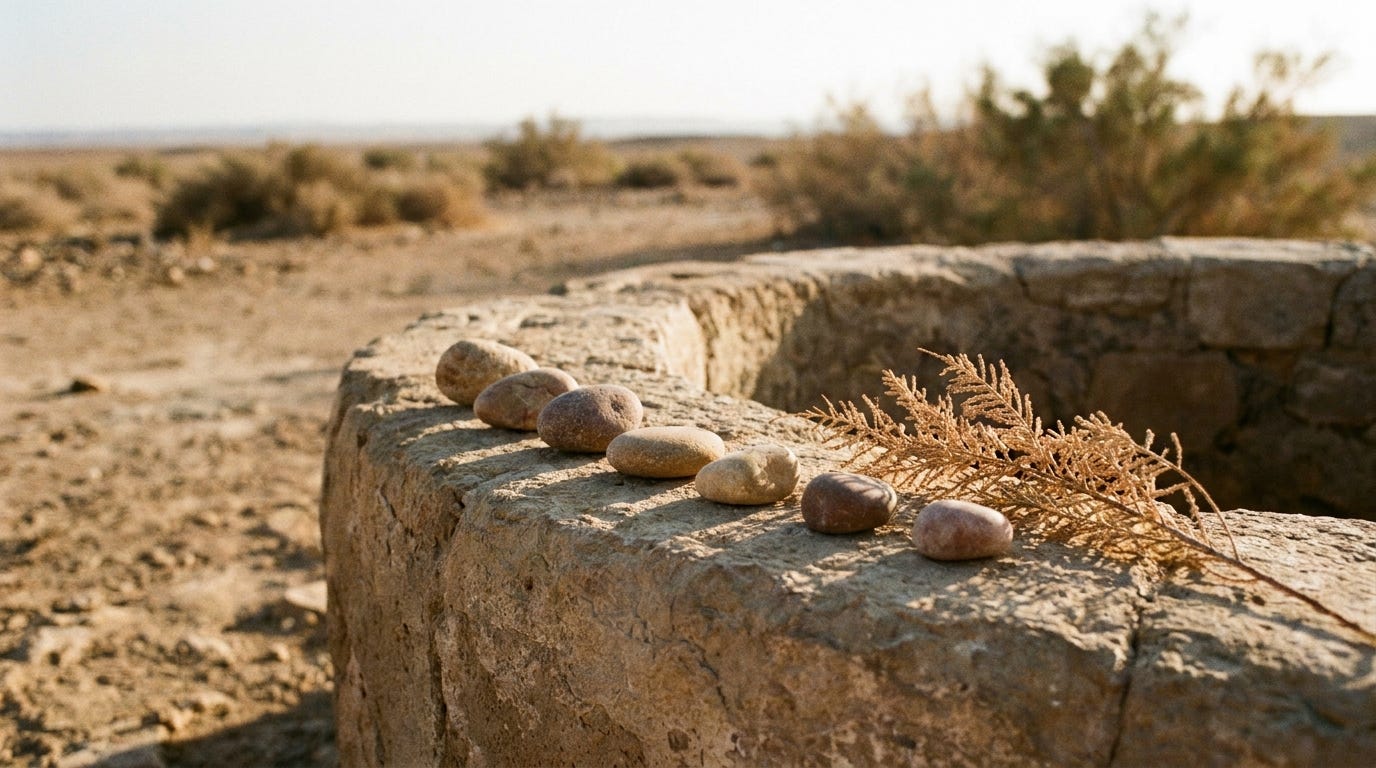
A gift accepted in public was the other half of the ancient legal toolkit. When Abraham later buys the field at Machpelah, it is deeded to him "in the presence of all the Hittites who had come to the gate of his city" (Genesis 23:18). Here the lambs do the work of the crowd at the gate. Abraham calls them edah (H5713), a witness or testimony, and the word belongs to the same family Jacob uses for the heap of stones he and Laban build: "this mound is a witness between you and me" (Genesis 31:48). Joshua sets up a stone under an oak and says, "It will be a witness against us, for it has heard all the words the LORD has spoken to us" (Joshua 24:27). In this world people made a promise last by tying it to something others could see, a heap of stones, a standing stone, seven lambs a king had to take home and feed.
What does El Olam mean?
Then Abraham plants an eshel (H815), a tamarisk, and calls on "the LORD, the Eternal God" (Genesis 21:33). The title is El (H410) with olam (H5769), and this is the only place in the Bible God is called by exactly that name. Olam is time stretched so far that its end is out of sight, in either direction. Isaiah reaches for the same word when he answers exiles who thought God had lost track of them: "The LORD is the everlasting God, the Creator of the ends of the earth. He will not grow tired or weary" (Isaiah 40:28).
Put the name beside Abimelech's request and the scene turns. The king asked a mortal man to swear for three generations. Abraham could swear and mean it, and he would be dead long before Abimelech's grandson grew old. He had been told so: "You, however, will go to your fathers in peace and be buried at a ripe old age," while his descendants waited four hundred years (Genesis 15:13–15). Every oath sworn at that well reached only as far as the men who swore it. So Abraham called on the one God whose oath reaches past every grave.
The tamarisk appears only twice more in Scripture, both times with Saul. He sits "under the tamarisk tree on the hill at Gibeah, with his spear in hand" (1 Samuel 22:6), hunting David, and later his bones are buried "under the tamarisk tree in Jabesh" (1 Samuel 31:13). Abraham planted his tree and called on the Eternal God. Saul sat under his holding a spear, trusting what he could grip, and his story ends under the same kind of tree.
The Greek translators of Genesis rendered El Olam with aionios (G166), the Greek word for eternal. Paul uses the same title at the end of Romans, where the gospel is "made known through the writings of the prophets by the command of the eternal God" (Romans 16:26). The name Abraham called on beside a well is the name under which the good news goes out to every nation.
How did Israel first hear Genesis 21:22–34?
Israel heard this chapter from inside the land. Their country ran "from Dan to Beersheba" (Judges 20:1), so every time they named their own borders they said the well of the oath at the southern end. They held that land because God had kept His word. Joshua's summary uses Beersheba's verb twice: "the LORD gave Israel all the land He had sworn to give their fathers," and "Not one of all the LORD's good promises to the house of Israel had failed" (Joshua 21:43–45). Abraham secured one well by oath and called on El Olam to keep the rest. Israel, hearing Genesis read, was standing in the rest.
They also heard a warning in it. By the prophet Amos's day, people at Israel's shrines were swearing by the place itself, "As surely as the way of Beersheba lives" (Amos 8:14), and Amos told them not to "journey to Beersheba" at all (Amos 5:5). They had kept the site and the habit of swearing, and lost the God Abraham called on there.
Abraham came to know God by holding a promise longer than his own life and naming God by what that promise needed. The same God has sworn to you, through the Son who is "a priest forever" by an oath that "will not change" (Hebrews 7:21). Keep what He has said where you can find it again, dated and named the way Abraham named a well; the Doxa app keeps it for you and for whoever comes to dig it out after you.
Keep exploring. If this raised a question, or brought back something God has said to you, take it further. Ask Doxa. It answers from Scripture, real stories, and your own journey, free in your browser. No signup to start.
Questions and comments are welcome below.
Download Doxa, the app for recording, weighing and remembering prophetic encouragement.